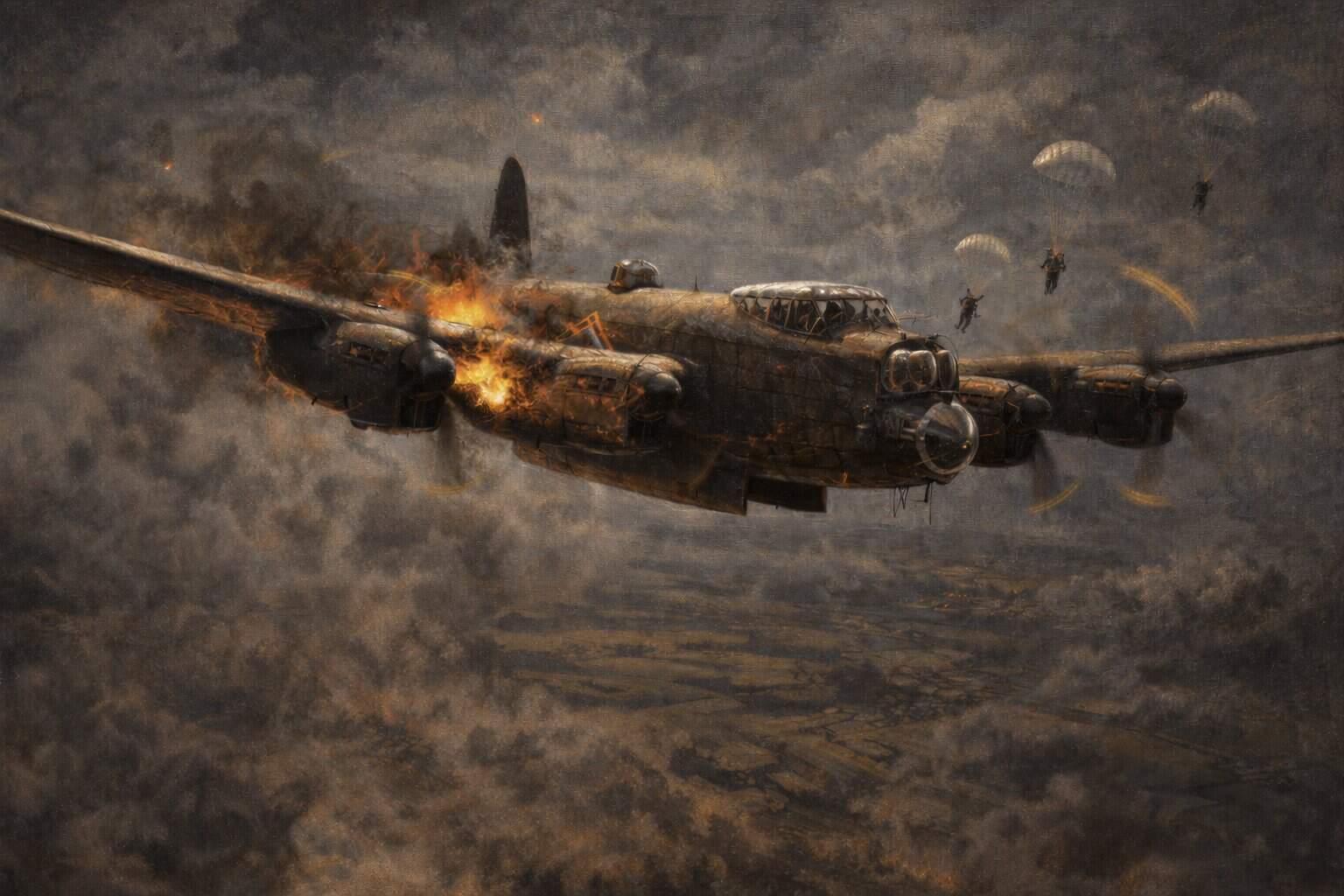
On 23 February 1945, Captain Edwin Swales, a South African serving with the RAF’s Pathfinder Force and known as ‘Ted’ to his comrades, led the attack on Pforzheim as Master Bomber. Before the night was over, he had directed one of Bomber Command’s most destructive late-war raids, brought his damaged Avro Lancaster back towards friendly territory, ordered his crew to escape, and died at the controls. His posthumous Victoria Cross recognised not only courage under attack, but duty carried through to the last moments of flight.
The attack on Pforzheim
By early 1945, the Allied air offensive against Germany had reached its final and most intense phase. Pforzheim, in south-west Germany, was selected for attack because it was linked to precision industries supporting the German war effort. The raid that night was devastating. Much of the town was destroyed and thousands of civilians were killed. It remains one of the most destructive Bomber Command operations of the closing months of the war.
That wider context matters. Swales’s actions occurred during a strategic bombing campaign aimed at weakening Germany’s remaining industrial and urban capacity as Allied armies advanced. The operational purpose was clear, but so too was the human cost. Any serious account of the raid must hold both realities together.
Swales as Master Bomber
Swales was flying with No. 582 Squadron, part of the Pathfinder Force, whose crews marked targets and guided the main bomber stream. As Master Bomber, he carried unusual responsibility. His task was not simply to reach the target and release bombs, but to remain over the aiming point, assess the marking, and issue instructions to the force behind him.
Over Pforzheim, his Lancaster came under fighter attack. One engine was put out of action, and further damage followed. Despite this, Swales continued to direct the raid. Remaining over the target in a crippled heavy bomber made him especially vulnerable, yet he stayed until he was satisfied that the attack had been properly delivered.
That decision lay at the heart of his Victoria Cross. He did not break away at the first chance of survival. He completed the task expected of the Master Bomber, even as the aircraft became harder to defend and control.
The final flight
After leaving the target, Swales attempted to reach friendly territory rather than abandon the aircraft over enemy-held ground. Damage to the Lancaster, worsening weather, and failing instruments made the return increasingly dangerous. Even so, he kept control long enough to cross into safer airspace.
Only when the aircraft could no longer be held with confidence did he order the crew to bail out. He maintained a steady enough course for them to escape in turn while he remained at the controls. Moments after the last crew member had jumped, the Lancaster crashed in northern France, killing him.
The sequence explains why his award carried such weight. Swales’s bravery was not confined to the bombing run. It extended through the effort to save his crew after the mission itself had been completed. The citation recognised both elements together: leadership in action over the target and self-sacrifice on the journey home.
Significance in RAF history
Swales’s death remains a powerful example of Commonwealth service within the RAF’s wartime air offensive. A South African officer serving in an elite RAF formation, he reflected the international character of the Allied air war. His award also underlined the burden carried by Pathfinder crews, whose work demanded accuracy, steadiness and prolonged exposure to danger.
At the same time, the raid on Pforzheim belongs to the harder moral history of Bomber Command. The courage of aircrew can be acknowledged without ignoring the destruction inflicted below. For the RAF, 23 February 1945 stands as more than a date of gallantry alone. It marks the meeting point of individual heroism, coalition service and the brutal logic of late-war strategic bombing.