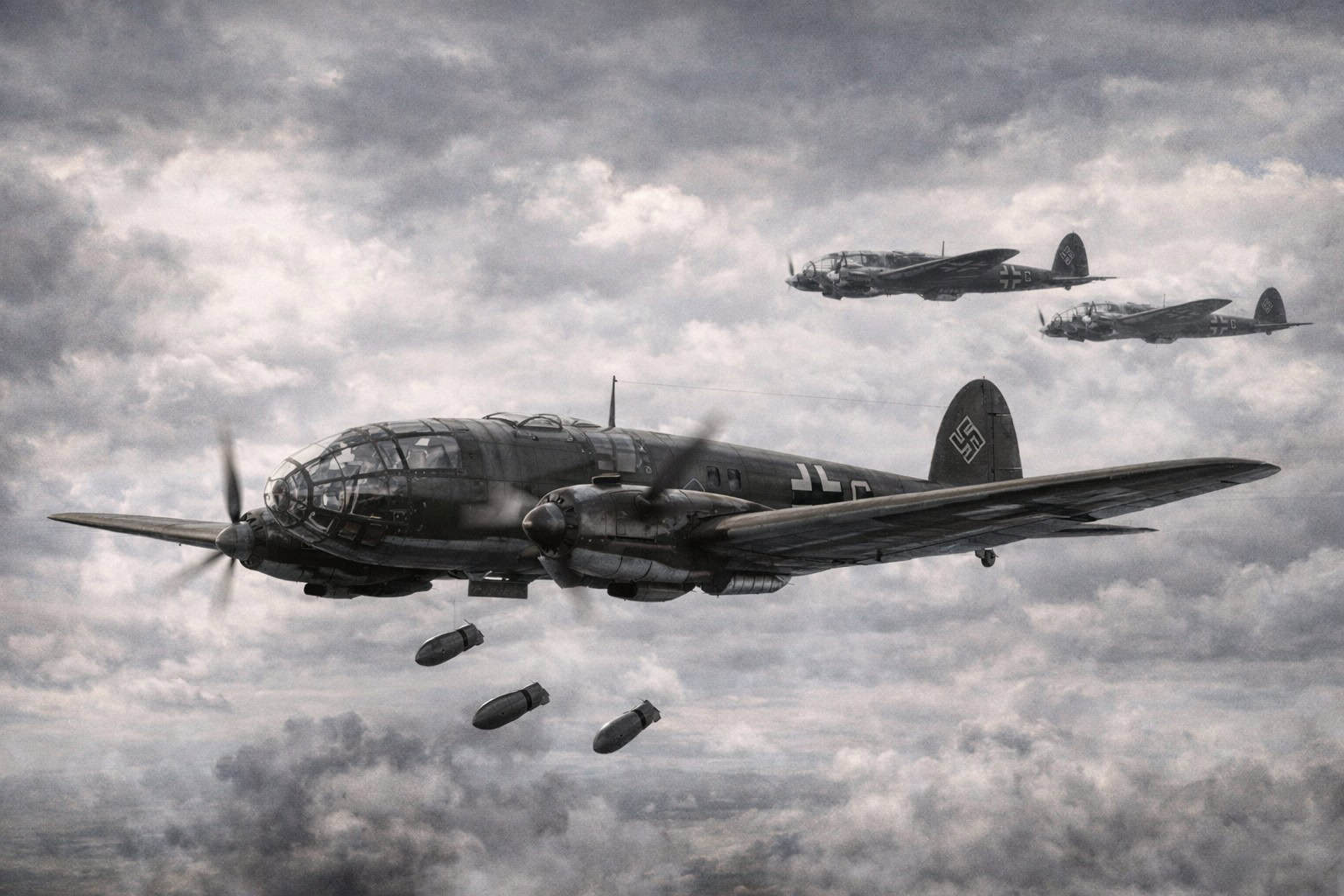
At dawn on 1 January 1945, around 850 German fighters and fighter-bombers crossed the front lines over Belgium, the Netherlands and northern France, flying low enough to skim rooftops and stay beneath Allied radar. Operation Bodenplatte was the Luftwaffe’s attempt to smash the tactical air power supporting the Allied armies fighting in the Ardennes, and for a violent half hour at several airfields it looked as though the gamble might succeed. By the time the last formations turned for home, the operation had cost Germany a toll it could not sustain, falling heaviest on the pilots it could least afford to lose.
Why Bodenplatte Was Launched
By New Year’s Eve 1944, the German offensive in the Ardennes had stalled against stiffening Allied resistance, and Allied fighter-bombers harried German supply columns whenever the weather let them fly. Hitler and the Luftwaffe high command judged that grounding the squadrons of the Second Tactical Air Force and the American Ninth Air Force, even for a few days, might buy the army on the ground the breathing space it needed. The plan had been ready since mid-December and was postponed several times as poor weather kept the Luftwaffe’s fighters on the ground, until conditions on New Year’s morning finally allowed it to go ahead. Every fighter unit still capable of operating in the west, many of them squadrons that had spent 1944 defending German cities against Allied bombers, was committed to a single coordinated strike against airfields across three sectors of the front.
The Secret Plan and Dawn Approach
Secrecy governed every stage of the planning, and it worked against the Luftwaffe almost as much as for it. Most pilots were not briefed until shortly before take-off, and some believed they were flying a reconnaissance sortie rather than a full-scale attack. To limit what a captured pilot could reveal, maps issued for the operation deliberately omitted the squadrons’ own bases and return routes. Flying at treetop height in close formation and near-total radio silence left almost no margin for navigation error, and several German formations paid for it before they reached a target at all. Around seventy-eight pilots of Jagdgeschwader 6, briefed to attack Volkel and its Tempest squadrons, never found the airfield: they crossed Heesch instead, where pilots of the Royal Canadian Air Force’s No. 401 Squadron scrambled to meet them, and close to a third of JG 6’s pilots were killed or captured in the resulting confusion.
The Attack on Allied Airfields
The worst damage fell on Eindhoven, where Focke-Wulf Fw 190s and Messerschmitt Bf 109s of Jagdgeschwader 3 spent almost half an hour strafing Typhoons of Nos. 124 and 143 Wings drawn up on the ground. Of roughly a hundred Typhoons parked on the airfield, twenty-six were destroyed outright or damaged beyond repair, and dozens more suffered lesser damage; among the casualties was Flight Lieutenant Pete Wilson, commanding officer of No. 438 Squadron RCAF, mortally wounded in the opening minutes of the attack. Further north, at Deurne near Antwerp, the Typhoon squadrons of No. 146 Wing, including No. 193 and No. 266 Squadron RAF, came under a separate assault. Gilze-Rijen escaped with barely a scratch, losing a single aircraft destroyed. Volkel, the intended target of one of the largest German formations sent out that morning, suffered almost no damage at all, saved by an attacking force that never found it.
The RAF and Second Tactical Air Force
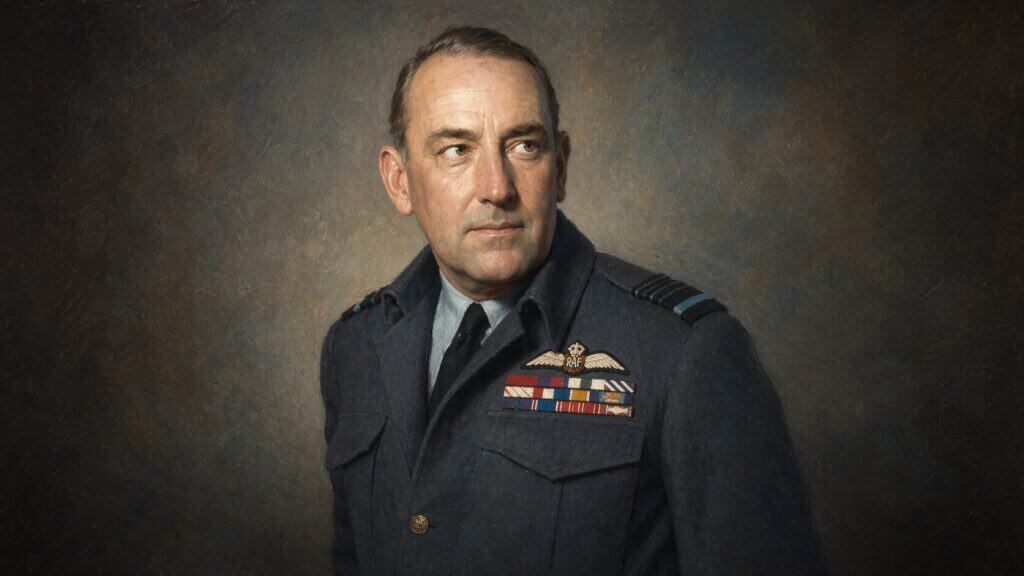
Accounts of the day sometimes describe the units defending Volkel as No. 121 and No. 122 Squadron RAF. The airfield’s fighters were in fact organised into two wings, No. 121 and No. 122, each grouping several squadrons under a single wing number. No. 121 Wing flew Hawker Typhoons, its squadrons numbered 174, 175 and 184, while No. 122 Wing flew Hawker Tempests, its squadrons numbered 3, 56, 80, 274 and 486, the last an RNZAF unit that had moved to Volkel only weeks before the attack. Both wings formed part of the Second Tactical Air Force under Air Marshal Sir Arthur Coningham, whose command had spent 1944 developing a doctrine of close air support and battlefield interdiction that made airfields like Volkel, Eindhoven and Deurne worth attacking in the first place. Tempests, Supermarine Spitfires and Typhoons flying from those bases existed to keep German armour and transport under constant pressure whenever the weather allowed them into the air.
Damage Done and Allied Recovery
Allied aircraft losses are difficult to state precisely, with wartime and post-war totals differing. The detailed post-war study by John Manrho and Ron Pütz calculated around 300 Allied aircraft destroyed on the ground and roughly 190 more damaged. Allied personnel losses were comparatively light: around ten pilots were killed across the whole operation, several of them caught while attempting to take off as the attack began. Wartime production and a supply chain built to absorb exactly this kind of setback meant replacement aircraft reached most squadrons within days, moved forward from depots and maintenance units that had spent the campaign preparing for losses of this scale. Formations that had lost half their strength on New Year’s morning were flying operations again within a week or two.
The Luftwaffe’s Irreplaceable Losses
Germany’s own losses told a different story. Around 143 pilots were killed or went missing and roughly 70 more were taken prisoner, a toll of more than 200 aircrew in a single morning. Among them were three Geschwaderkommodore, five Gruppenkommandeure and fourteen Staffelkapitane, the wing and squadron leaders whose combat judgement could not be replaced by shortened wartime training programmes however many airframes reached the front. Individual units were shattered: several Jagdgeschwader, including JG 1, 2, 6, 11, 26 and 53, suffered casualty rates above thirty per cent, and JG 4 lost closer to forty. Some of the toll was self-inflicted. German flak batteries around targets such as the V2 launch sites near The Hague had not been told the operation was taking place, and fired on their own aircraft as they crossed at low level, a hazard made worse by the poor coordination that secrecy had forced on the whole operation.
Why Bodenplatte Failed
Allied industrial output, supply chains and depth of trained manpower let the tactical air forces absorb and replace their material losses far more readily than Germany could replace experienced fighter pilots and leaders. The pilots who flew Luftwaffe fighters, particularly the flight and squadron leaders who passed on tactics and judgement to newer men, took years to train and could not be replaced at anything close to the same rate. General der Jagdflieger Adolf Galland later judged that Germany had sacrificed its “last substance” in Bodenplatte, a reference to the experienced fighter pilots and leaders lost for gains the Allies could rapidly replace. Within weeks, several of the Jagdgeschwader that had flown in Bodenplatte, including JG 1, 3, 4, 6, 11 and 77, were ordered east to meet the Soviet Vistula-Oder Offensive, a redeployment that both drained the Luftwaffe’s remaining strength in the west and underlined how little it now had to spare. No operation of comparable scale followed it in the west. The force that had staked its remaining depth of experienced pilots on a single morning spent the rest of the war fighting a steadily losing defensive campaign.
The raid had also failed on its own terms. When flying weather returned to north-west Europe in mid-January, the squadrons of Second Tactical Air Force were back over the Ardennes in strength, striking the German supply routes and troop concentrations that Bodenplatte was supposed to have kept safe from exactly this kind of attack. Whatever respite the ground offensive gained from a morning of burning airfields lasted only until the skies cleared.
1 January 1945 in Perspective
Seen from the ground that morning, the raid looked like exactly what it was meant to be: a sudden, violent demonstration that the Luftwaffe still had teeth, and the burned-out Typhoons and Spitfires at Eindhoven and Deurne offered evidence enough of that. The count that decided the operation’s outcome took weeks rather than minutes to complete, and it fell heavily against Germany. Within four months the war in Europe was over, and the force that had gambled its last reserve of experienced pilots on New Year’s Day had none left to stake a second time.