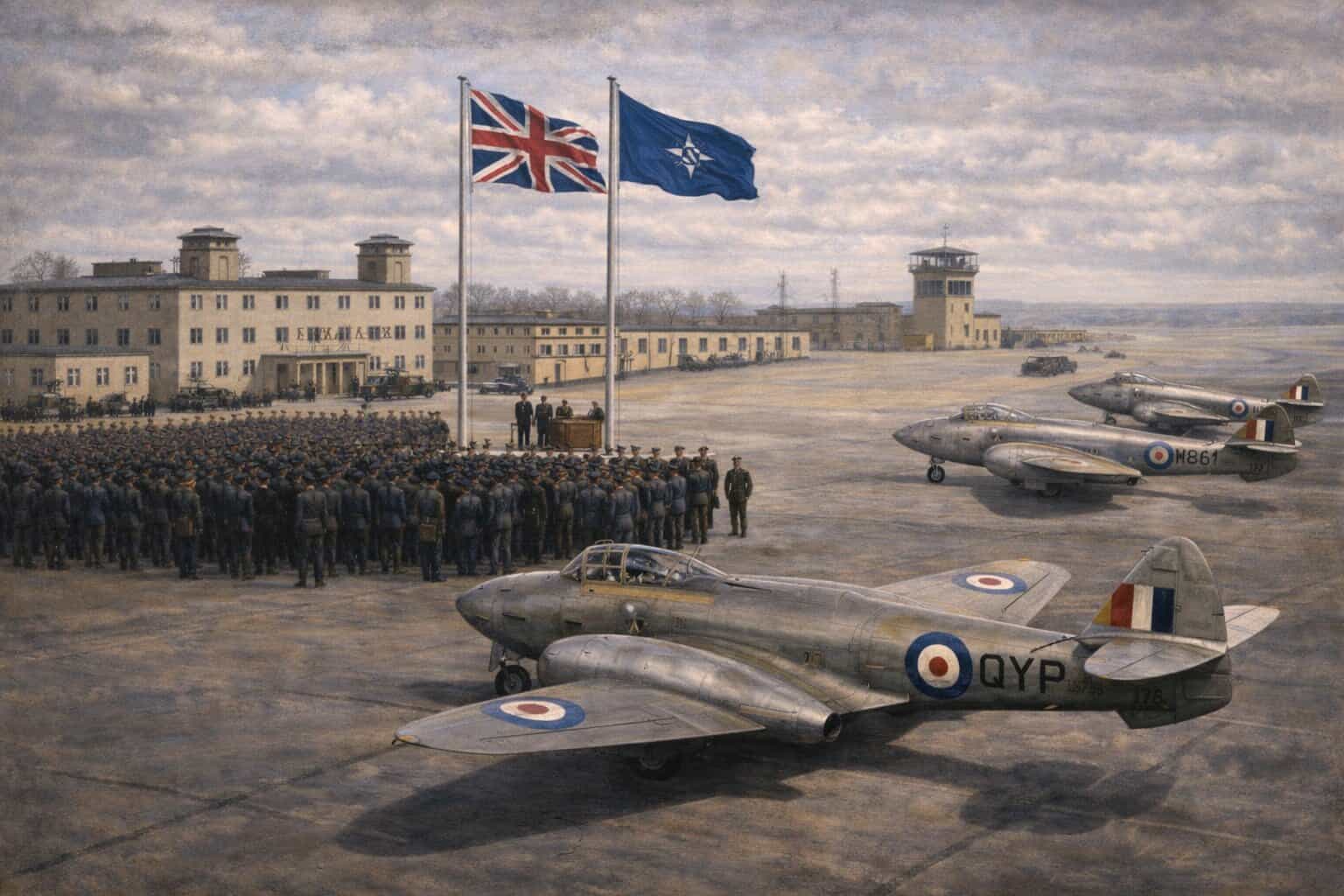
On 15 January 1952, RAF Wildenrath opened in the Federal Republic of Germany, the first of four new airfields built for the Royal Air Force in the early years of the Cold War. Alongside RAF Geilenkirchen, RAF Brüggen and RAF Laarbruch, Wildenrath formed part of a group of stations that became known as the “Clutch” stations, built to give the RAF a modern, forward base of operations in West Germany as the alliance confronting the Soviet Union took shape.
The station’s opening came at a moment of rapid change for Britain’s air forces in Germany. In the years immediately after the Second World War, RAF units in the country had occupied former Luftwaffe airfields as part of the occupying garrison. As West Germany moved towards integration into the Western alliance and the Korean War sharpened concern about Soviet military power, Britain’s air presence expanded rapidly. The Second Tactical Air Force was re-created on 1 September 1951, and Wildenrath became part of the modern network of West German airfields supporting its growing front-line force.
Why the Clutch Stations Were Built
Wildenrath was the first of the four Clutch stations to open, followed by RAF Geilenkirchen and RAF Brüggen in 1953 and RAF Laarbruch in 1954. All four were built west of the Rhine, at a deliberate distance from the inner German border separating NATO territory from the Soviet-controlled east, giving interceptor aircraft warning time to scramble in the event of an attack.
The four stations were equipped with runways and technical facilities suited to jet operations, replacing the wartime-era airfields the RAF had previously occupied in Germany. Wildenrath itself lay close to the Dutch border, within easy reach of the RAF’s other new stations and of the wider NATO air defence network taking shape across the region. The construction programme also brought supporting infrastructure to the area, including bulk fuel storage and rail links intended to keep the stations supplied if their normal routes were cut. Wildenrath, Brüggen and Laarbruch later formed part of the RAF contribution assigned to NATO’s Second Allied Tactical Air Force, which coordinated allied tactical air power in support of NATO forces in northern West Germany.
Wildenrath and 2TAF
Wildenrath’s early flying units included Nos. 67 and 71 Squadrons during the RAF’s rapid transition to modern jet fighters. Initially operating earlier jet types, they converted at Wildenrath to Canadair-built Sabre F.4s in 1953, while an ad hoc conversion unit helped prepare pilots for the new swept-wing fighter. The Sabre had been obtained as a stopgap while British swept-wing designs were delayed, and its arrival gave the Second Tactical Air Force a much-needed improvement in fighter performance at a time of acute concern over the Soviet MiG-15.
The RAF’s Second Tactical Air Force, reconstituted from the post-war British Air Forces of Occupation in September 1951, provided the command structure for Wildenrath and the other new stations built in West Germany during this period. The British command was renamed RAF Germany on 1 January 1959. By then, the RAF’s forces in West Germany were operating within an increasingly integrated NATO command structure, while retaining their own national chain of command.
From Conventional Jet Base to Cold War Readiness
In its first years, Wildenrath’s role centred on conventional fighter operations and the training that came with converting squadrons to jet aircraft, mirroring the wider re-equipment across the RAF’s Second Tactical Air Force as older piston-engined types gave way to jets along the front line in Germany. Its later importance rested on capabilities added well after the station opened. No. 88 Squadron reformed at Wildenrath on 15 January 1956 with English Electric Canberra B(I).8 aircraft, and was renumbered No. 14 Squadron in December 1962. Alongside No. 17 Squadron, also flying Canberras, No. 14 Squadron gave Wildenrath a place in NATO’s tactical nuclear strike posture in Western Europe, a role that took shape over the second half of the 1950s and continued into the following decade.
This nuclear capability, along with the hardened dispersal facilities later associated with Cold War airfields generally, developed at Wildenrath well after its 1952 opening. The station’s original construction provided runways and technical facilities suited to the fighter squadrons of the day; the readiness measures for which Cold War airfields in Germany later became known developed over the years that followed, as NATO’s own alert and strike arrangements matured.
Wildenrath’s Longer RAF Germany Legacy
Wildenrath remained part of RAF Germany’s order of battle for four decades after its opening. Phantom FGR.2 squadrons, Nos. 19 and 92, moved to the station from RAF Gütersloh in 1976 and 1977, and Harrier squadrons operated from Wildenrath during the 1970s. Ground-based air defence, including an RAF Regiment squadron equipped with Rapier missiles, and signals units were based there alongside the flying squadrons in Wildenrath’s later years, and No. 60 Squadron continued communications and transport flying from the station into its final years. RAF Wildenrath closed as a flying station on 1 April 1992, and its airfield was later converted for railway testing use.
The station’s significance lies in what it represented when it opened: a purpose-built, forward base for the RAF’s contribution to the defence of Western Europe, built at a time when the alliance confronting the Soviet Union was still taking its Cold War shape. The roles Wildenrath went on to hold, from nuclear-armed Canberras to Phantom fighters, were later additions to a station that began, in January 1952, as one of four new airfields answering the strategic concerns of the early 1950s.