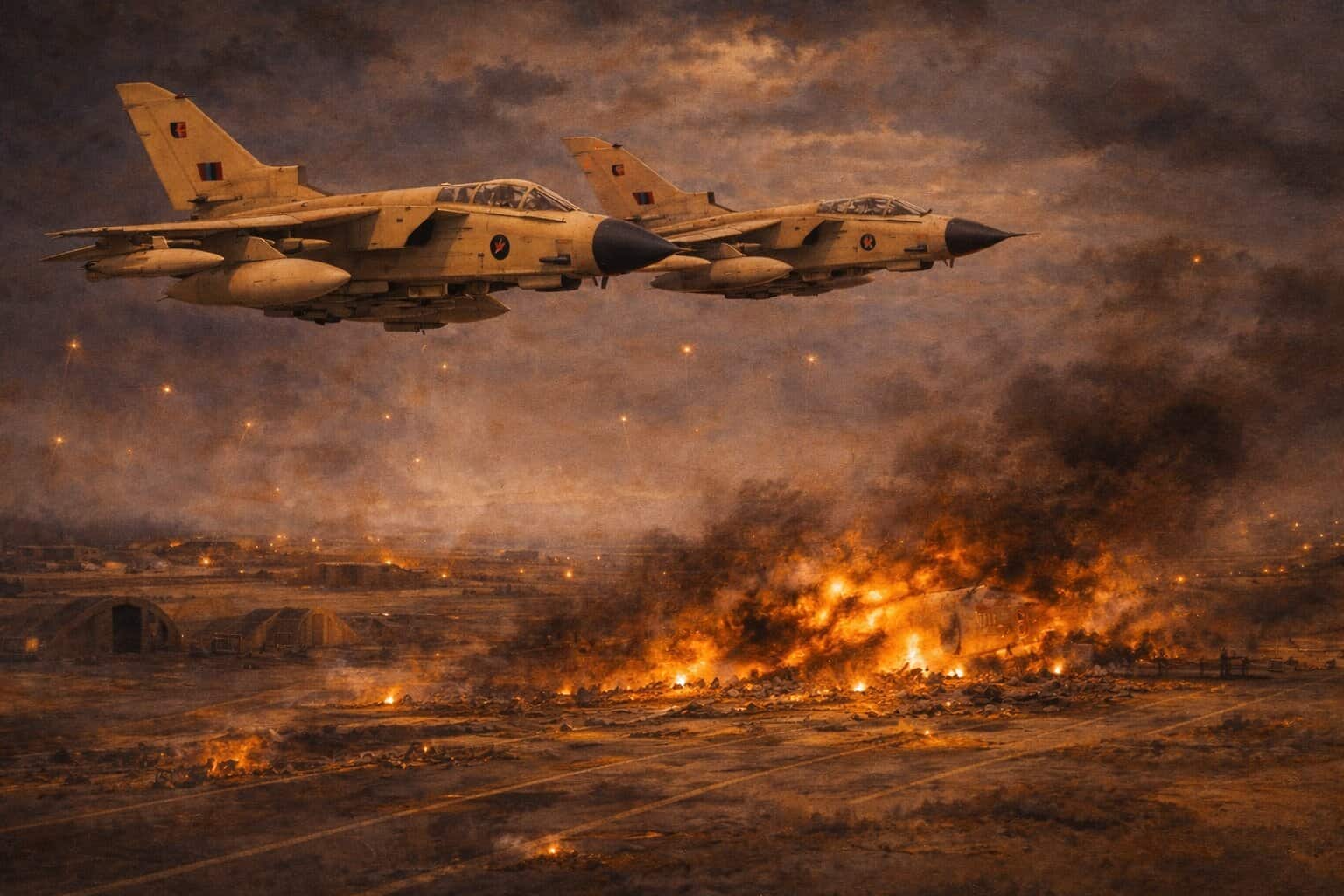
On 16 January 1991, coalition air forces commenced Operation Desert Storm, initiating a sustained air campaign against Iraqi military targets following Iraq’s invasion of Kuwait in August 1990. That night, Royal Air Force Panavia Tornado aircraft joined United States and allied aircraft in coordinated strikes against Iraqi airfields and associated infrastructure.
The coalition’s objective was to degrade Iraq’s air force, suppress its air defence network, and neutralise command and control facilities in preparation for potential ground operations. The opening phase focused heavily on airfields, hardened aircraft shelters, and runway denial in order to restrict Iraqi air operations at the outset of hostilities.
RAF Deployment and Preparation
In the months leading up to January 1991, the United Kingdom had deployed Tornado GR1 aircraft to the Gulf region as part of the build-up known as Operation Granby. Crews trained intensively for low-level strike missions against heavily defended targets. The Tornado GR1, designed during the Cold War for high-speed penetration at very low altitudes, was well suited to runway-denial operations using the JP233 weapon system.
JP233 was developed to disable airfields by dispersing submunitions across runways, creating craters and deploying area denial charges intended to hinder rapid repair. In addition to JP233, RAF aircraft were armed with 1,000 lb bombs for use against hardened structures and support facilities.
The Opening Night
In the early hours of 16 January, RAF Tornados launched from bases in the Gulf to attack selected Iraqi airfields. Missions were flown at low altitude to reduce exposure to radar detection, a tactic consistent with Tornado doctrine developed during the Cold War. Aircraft approached targets at high speed, released their munitions, and exited under threat from anti-aircraft artillery and surface-to-air missiles.
The opening night was characterised by intense air defence activity. Iraqi forces possessed a dense and integrated air defence network, including radar-guided missiles and anti-aircraft guns positioned around key installations. Despite these defences, coalition aircraft struck multiple targets across Iraq and occupied Kuwait.
During the initial attacks, one RAF Tornado was lost. The aircraft was shot down while conducting a low-level airfield strike. Iraqi forces captured both members of the crew. Their loss underscored the risks inherent in the early phase of the campaign, particularly for aircraft conducting low-altitude penetration missions against well-defended targets.
Immediate Results and Tactical Reassessment
The initial strikes inflicted damage on Iraqi airfield infrastructure and disrupted air operations. However, the intensity of ground-based air defences prompted reassessment of tactics. In subsequent days, RAF Tornado missions transitioned from very low-level attacks to medium-altitude operations, employing laser-guided bombs and benefiting from improved suppression of enemy air defences by coalition assets.
This adaptation reflected the dynamic nature of modern air campaigns. As Iraqi radar and missile systems were degraded, coalition aircraft gained greater freedom of manoeuvre. The shift reduced exposure to small-arms and anti-aircraft fire while maintaining strike effectiveness.
Significance in the Wider Air War
The participation of RAF Tornados on 16 January 1991 marked the beginning of Britain’s combat involvement in the Gulf War air campaign. Desert Storm became one of the most extensive and technologically advanced air operations since the Second World War. Precision-guided munitions, coordinated electronic warfare, and multinational command structures characterised the campaign.
For the RAF, the opening night demonstrated both the strengths and limitations of Cold War doctrine when applied in a regional conflict. The Tornado’s design for low-level penetration proved effective but costly under certain conditions. The rapid tactical adjustment that followed highlighted the flexibility of coalition air operations.
The events of 16 January 1991 illustrate the centrality of air power in modern warfare. The coalition’s strategy relied upon achieving air superiority and degrading enemy capability before ground forces were committed. RAF involvement in these opening strikes underscored Britain’s role within the coalition framework and its capacity to conduct high-intensity operations alongside allied forces.