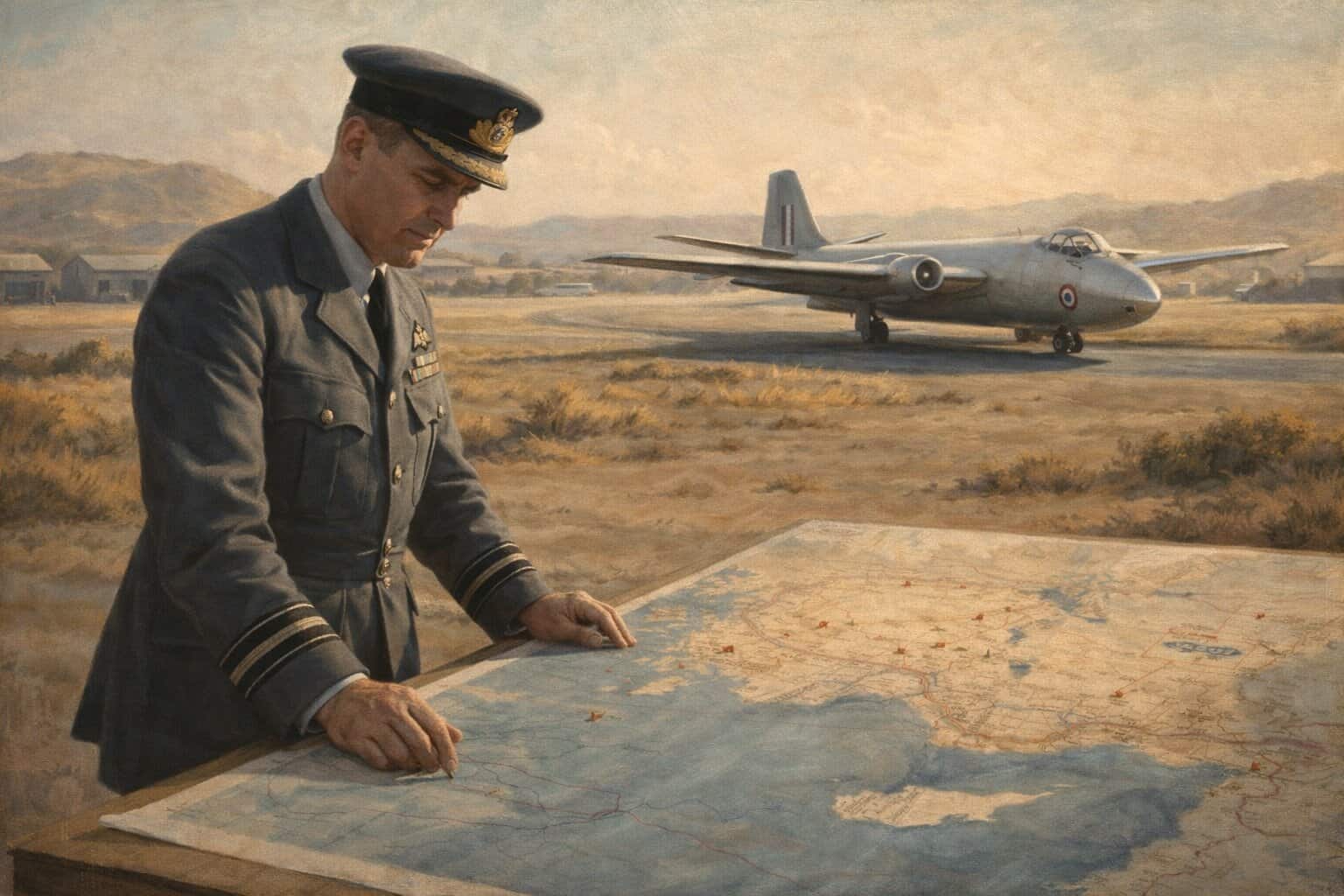
On 9 January 1954, the Royal Air Force established Air Headquarters Cyprus at RAF Nicosia, creating a new headquarters within the Middle East Air Force for RAF forces and units in Cyprus. The headquarters was formed as Britain reorganised its Middle East air command structure in response to the changing security of its position in the Suez Canal Zone, during the opening years of the Cold War.
Why Cyprus Was Becoming More Important
By the early 1950s, Britain’s hold on the Canal Zone in Egypt, long the centre of its Middle Eastern military presence, had grown increasingly contested. Nationalist pressure in Egypt, combined with the cost of maintaining a large garrison there, pushed British defence planners to look for alternative bases from which to sustain air power across the region. Cyprus, within reach of the Levant, Egypt and the wider Middle East, offered a base that remained under direct British sovereignty. RAF units had already been operating from airfields on the island for some years under existing arrangements. Forming a dedicated headquarters brought that activity under a single, purpose-built command as Cyprus’s importance to British strategy grew, and as Britain looked for secure alternatives to bases whose long-term future was becoming uncertain.
AHQ Cyprus Is Established at Nicosia
Air Headquarters Cyprus was formed within the Middle East Air Force on 9 January 1954, based at RAF Nicosia, the island’s principal RAF station. Command was given to Air Commodore Clayton D. C. Boyce, who served as Air Officer Commanding Cyprus, and later Cyprus and the Levant, until 1956. The new headquarters created a dedicated RAF command in Cyprus within the wider Middle East Air Force structure. Its formation reflected a broader pattern across the RAF’s Middle East structure in the mid-1950s, as regional headquarters were created, renamed and merged in response to shifting political and defence arrangements across Egypt, Iraq and the Levant.
What the New Headquarters Controlled
AHQ Cyprus provided the RAF headquarters for forces and units based on the island within the Middle East Air Force structure. Contemporary organisational listings place RAF Nicosia, together with Middle East Air Force training and target-towing flights and No. 14 Squadron of the Royal New Zealand Air Force, under its control in 1954. These units supported the routine training and readiness work expected of a Middle East Air Force station rather than any single, dramatic operation. AHQ Cyprus’s remit expanded and contracted with Middle East Air Force priorities over the following two years, as the wider command structure around it continued to change.
RAF Akrotiri, which would go on to become the RAF’s principal station on Cyprus, did not exist when AHQ Cyprus was formed. Akrotiri’s history began on 1 July 1955, when the first 30 personnel established themselves on the site. Its development belonged to the later phase of the RAF’s expansion in Cyprus, amid the pressures created by the island’s deteriorating security situation. Akrotiri’s prominence, including its role during the Suez Crisis of 1956, belongs to that later phase of Cyprus’s RAF history, after AHQ Cyprus had already been established.
A Short-Lived Headquarters in a Changing Middle East
AHQ Cyprus did not remain in its original form for long. On 15 January 1956, it was absorbed into AHQ Levant, which transferred to RAF Nicosia from RAF Habbaniya in Iraq as Britain’s Middle Eastern command structure was redrawn again. AHQ Levant had itself only recently taken that name, having been reformed on 1 May 1955 by renaming AHQ Iraq as Britain’s defence arrangements with Iraq changed. Boyce’s own title had already broadened to Air Officer Commanding Cyprus and the Levant ahead of the formal amalgamation. Cyprus continued to host RAF commands through further changes over the following decades, including the growth of RAF Akrotiri into the island’s main station and the formation of British Forces Cyprus in 1976. AHQ Cyprus was an early stage in that longer process of reorganisation, formed to meet the needs of the moment in January 1954 and superseded as circumstances moved on.
Why 9 January 1954 Is Significant
The formation of AHQ Cyprus created a dedicated RAF headquarters on the island at a moment when Britain’s position in the Canal Zone was weakening and Cyprus’s value to Middle East air strategy was rising. The headquarters lasted only two years before its absorption into AHQ Levant in January 1956, but its creation reflected a wider pattern: as the Cold War deepened and Britain’s regional footing shifted, Cyprus became one of the places where the RAF kept rebuilding its Middle East command structure to match changing circumstances. The reorganisation represented by AHQ Cyprus would continue as the island’s role in British air strategy evolved through Suez, the Cyprus Emergency and beyond.