On This Day, 1939: On 21 October 1939, 46 Squadron Hurricanes intercepted Heinkel He 115 floatplanes over the North Sea in the…
Read the entry →
Sergeant
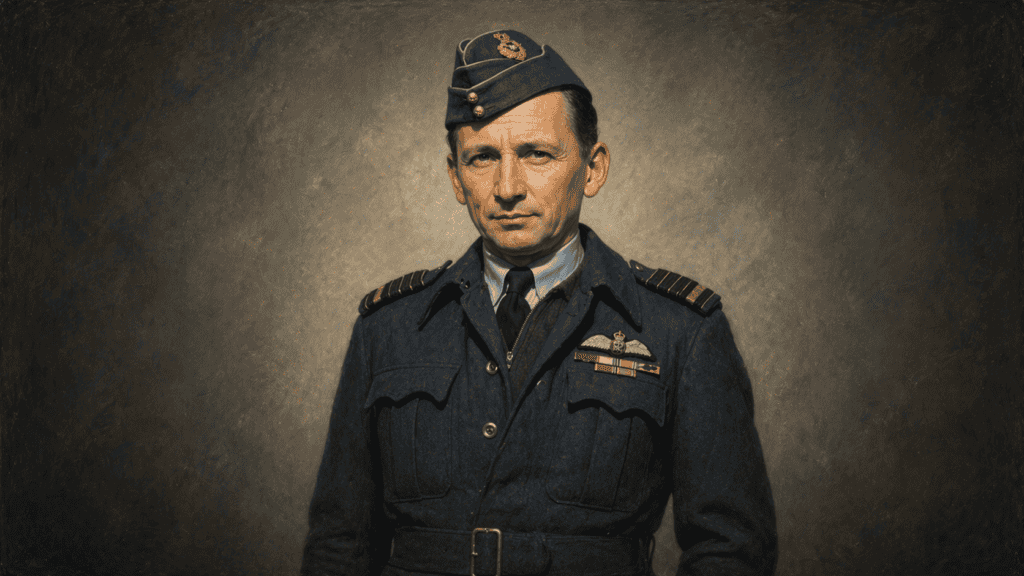
Thomas Mottershead
Thomas Mottershead VC became the only non-commissioned RFC airman awarded the Victoria Cross for aerial action in the First World War.
Early Life and Entry into the Royal Flying Corps
Thomas Mottershead was born on 17 January 1892 in Widnes, Lancashire, into a working-class family in an industrial town shaped by the chemical trade. Unlike many early military aviators, he did not come from a privileged background nor pass through the traditional officer class that dominated the fledgling air services. His path into military aviation was technical rather than social.
He enlisted in the Royal Flying Corps in August 1914, at the outbreak of the First World War, initially serving as a mechanic. Posted to the Central Flying School at Upavon, he worked among aircraft at a time when military aviation was still experimental and perilous. His aptitude and reliability led to promotion to sergeant in April 1916, and shortly afterwards he began pilot training which was an unusual progression for a non-commissioned man in a service where most pilots were commissioned officers.
By mid-1916 he had qualified as a pilot and was posted to operational service in France.
Operational Flying on the Western Front
Mottershead served first with No. 25 Squadron and later with No. 20 Squadron, flying the Royal Aircraft Factory F.E.2, a pusher biplane already becoming outclassed by newer German fighters. The aircraft’s rear-mounted engine and forward observer position made it stable for reconnaissance and fighting patrols but vulnerable in combat.
The Western Front air war of 1916–17 was increasingly lethal. Aircrew faced anti-aircraft fire, mechanical unreliability, and aggressive opposition from German scout units. Casualty rates were high, and survival often depended as much on judgement and endurance as on technical skill.
As a sergeant pilot, Mottershead occupied a rare position: a non-commissioned aviator flying operational sorties in a service dominated by officers. His conduct earned him the Distinguished Conduct Medal in 1916, marking him as an airman of proven courage before the action that would define his legacy.
The Action of 7 January 1917
On 7 January 1917, while flying an F.E.2d with No. 20 Squadron, Mottershead’s aircraft was attacked during a patrol over the Western Front. The machine was set alight. Flames spread rapidly through the fabric-covered structure, and he sustained severe burns.
Despite this, he did not abandon the aircraft. With his clothing on fire and in acute pain, he maintained control long enough to cross back over Allied lines. He then executed a controlled descent and landing, selecting ground that allowed his observer to escape.
The aircraft was destroyed by fire on landing. Mottershead was taken to a casualty clearing station, where he succumbed to his injuries five days later, on 12 January 1917. He was twenty-four years old.
His actions were recognised with the award of the Victoria Cross, announced posthumously in February 1917. He remains the only non-commissioned airman of the Royal Flying Corps, and by extension the Royal Air Force lineage, to have received the decoration for aerial action.
| Dates | Role | Unit | Aircraft |
|---|---|---|---|
| May-June 1916 | Pilot under training | Royal Flying Corps | Training types (various) |
| July 1916 - Late 1916 | Sergeant Pilot - Operational Flying | No. 25 Squadron (RFC) | Royal Aircraft Factory F.E.2 |
| Late 1916 - January 1917 | Sergeant Pilot - Operational Flying | No. 20 Squadron (RFC) | Royal Aircraft Factory F.E.2d |
| 7 January 1917 | Sergeant Pilot - Combat action (Victoria Cross) | No. 20 Squadron (RFC) | Royal Aircraft Factory F.E.2d |
Mottershead’s award was significant not only for the gallantry displayed, but for what it represented within the culture of early military aviation. The Royal Flying Corps was socially stratified; pilots were almost always commissioned officers. His Victoria Cross stood as recognition that courage and professional competence transcended rank and background.
He is buried in Bailleul Communal Cemetery Extension in France. Memorials in Widnes commemorate his life, and his story continues to be cited in discussions of early air combat and the evolution of the professional airman.
Though his operational career was short, his final flight became emblematic of the hazards faced by the pioneers of military aviation. In an era before parachutes were routinely issued to British aircrew, and when aircraft structures were highly flammable, the risks were stark and immediate.
Mottershead’s legacy rests not on long service or command responsibility, but on a single act of disciplined determination under catastrophic circumstances, an act that ensured another airman lived. Within the annals of First World War aviation, that distinction remains unique.
Thomas Mottershead VC: The Burning FE2d, 7 January 1917
On 7 January 1917, Sergeant Thomas Mottershead of No. 20 Squadron was awarded the Victoria Cross…
7 January 2026 · 4 minJames McCudden Awarded the Military Cross in March 1917
On 12 March 1917, James McCudden received the Military Cross, recognising a pilot whose skill and…
12 March 2026 · 3 minMilitary Aircraft in 1914: The RFC’s Reconnaissance Role
Military aircraft in 1914 gave the RFC vital reconnaissance, while photography, wireless and artillery observation began…
29 September 2026 · 2 min