On This Day, 1988: Sheila Scott died on 20 October 1988, leaving a legacy of solo world flights, polar exploration and record-breaking…
Read the entry →Vickers Wellington
Vickers-Armstrongs (Aircraft) Ltd
Explore the Vickers Wellington, the geodetic twin-engined bomber that became central to early RAF night bombing and maritime patrol work.
The Vickers Wellington stands near the centre of Royal Air Force bomber history during the 1930s and the early years of the Second World War. In September 1932, the Air Ministry issued Specification B.9/32, calling for a modern twin-engined day bomber capable of carrying a 1,000 lb bomb load over approximately 720 miles. Vickers answered this requirement with the Type 271 design, which competed against a Handley Page proposal and later evolved into the Wellington. From the outset, the aircraft reflected the interaction of strategic need, structural innovation and changing air power doctrine.
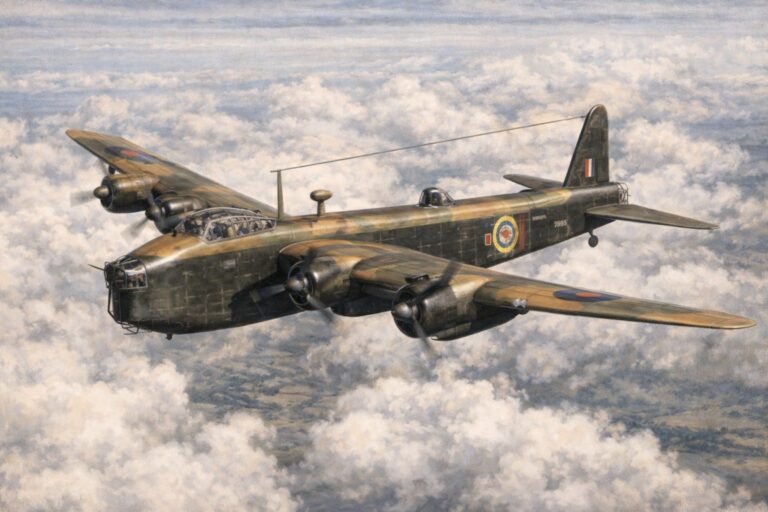
The decisive feature that set the Wellington apart was Barnes Wallis’s adoption of geodetic construction, first tested on the Vickers Wellesley. Instead of a conventional metal shell, Wallis designed a lattice of intersecting metal members covered with fabric, giving the airframe high strength at a moderate weight. The prototype flew on 15 June 1936, and the Air Ministry placed an order for 180 aircraft on 15 August 1936 under a revised specification. The type entered service on 10 October 1938 with No. 99 Squadron, shortly before the outbreak of war, and did so as one of the most modern aircraft in Bomber Command.
During the early war years, the Wellington formed the backbone of RAF night bombing operations over Europe. In total, 11,461 aircraft were produced, reflecting both the scale of the programme and the confidence placed in the design. Central to that record was the geodetic structure, which distributed loads throughout the airframe and frequently allowed damaged aircraft to return safely.
The Geodetic Construction Method: Engineering Innovation
The Wellington emerged from Barnes Wallis’s interest in geodetic structures, which had previously been applied to the long-range Vickers Wellesley. Wallis sought a frame that combined low weight with high strength and even stress distribution. The Wellington applied this concept to a twin-engined bomber at a time when many aircraft designers favoured more conventional semi-monocoque metal structures.
In a geodetic airframe, narrow metal members run in intersecting spirals along the fuselage and wings. On the Wellington, these members were made of duralumin, formed into a lattice tube, and then covered with fabric to provide the aerodynamic outer surface. Rather than concentrating loads on a few heavy spars and frames, the structure distributed tension and compression across numerous members, producing a high strength-to-weight ratio.
Operational experience demonstrated the value of this approach. When enemy fire tore holes in the fabric covering, the lattice frame often retained sufficient integrity for controlled flight. Numerous aircraft returned with extensive skin damage but intact structural frameworks. The lattice allowed loads to be redistributed rather than concentrated at a single weakened point.
This construction approach delivered several notable advantages. The multiple load paths gave the airframe high damage tolerance, keeping it structurally sound even when sections were compromised. Material was used efficiently, enabling a useful bomb load on just two engines. Fabric repairs also proved simpler than working with stressed metal skins.
The main drawback was manufacturing complexity. Once production techniques were standardised, however, output rose significantly.
Operational Service and Strategic Evolution
The Wellington entered squadron service in October 1938 and became central to Bomber Command at the outbreak of war. On 4 September 1939, aircraft from Nos. 9 and 149 Squadrons took part in one of the first RAF bombing raids of the conflict, attacking German shipping near Brunsbüttel.
Early doctrine expected daylight bomber formations to defend themselves through mutual defensive fire. In practice, Wellington formations encountered fast, heavily armed German fighters and suffered significant losses. The aircraft’s defensive armament proved insufficient against coordinated interception. Bomber Command therefore shifted the Wellington force to night operations, where reduced visibility lowered interception rates, though navigation and bombing accuracy remained challenging.
The losses in daylight operations became particularly clear in December 1939, when formations attacking German naval targets suffered heavily against fighter opposition, reinforcing Bomber Command’s move towards night operations.
The type’s prominence was evident during Operation Millennium on 30 May 1942, the first thousand-bomber raid against Cologne. Of 1,047 aircraft dispatched, 601 were Wellingtons, illustrating their dominance within Bomber Command at that stage.
From late 1942, the introduction of four-engined bombers such as the Lancaster and Halifax reduced the Wellington’s role in the main strategic offensive. Its final major bombing operations as part of the primary force occurred in October 1943. Nevertheless, Wellingtons continued in mine-laying, special duties and overseas theatres into 1944–45. In North Africa and the Mediterranean, Wellington squadrons operated from bases including Malta and Egypt, attacking ports, shipping, communications and other targets while supporting the wider Allied campaign.
Coastal Command and Maritime Patrol Variants
As the Battle of the Atlantic intensified, the RAF required aircraft capable of extended maritime patrol. The Wellington provided a suitable platform, leading to the development of the GR Mk VIII, adapted for anti-submarine warfare.
Modifications included ASV Mk II radar for detecting surfaced submarines, depth charges in place of standard bomb loads, and a retractable Leigh Light to illuminate radar contacts at night.
On 6 July 1942, a Wellington of No. 172 Squadron used radar and Leigh Light to locate and attack U-502 in the Bay of Biscay, resulting in its destruction. The attack demonstrated the effectiveness of combining airborne radar with the Leigh Light against surfaced submarines at night.
Later maritime variants, including the GR Mk XI to XIV, incorporated Bristol Hercules engines and improved ASV Mk III radar. In this role, Wellingtons patrolled the Bay of Biscay and other maritime approaches, attacking submarines and supporting convoy protection. The closure of the mid-Atlantic air gap depended chiefly on longer-range aircraft and additional escort resources.
Post-War Service and Legacy
Wellingtons also served extensively in aircrew training, including specialist navigation and radar instruction. Training variants and conversions remained in RAF service after the war, with normal RAF Wellington service ending in March 1953. The surviving MF628 continued flying for special purposes, including film and display work, until January 1955, extending the aircraft’s flying history beyond its regular service career.
A commonly cited production total is 11,461 Wellingtons. Two substantially complete examples survive: N2980 at Brooklands Museum and MF628 at the RAF Museum Cosford. The aircraft’s reputation rests on its structural resilience and versatility across bombing, maritime patrol and training roles.
| Dimensions | |
| Wingspan | 86 ft 2 in (26.26 m) |
| Length | 64 ft 7 in (19.69 m) |
| Height | 17 ft 5 in (5.31 m) |
| Wing area | 840 sq ft (78.0 m²) |
| Weights | |
| Empty weight | 19,700 lb (8,936 kg) |
| Max takeoff weight | 37,000 lb (16,783 kg) |
| Max bomb load | 4,500 lb (2,041 kg) |
| Performance | |
| Maximum speed | 235 mph (378 km/h) |
| Cruise speed | 180 mph (290 km/h) |
| Service ceiling | 18,000 ft (5,486 m) |
| Range | 2,550 mi (4,104 km) |
| Powerplant | |
| Engines | 2 × Bristol Pegasus XVIII radial |
| Power | 1,050 hp (783 kW) each |
| Armament | |
| Guns | 6 × .303 in Browning machine guns in nose and tail turrets (early variants) |
| Bombs / weapons | 4,500 lb (2,041 kg) |
RAF Bombing Strategy: From Daylight Raids to the Night War
How RAF bombing strategy evolved from costly daylight raids to a sustained night offensive shaped by…
27 April 2026 · 14 minNo. 115 Squadron Losses over the North Sea and Denmark
On 7 April 1940, two No. 115 Squadron Wellingtons were lost over the North Sea and…
7 April 2026 · 3 minSergeant James Allen Ward Awarded the Victoria Cross
On 8 July 1941 Sergeant James Allen Ward received the Victoria Cross after climbing onto a…
8 July 2026 · 3 min