On This Day, 1939: On 21 October 1939, 46 Squadron Hurricanes intercepted Heinkel He 115 floatplanes over the North Sea in the…
Read the entry →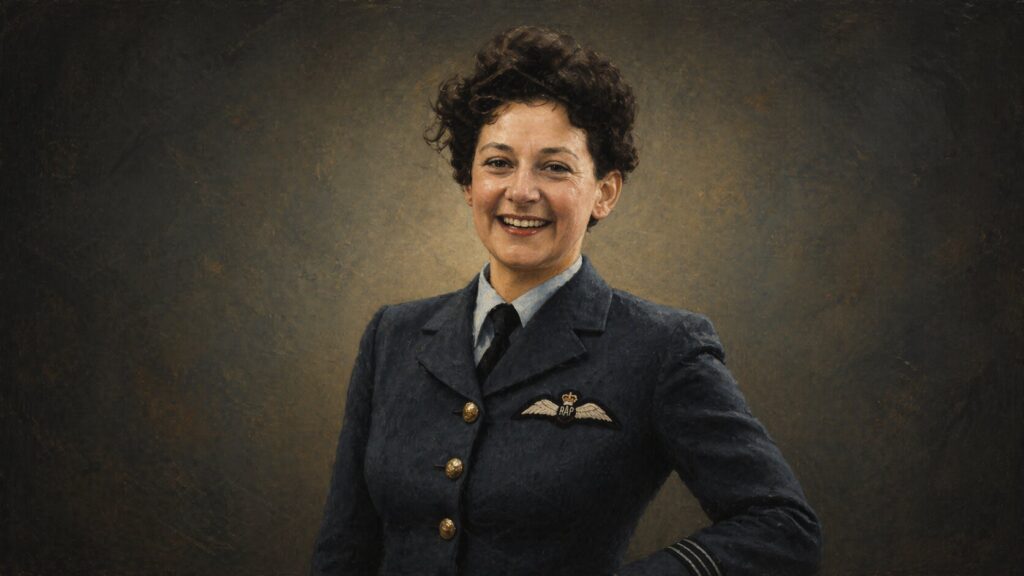
Flight Lieutenant
Julie Ann Gibson
Discover how Julie Ann Gibson became the first female regular RAF pilot in 1991, from engineering officer to Andover and Hercules aircraft captain.
Early Life
Julie Ann Gibson became the first female regular RAF officer to graduate as a pilot in 1991, a milestone in the opening of operational flying careers to women. Her achievement followed a substantial RAF career in engineering and came as the service began recruiting women for pilot training in 1989.
Gibson grew up in a military family; her father was a Royal Navy lieutenant commander. She studied aeronautical engineering at City, University of London, graduating in 1983, and learnt to fly during her university years. This combination of technical education and early flying experience would shape her subsequent RAF career.
Engineering Officer
Gibson joined the RAF in 1984, training at the Royal Air Force College Cranwell. At the time women could not enter the regular RAF pilot career path. She instead served as an engineering officer, including a posting with No. 74 Squadron at RAF Wattisham, where the squadron operated the Phantom F-4J(UK). She subsequently held a leadership appointment at the Tactical Weapons Unit at RAF Brawdy.
These appointments gave her practical experience of the organisation and technical support required to keep military aircraft operating. Her eventual move into flying was therefore a change of specialisation within an established service career.
Opening the Pilot Training Path
In 1989 the RAF began accepting applications from women for pilot training. Gibson applied on the first day the opportunity became available. On 10 May 1990 she and Flight Lieutenant Sally Cox became the first women to fly solo in RAF jet aircraft, each flying a Jet Provost during training at No. 1 Flying Training School, RAF Linton-on-Ouse.
Gibson completed her pilot training in 1991. On 14 June 1991, she was awarded her wings at No. 6 Flying Training School, RAF Finningley, becoming the first female regular officer to graduate as an RAF pilot. Some RAF Museum retrospective material places her operational milestone in 1990, but the Museum's dated aviation chronology and the RAF's own historical account confirm the formal qualification milestone in June 1991. Her solo jet flight in May 1990 was a distinct earlier achievement.
Women had flown military aircraft in earlier decades, notably with the Air Transport Auxiliary, and Jean Lennox Bird had received an RAF pilot's badge in 1952 as a WRAF Volunteer Reserve pilot. Gibson's particular achievement was becoming the first female regular RAF officer to graduate through the newly opened pilot career route. Women were also entering the navigator branch: Anne-Marie Dawe graduated as the RAF's first female multi-engine navigator on 1 March 1991.
Operational Flying
After qualifying, Gibson flew the Hawker Siddeley Andover with No. 32 Squadron at RAF Northolt. She later flew the Lockheed C-130 Hercules from RAF Lyneham, progressing to become an aircraft captain. The RAF Museum records that her Hercules duties involved transporting personnel and equipment to destinations around the world.
These were substantive operational transport responsibilities. A Hercules captain had to coordinate a crew and make decisions affecting an aircraft, its passengers and its mission. In an oral-history interview Gibson reflected on the responsibility of command, including the realisation that the final decision rested with her while drawing on the experience of her crew.
Experience and Legacy
Gibson's service also exposed the assumptions women pilots encountered. In RAF Stories interviews she recalled people outside the service failing to recognise that she was the captain of the Hercules, and a passenger who initially declared that he would not fly with a woman. Her accounts provide a first-hand perspective on the difference between formally opening a profession and changing public expectations.
Her achievement belonged to a wider period of change. The Women's Royal Air Force was formally integrated into the RAF in 1994, and women went on to enter fast-jet operational flying. Gibson's earlier training and subsequent transport service demonstrated that women could progress from RAF officer careers into the same professional flying responsibilities as their male colleagues.
Her historical significance rests not simply on being first, but on what followed: flying the Andover and Hercules as an operational RAF pilot and ultimately commanding a transport aircraft. Her story links the reform of service entry rules to the everyday responsibilities of RAF aircrew.
| Dates | Role | Unit | Aircraft |
|---|---|---|---|
| 1984 | Officer cadet | Royal Air Force College Cranwell | |
| Mid-1980s | Engineering officer | 74 Squadron, RAF Wattisham | |
| Late 1980s | Command appointment | Tactical Weapons Unit, RAF Brawdy | |
| 1990–1991 | Pilot trainee | Advanced Flying Training Wing and No. 6 Flying Training School | |
| 1991 | Pilot | 32 Squadron, RAF Northolt | Hawker Siddeley Andover |
| Later service | Pilot | RAF Lyneham | Lockheed C-130 Hercules |
Julie Ann Gibson is remembered chiefly for crossing an institutional threshold rather than for a single combat episode or command appointment. Her importance rests on becoming the RAF’s first full-time female pilot in 1991, at the point when the service was beginning to dismantle a long-standing restriction on women entering flying roles.
That makes her place in RAF history structural as well as personal. Later milestones, including the arrival of women in fast-jet and combat flying, have often drawn greater public attention, but Gibson’s achievement came earlier and helped establish the service reality from which those later developments followed. She is therefore best understood as a figure in the modernisation of RAF opportunity, training and professional culture.
Julie Ann Gibson Becomes RAF’s First Female Pilot Graduate
On 14 June 1991, Julie Ann Gibson became the RAF’s first female regular pilot graduate, a…
14 June 2026 · 3 minRAF Puma Farewell Flight Marks the End of 54 Years
On 26 March 2025, the RAF began the Puma HC Mk2 farewell tour from RAF Benson,…
26 March 2026 · 3 minPanavia Tornado GR1 in RAF Gulf War Operations, 1991
How the Panavia Tornado GR1 flew RAF strike missions in Operation Granby, from risky low-level attacks…
24 April 2026 · 6 min