On This Day, 1988: Sheila Scott died on 20 October 1988, leaving a legacy of solo world flights, polar exploration and record-breaking…
Read the entry →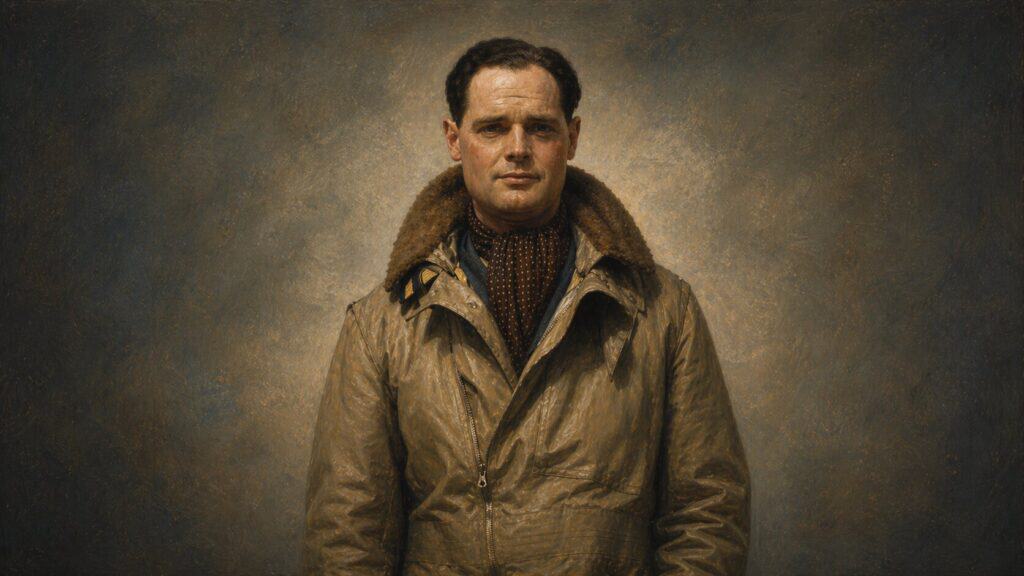
Group Captain
Douglas Bader
Douglas Bader led 242 Squadron in 1940, became one of the RAF’s best-known fighter leaders, and later championed disabled people.
Early Life
Douglas Robert Steuart Bader was born in St John’s Wood, London on 21 February 1910 and spent part of his early childhood in India before returning to the United Kingdom. The RAF Museum’s account of his early years places emphasis on his determination from a young age: with an uncle connected to RAF College Cranwell, he decided while still a boy that he would join the Service.
His years at school and at Cranwell were marked by strong competitiveness and a preference for action over caution. At Cranwell, he distinguished himself in sport as much as in flying, graduating in 1930 with a scholarship background and a reputation for confidence. That mixture of ability and impatience would become a recurring theme throughout his life: it helped drive him to high achievement, but it also contributed to the episode that nearly ended his flying career before it had properly begun.
Entry into Service
On leaving Cranwell, Bader was posted to No. 23 Squadron at RAF Kenley. There he flew the Gloster Gamecock, and he rapidly developed a talent for aerobatics, including participation in the RAF display culture of the early 1930s. Shortly after the squadron’s Gamecocks were replaced by Bristol Bulldogs, he crashed at Woodley aerodrome near Reading on 14 December 1931 and suffered injuries that required the amputation of both legs.
The RAF Museum records the speed and force of his recovery: within months he was walking unaided on artificial limbs and pressing to return to flying. He demonstrated that he could meet demanding requirements in the air, but a medical board ultimately ruled that he could not continue as an RAF pilot. In 1933 he left the Service and joined the aviation department of Asiatic Petroleum, soon to become part of Shell.
Operational Career
In the summer of 1939, with war approaching, Bader sought to rejoin the RAF. He passed the necessary tests at the Central Flying School, completed a refresher course, and in February 1940 joined No. 19 Squadron at Duxford, where he first flew the Supermarine Spitfire operationally. A posting to No. 222 Squadron, also at Duxford, brought him into action over Dunkirk in June 1940.
On 24 June 1940 he was promoted to squadron leader and given command of No. 242 Squadron at Coltishall. The RAF Museum describes the squadron as having suffered heavy casualties in the Battle of France and struggling with morale when he arrived. Bader focused on training, teamwork and confidence, and the unit’s first major success came on 30 August 1940, when it claimed twelve enemy aircraft, two of which were credited to him.
As the Battle of Britain progressed, Bader became associated with larger-scale fighter formations, including the Duxford Wing concept. Whatever later arguments would arise about the timing and effectiveness of such formations, his role in 1940 was undeniably that of a front-line leader who both flew and organised. His decorations were awarded in that context: the published citation for his Distinguished Flying Cross spoke directly to his continuing gallantry and leadership, crediting him at that stage with ten hostile aircraft destroyed and several more damaged.
In March 1941 he left No. 242 Squadron and was promoted to lead the fighter wing based at Tangmere, by then committed to offensive operations over occupied Europe. The RAF Museum notes that his score rose further, and it also records that he was forced to bail out of his Spitfire in early August 1941, after which he became a prisoner of war.
Major Actions or Commands
Bader’s wartime command is most clearly anchored in two linked periods: the rebuilding and combat employment of No. 242 Squadron in 1940, and his subsequent wing leadership in 1941. His DFC citation, formally published in January 1941, captures the official view of him at that time: a squadron and wing leader who combined personal aggression with the ability to inspire those around him.
After being shot down and captured, the RAF Museum’s prisoner-of-war account emphasises his repeated escape attempts and the determination with which he tried to remain a problem for his captors. It also records the episode of his prosthetic leg being replaced after his capture, a detail that has become one of the better-documented anecdotes of his captivity.
Later Life and Death
Following the war, Bader returned to civilian life and continued his career in the oil industry, while also becoming closely associated with support for disabled people. The RAF Museum states that he was appointed CBE in 1956 and knighted in 1976 for service to the disabled, placing his post-war public role alongside his wartime fame.
He died suddenly in 1982, aged seventy-two. The RAF Museum notes the long-term physical strain of life on prosthetic limbs and records that he died unexpectedly, a reminder that the physical cost of his 1931 accident never truly left him, even as his public identity became inseparable from triumph over adversity.
Historical Significance
Bader’s historical importance rests on three overlapping elements. First, he was a combat leader during the crucial period of 1940, commanding a front-line fighter squadron and later a wing at a time when the RAF’s margin for error was narrow. Secondly, his wartime recognition was not confined to publicity: the formal citations and decorations underline that the RAF assessed him as an effective and courageous operational leader.
Thirdly, his post-war life gave his story a second and lasting public dimension. The RAF Museum’s account of his CBE and knighthood frames him as an influential figure in disability advocacy, ensuring his name remained prominent long after 1945. For RAF Chronicle readers, that matters because it shows how RAF service could translate into broader public service, and how an individual’s reputation could be shaped as much by what followed the war as by what happened during it.
Awarded for gallantry and leadership in operations with No. 242 Squadron; the published citation credited him with destroying ten hostile aircraft and damaging several more.
How the Dowding System Worked in Britain’s Air Defence
How the Dowding system linked radar, observers, plotting rooms and fighter control to direct RAF interceptions…
6 October 2026 · 2 minThe RAF in the Desert Air War and North African Campaign
How the RAF fought and adapted in the desert air war, where North African conditions helped…
30 April 2026 · 3 minChurchill Delivers the ‘Few’ Speech in the Battle of Britain
Churchill’s 20 August 1940 Commons speech immortalised Fighter Command as ‘the Few’, fixing the Battle of…
20 August 2026 · 3 min