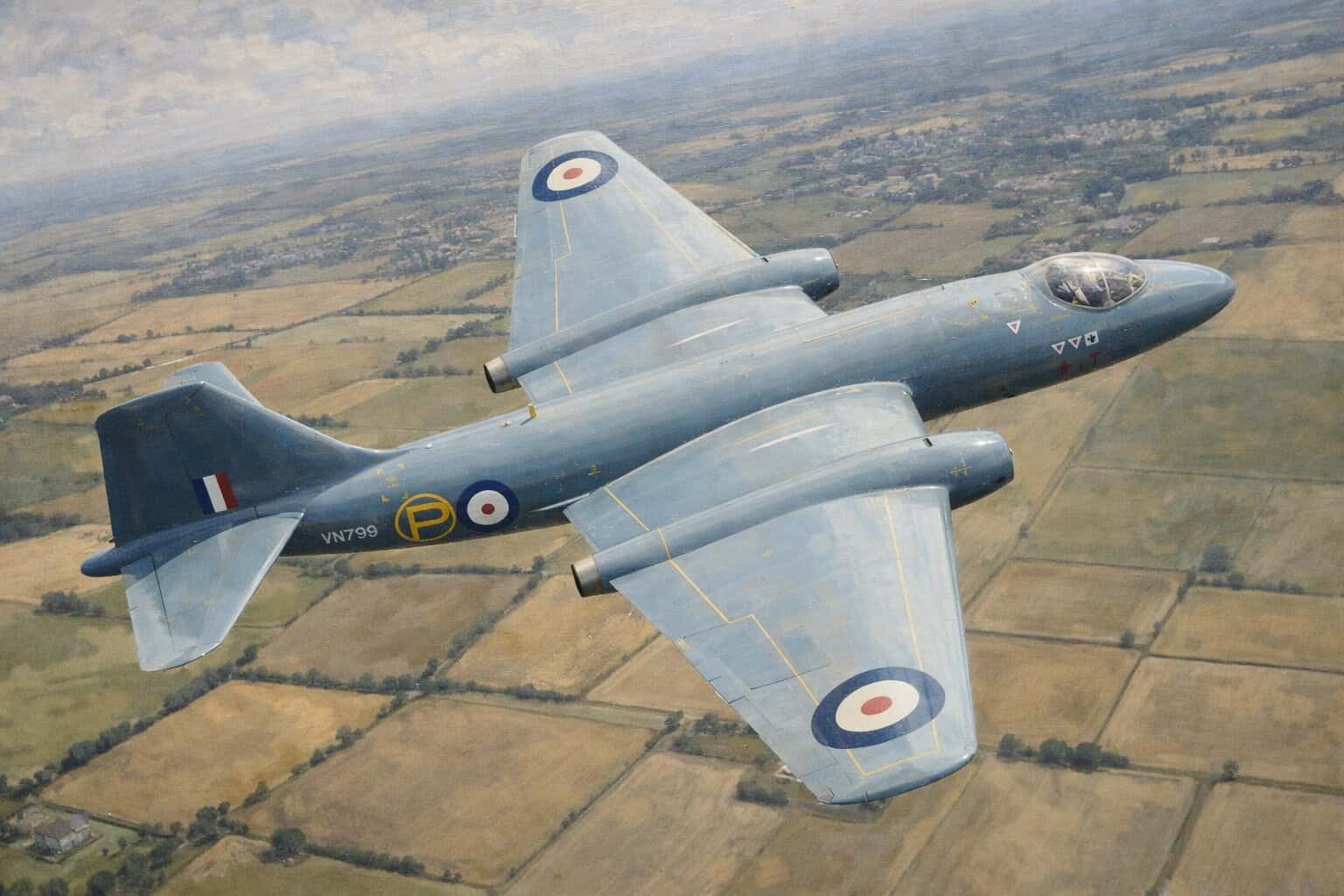
On 5 May 1958, Canberra units of the Second Tactical Air Force in Germany gained an atomic strike capability. The decision marked an important shift in the RAF's Cold War role on the continent. For much of the post-war decade, the service in Germany had been associated with conventional tactical air power, close support and the defence of NATO's central front. By the late 1950s, however, strategy was changing. Nuclear weapons were becoming central to Western planning, and 2TAF was drawn directly into that new reality.
A changing Cold War mission
Second Tactical Air Force existed to support the defence of Western Europe, with Germany at the heart of its responsibilities. In the event of war, its aircraft would have been expected to strike military targets, support allied ground forces and disrupt an advancing enemy. Granting Canberra units an atomic-strike role altered the scale and consequences of that mission. It meant that a force designed for tactical operations was now expected to deliver weapons whose political and military significance extended far beyond the battlefield immediately below. This was not simply a technical adjustment. It reflected a wider shift in British and allied defence thinking.
As the Cold War intensified, nuclear capability was increasingly seen as a means of deterrence and, if deterrence failed, as a way of compensating for the Warsaw Pact's strength in conventional forces. The RAF's presence in Germany therefore became part of a larger strategic calculation. Air power was expected not only to fight, but to help prevent war by making the potential cost of aggression unmistakably severe.
Why the Canberra mattered
The English Electric Canberra had already established itself as one of the RAF's most important post-war aircraft. Fast, versatile and capable of operating in several roles, it was well suited to the demands placed upon the service in the 1950s. Assigning atomic strike capability to Canberra units in Germany showed how adaptable the type had become within RAF planning. It also confirmed that tactical air forces on the NATO front were no longer separate from the nuclear age; they were now embedded within it.
For the men serving in those units, the change also carried a distinct professional and moral weight. Training, readiness, and operational planning all took on greater significance when the aircraft in question might be tasked with delivering an atomic weapon. Even without detailing individual bases, squadrons or weapon types, the broader meaning is clear: this was a moment when everyday flying duties in Germany became tied to the gravest level of Cold War warfare.
A revealing moment in RAF history
The importance of 5 May 1958 lies in what it reveals about the RAF's evolution after the Second World War. The service was no longer shaped only by memories of wartime bombing or by imperial policing overseas. It was adapting to an international order dominated by alliance structures, nuclear deterrence and the possibility of sudden large-scale conflict in Europe. 2TAF's new role demonstrated how thoroughly those pressures had reshaped operational planning. Seen in that light, the moment deserves remembrance not because it involved dramatic combat, but because it showed where the RAF stood in the late 1950s.
The atomic strike role given to Canberra units in Germany placed part of the service on the nuclear front line of the Cold War. It underscored the extent to which air power had become inseparable from deterrence, diplomacy, and the precarious balance that defined Europe for decades. it is a reminder that RAF history is not only a story of battles fought, but also of burdens carried in order to prevent a far greater war.