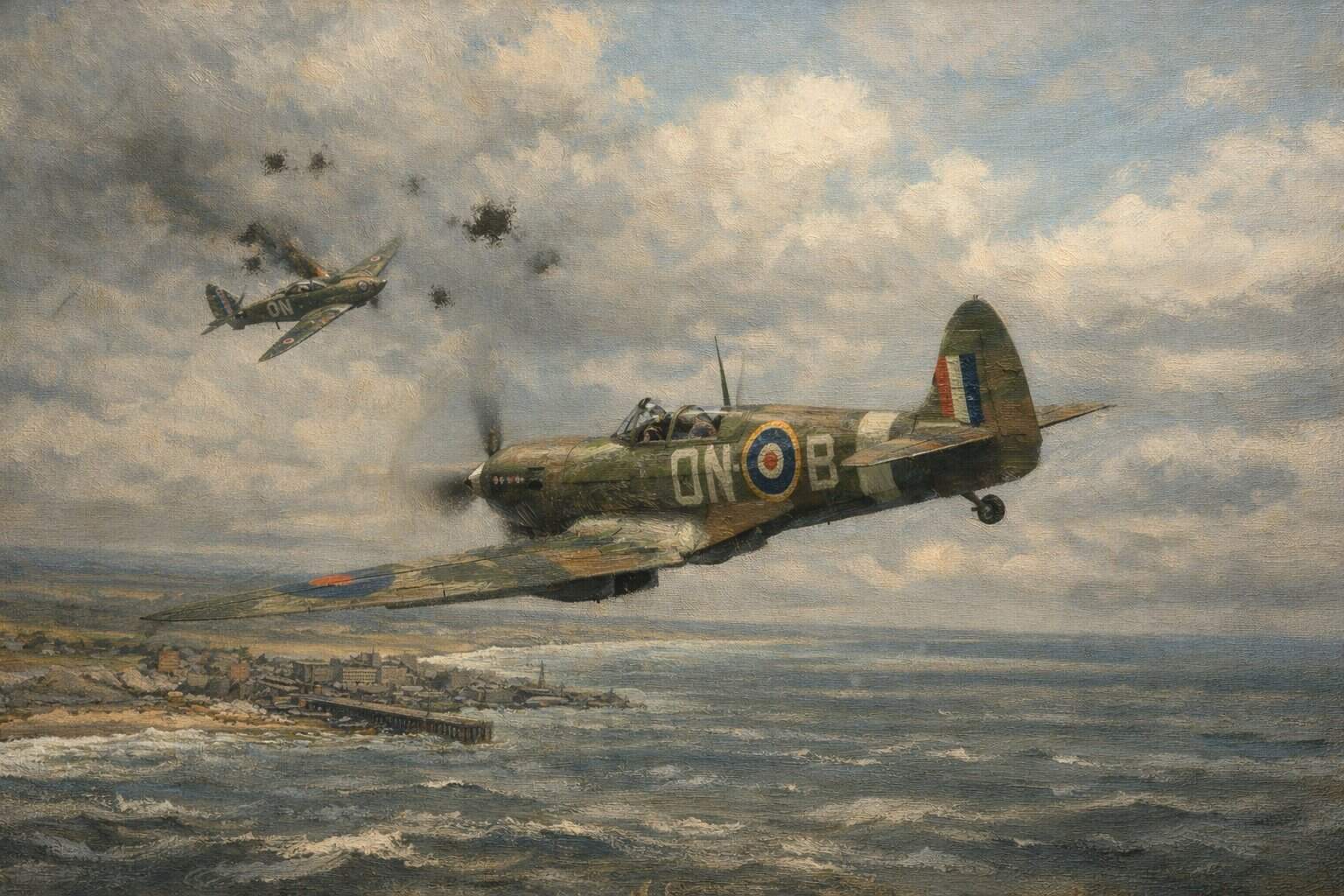
On 17 February 1943, a Royal Air Force operation against the German-held port of Dunkirk was abandoned in the face of strong enemy resistance. The mission, which involved bombers escorted by fighters, was part of the ongoing Allied effort to disrupt German coastal positions and shipping along the Channel. Although the bombers returned safely, the operation cost several escorting fighters, underscoring the risks faced by operating over heavily defended territory.
The Operational Context
By early 1943, the RAF maintained regular offensive operations against targets in occupied Western Europe. Ports such as Dunkirk were of particular importance, serving as bases for German naval units and as key points in the coastal defence system.
Bomber sorties against these targets were typically conducted by light or medium bombers, often flying at low or medium altitude to improve accuracy. These aircraft required fighter escort to protect them from interception by German fighters and to counter anti-aircraft defences.
On this occasion, aircraft of No. 22 Squadron, flying the Bristol Beaufort, were tasked with attacking Dunkirk, with No. 124 Squadron, flying the Supermarine Spitfire, providing close escort. Such operations demanded precise coordination between bomber and fighter units, particularly when operating within range of strong enemy defences.
The Approach to the Target
As the formation crossed the Channel and approached the target area, it encountered increasingly heavy opposition. German air defences in the Dunkirk region were well established, combining anti-aircraft artillery with fighter interception.
The escorting Spitfires engaged enemy aircraft while attempting to maintain protection for the bombers. However, the scale and intensity of the opposition made it clear that continuing the mission would involve significant risk to the bomber force.
In these circumstances, the decision was taken to abandon the attack. The bombers turned back before reaching the target and returned safely to base, avoiding what might have been substantial losses.
Losses Among the Escort
While the bombers escaped without loss, the escorting fighters bore the brunt of the engagement. Four Spitfires of No. 124 Squadron failed to return following the sortie.
Among those lost was Flying Officer B. R. Murphy, whose aircraft was shot down during the operation. He survived the initial combat and successfully evaded capture, eventually making his way back to Britain several months later via Spain and Gibraltar.
Sergeant Bruce Mackenzie Hirstich, a New Zealander, was seriously injured when his aircraft was hit. Although he managed to escape from the wreckage, he was captured and later died of his injuries while a prisoner of war.
Flying Officer Bernard John Hull, a decorated pilot who had previously completed numerous operational sorties and been awarded the Distinguished Flying Medal, was reported missing and is commemorated on the Runnymede Memorial.
Flight Lieutenant Frederick Gerald Hudson Chalk, who had earlier served as an air gunner in Bomber Command before retraining as a pilot, was also lost. Initially reported missing, he was later found to have been buried as an unknown airman in France and was subsequently reinterred with full identification many years after the war.
The Decision to Abort
The decision to abandon the mission reflected the realities of air operations over heavily defended areas in occupied Europe. While offensive action remained essential, the preservation of trained crews and aircraft was also a critical consideration.
By turning back in the face of strong opposition, RAF commanders avoided losing the bomber force. However, the losses among the escorting fighters demonstrated that even a limited engagement could prove costly.
Such decisions were a routine but difficult aspect of air warfare, requiring constant judgment between operational objectives and acceptable risk.
Significance in the Air War
The events of 17 February 1943 illustrate the continuing intensity of the air war over the Channel and northern France. Even relatively small-scale operations could encounter determined resistance from German defences, particularly around strategically important ports.
The mission also highlights the vital role of fighter escort in protecting bomber aircraft. While the bombers on this occasion returned safely, the cost was borne by the escorting Spitfire pilots, who engaged the enemy directly.
In the wider context of the war, such operations were part of the sustained pressure the RAF exerted against German positions in Western Europe. They contributed to the gradual erosion of Germany’s defensive capabilities, even when individual missions failed to achieve their immediate objectives.
At the same time, the losses suffered by No. 124 Squadron serve as a reminder of the human cost of these operations. The experiences of the pilots involved, ranging from successful evasion to capture and loss, reflect the varied and often uncertain outcomes faced by airmen operating over enemy territory.
The abandoned attack on Dunkirk stands as a representative example of the challenges of offensive air operations during the war: tactically complex, often hazardous, and shaped by the constant balance between mission success and survival.