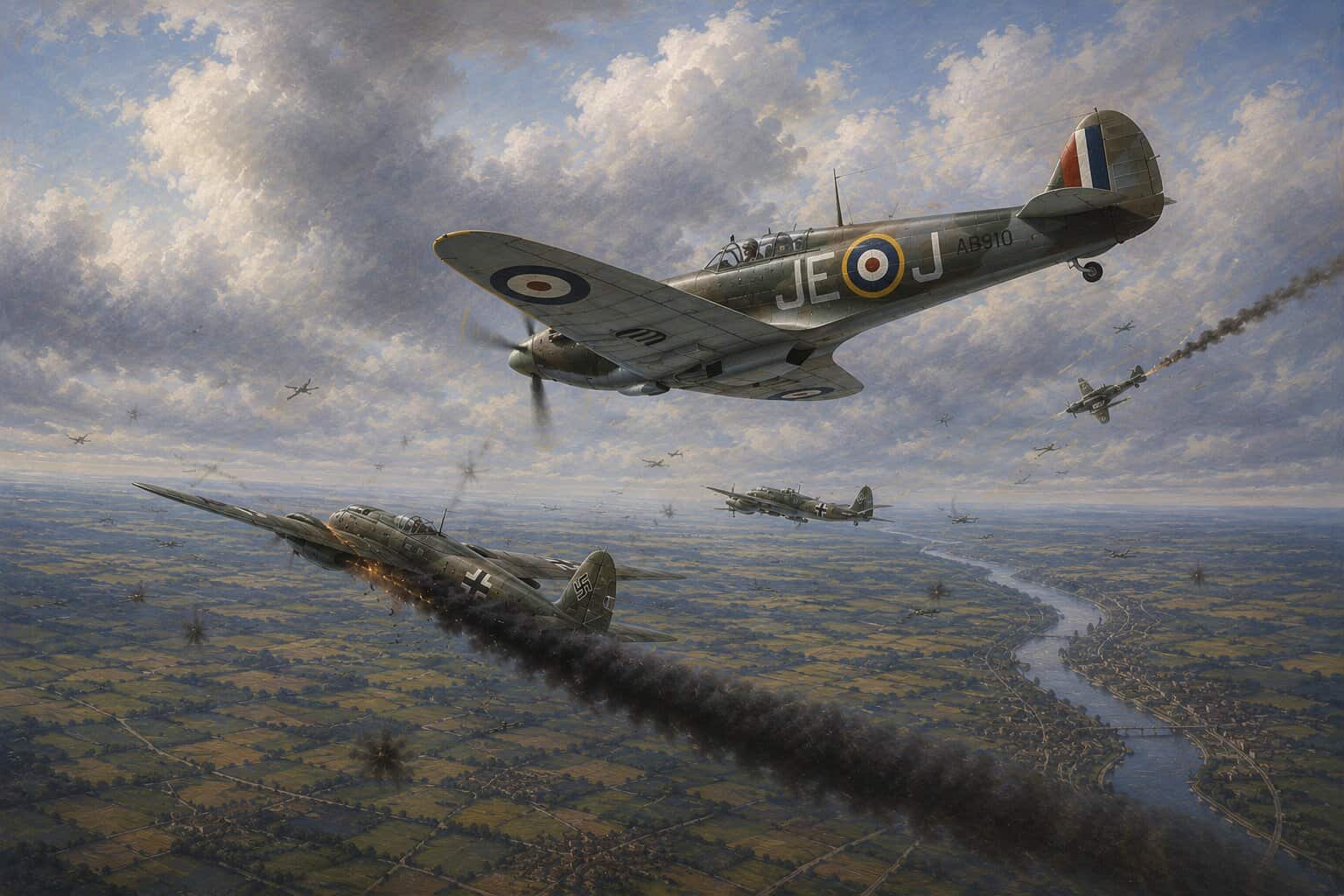
On 16 July 1940, Adolf Hitler issued War Directive No. 16, ordering preparations for the invasion of Britain under Operation Sea Lion. The document mattered greatly to RAF history because it stated plainly that the Royal Air Force had to be reduced to the point where it could no longer interfere significantly with a crossing of the Channel. In other words, the invasion project immediately made control of the air a central condition of German success.
The directive and its meaning
The directive did not mean that an invasion was certain to happen exactly as written, nor did it settle every military question involved. What it did do was reveal German thinking at a decisive moment in the war. France had fallen; Britain stood alone in western Europe, and the next stage of the conflict depended on whether Germany could convert its continental victory into pressure across the Channel. For that to be plausible, the Luftwaffe had to do more than raid British targets. It had to break the RAF's capacity to interfere with shipping, assembly areas and the passage of troops. Hitler's directive acknowledged an operational reality that British planners also understood: no seaborne invasion of southern England could proceed safely while British air power remained effective.
Why the RAF stood at the centre of the problem
The wording of the directive is revealing because it shows how central the RAF had become in strategic calculation. The German Army could prepare formations and the Kriegsmarine could examine transport arrangements, but neither could remove the threat posed by British aircraft over the Channel and the invasion coast. Fighter opposition, bombing attacks against shipping, and the RAF's broader ability to contest the air would all threaten any crossing force. That made the coming struggle more than a sequence of isolated air attacks. It became a contest over whether Britain could deny Germany the conditions needed for invasion. The RAF was not merely defending airfields or cities for their own sake. It was standing between Germany and the practical execution of its largest immediate strategic ambition.
The road into the Battle of Britain
War Directive No. 16 forms part of the essential pre-history of the Battle of Britain. The battle is often remembered for the pilots, aircraft, and dramatic engagements of later weeks, but the campaign also rested on strategic purpose. German air operations were not simply punitive or demonstrative. They were tied to the wider problem of forcing Britain into a position in which an invasion might be attempted with an acceptable chance of success. This helps explain why the RAF's survival mattered so much. If Fighter Command and the wider British air system could remain in being, then Sea Lion became vastly harder to contemplate. The issue was not abstract prestige. It was the practical relationship between air power and amphibious warfare in a narrow, dangerous sea.
A defining moment before the battle
16 July 1940, is significant because it shows how clearly Britain's enemies recognised the RAF's importance. Hitler's invasion directive did not merely threaten Britain; it confirmed that the Luftwaffe had to suppress British air resistance before that threat could be made meaningful. In that sense, the document framed the stakes before the great air fighting fully unfolded. On this day, the war moved one step closer to the Battle of Britain in its fullest sense. Directive No. 16 turned invasion planning into an operational programme and placed the reduction of RAF interference at its heart. The result was to underline a truth that the months ahead would prove beyond argument: as long as the RAF remained capable of fighting, Britain's invasion problem was not solved.