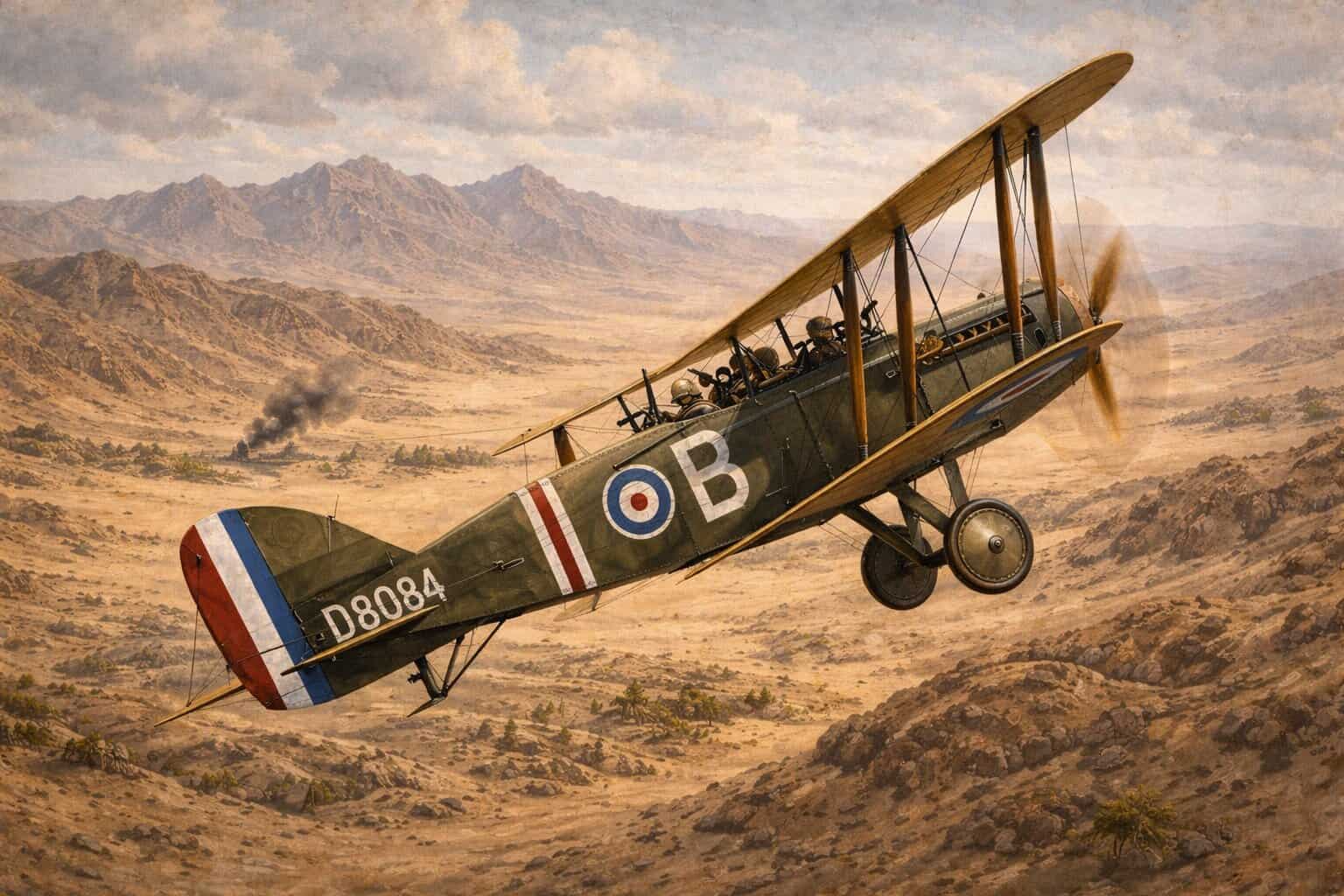
On 1 May 1925, Mahsud tribesmen in South Waziristan sought peace after RAF air operations, bringing to an end the campaign commonly known as Pink’s War. Though small in scale compared with later twentieth-century conflicts, it holds an important place in RAF history as a notable example of an air campaign conducted with minimal ground-force involvement. The result appeared to confirm, at least to contemporary advocates, that aircraft could achieve political and military effect in difficult frontier country without the heavy commitments associated with major land expeditions.
A frontier campaign from the air
The campaign, named after Wing Commander Richard Pink, took place in the distinctive environment of Britain’s North-West Frontier, where terrain, distance and tribal politics complicated conventional military control. In such circumstances, air power seemed to offer speed and economy. Aircraft could reach areas that were hard for columns to enter, apply pressure quickly and maintain a persistent presence over regions where communications were poor. That made the RAF an attractive instrument for policymakers seeking results without large-scale deployment.
Pink’s War is often remembered precisely because it was presented as an operation in which air action was central rather than merely supportive. This did not mean that ground forces were irrelevant, but the campaign was presented as having ended with only minimal involvement of ground forces. For the inter-war RAF, that was deeply significant. It aligned with the service’s broader argument that air control could be an effective means of imperial policing and frontier management.
The meaning of the peace request
The fact that the Mahsud tribes sought peace on this date gave the campaign its apparent conclusion and its historical force. In military terms, a peace approach suggested that sustained pressure had altered the calculations of those being targeted. For advocates of independent air action, such an outcome was powerful evidence. They could point to a campaign that had achieved its end not by occupying territory by force, but by imposing sufficient disruption and air threat to prompt negotiation.
That interpretation should be handled carefully. Frontier warfare was never simple, and apparent settlements could be temporary. Air power could coerce, but it could not erase the region's political complexity. Even so, the event remains important because it shows how the RAF’s inter-war role was understood by its leaders and by the government: as a means of obtaining compliance in remote areas through rapid, sustained pressure.
Why Pink’s War matters to RAF history
For later generations, Pink’s War raises difficult as well as interesting questions. It speaks to the moral and political ambiguities of imperial air operations, where technological advantage and strategic economy often came at the expense of populations with little ability to answer in kind. Yet those questions are part of the history, not reasons to ignore it.
On 1 May 1925, the request for peace marked the end of a campaign that became emblematic of inter-war RAF doctrine. It showed how strongly the service believed in the utility of air power as a substitute for larger land campaigns, and how imperial policy could be shaped around that belief. Whether seen as proof of efficiency or as a troubling example of coercive control, Pink’s War remains a revealing chapter in the RAF’s early development.