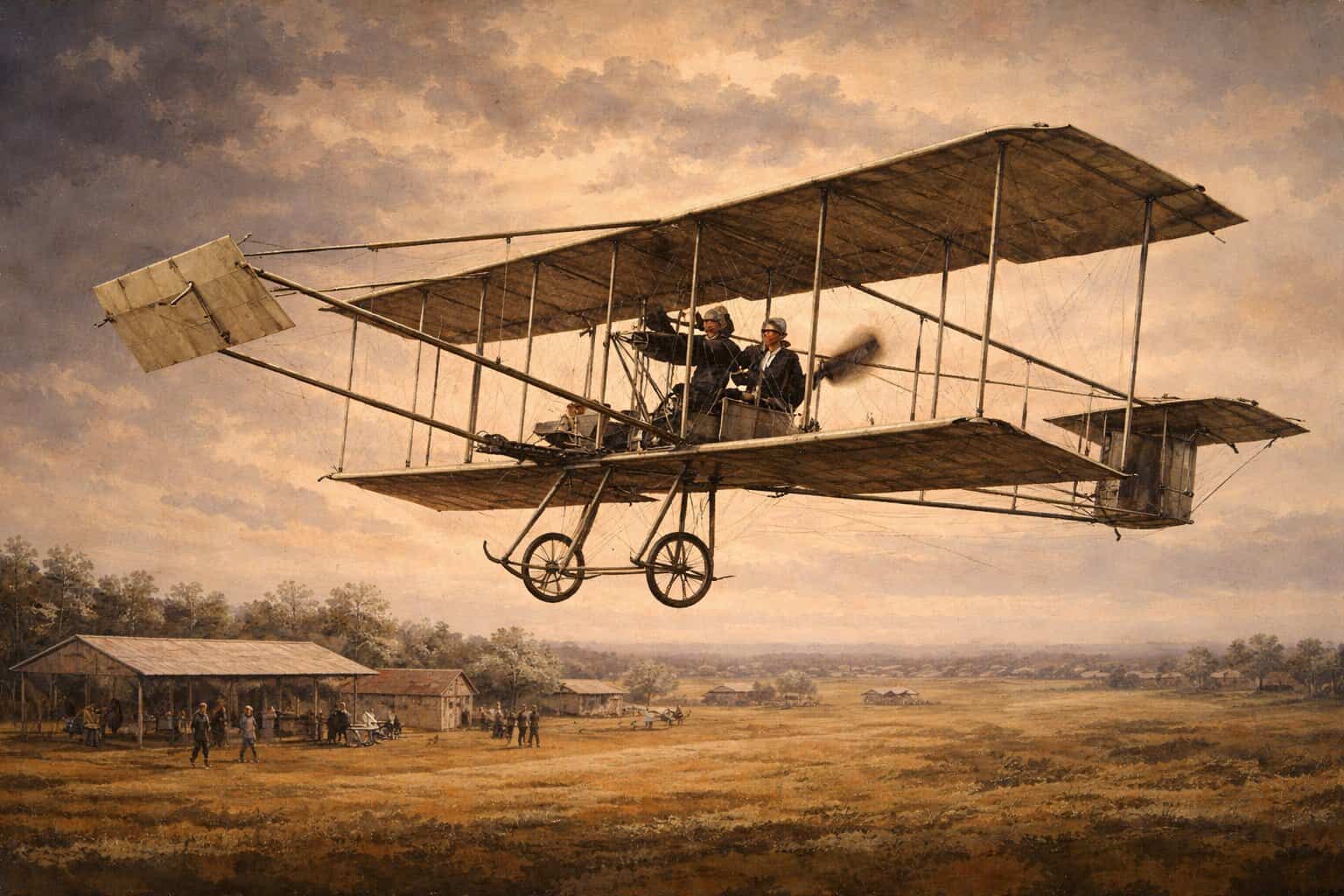
On 14 January 1911, the War Office purchased Geoffrey de Havilland's No. 2 biplane, renaming it F.E.1, for Farman Experimental. De Havilland had built and flown the machine privately with the help of Frank Hearle before approaching Mervyn O'Gorman, superintendent of the Army's Balloon Factory at Farnborough.
The War Office had agreed to buy the aircraft shortly before Christmas 1910 and to employ de Havilland, with Hearle as his mechanic. The purchase, recorded on 14 January 1911, cost £400 and brought both the aircraft and its designer into Britain's small but rapidly developing military aviation establishment.
Geoffrey de Havilland and No. 2
The No. 2 was de Havilland's second aircraft design, built at a workshop in Fulham during 1910 after an earlier attempt had failed to fly successfully. He used the new machine to teach himself to fly during the closing months of 1910, refining his own handling of powered flight at the same time as he refined the aircraft itself.
The biplane followed the general layout popularised by the French Farman III: a pusher propeller mounted behind the pilot, a forward elevator carried on booms ahead of the wings, and lateral control by ailerons fitted to the upper wing. It was a modest, experimental machine. It was airworthy, and that was enough to interest the Balloon Factory.
Why It Became F.E.1
Once the War Office had taken formal ownership of the aircraft, the Factory renamed it F.E.1, an abbreviation of Farman Experimental, in recognition of the Farman-style configuration it had inherited. The designation was the first applied under Farnborough's new system for classifying experimental aircraft types by their layout and origin, a scheme that would later produce further designations such as the B.E. (Blériot Experimental) series.
The F.E.1 itself had a short working life. Its successor, the F.E.2, was described as a modification of the F.E.1 but was in practice a new aeroplane, first flown by Geoffrey de Havilland in August 1911. The designation was later reused for substantially different F.E.2 designs, eventually leading to the F.E.2a, F.E.2b and F.E.2d aircraft that served during the First World War.
British Military Aviation in 1911
In January 1911, Britain had no independent air service of any kind. Military aviation was conducted under Army authority through the Balloon Factory. The organised structures that would follow, the Air Battalion, Royal Engineers, formed later in 1911, and the Royal Flying Corps, formed in 1912, still lay ahead. The purchase of the F.E.1 sat within that same period of institutional experimentation. Both later organisations drew on lessons the Factory was only beginning to learn from aircraft like the F.E.1.
At this stage, the military case for aircraft rested chiefly on reconnaissance: the possibility of observing troop movements and terrain from the air in a way ground-based scouting could not match. Aeroplanes of 1911 were fragile and short-ranged, and questions about their reliability were far from settled. The F.E.1 and the handful of other experimental types acquired by the Factory around the same time were used to work through exactly those questions, testing engines, structures and control systems under conditions closer to service use than private ownership could provide.
What the Purchase Represented
The acquisition of the de Havilland No. 2 was a small transaction by later standards: a single aircraft, bought for £400, from a designer the War Office had also just taken onto its own staff. The aircraft itself flew for only a few months before it was wrecked. Its real interest lies in what the purchase shows about the pace of change in British military aviation at the start of 1911. Within a little over a year, the Army would have a dedicated aviation unit. Within seven years, that unit's descendants would form the Royal Air Force. The F.E.1 was one of the first aircraft bought, classified and tested under a system built specifically for that purpose, and its purchase marks a clear point at which the War Office moved from watching aviation development from a distance to sponsoring it directly.