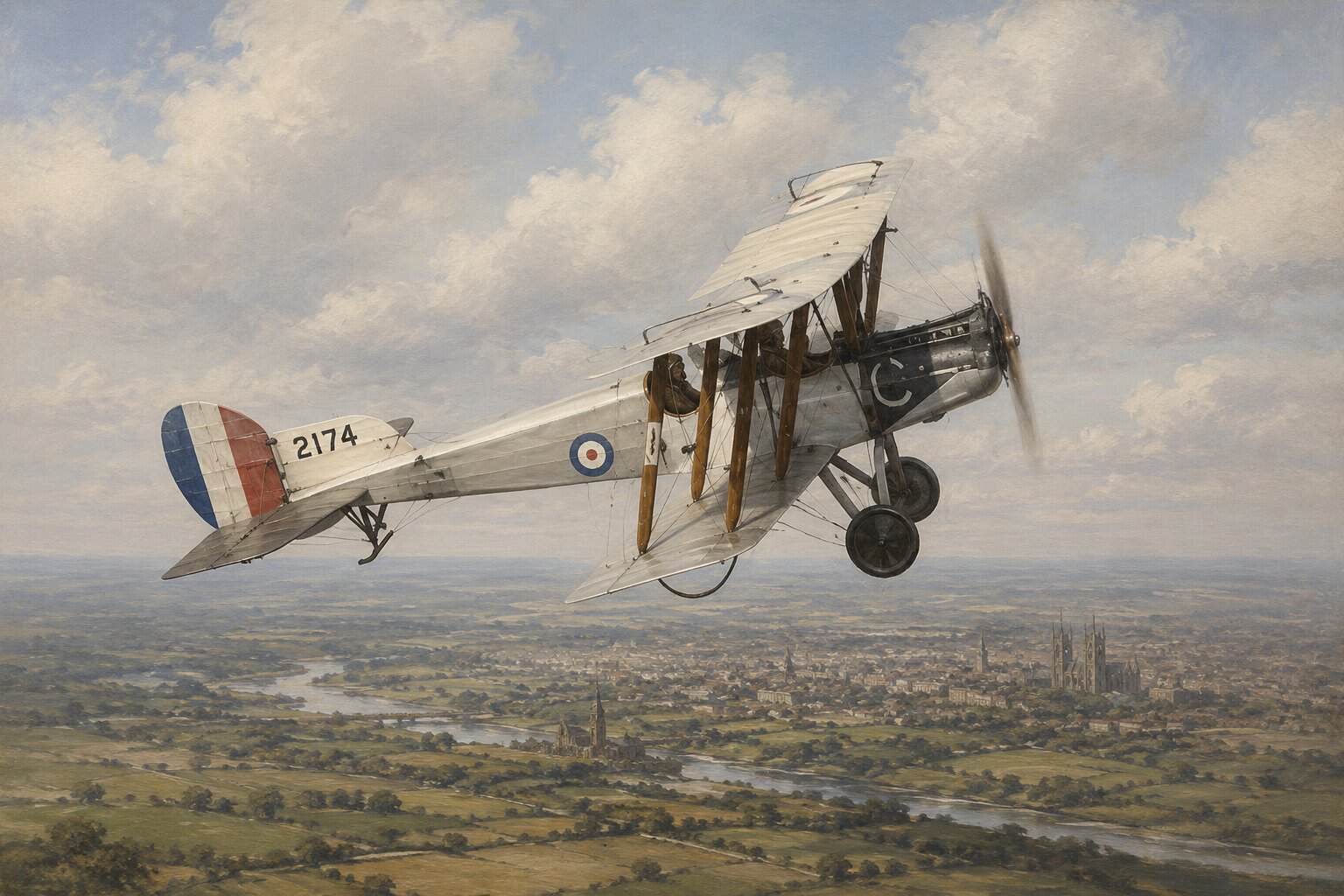
On 12 August 1914, the Royal Flying Corps began moving aircraft, aircrews and ground personnel across the Channel to support the British Expeditionary Force in France. It was an unglamorous movement in practical terms, involving organisation, transport and preparation rather than dramatic combat, yet it marked a decisive moment in British military aviation. For the first time, British air power was being projected overseas in direct support of a field army entering a major European war.
The Move Across the Channel
The significance of the day lay not in a single dogfight or bombing raid, but in the fact that the Royal Flying Corps was beginning front-line service on the continent. Aircraft did not operate alone. Pilots, observers, mechanics, transport staff and the wider support apparatus all had to be moved and established in unfamiliar conditions. What crossed the Channel on 12 August was therefore more than a handful of aeroplanes. It was the opening stage of an organised air presence intended to work alongside the British Expeditionary Force from the very beginning of the campaign.
This mattered because aviation was still a new military arm. In 1914, its value had not yet been proven on the scale that later generations would take for granted. Even so, British planners understood that aircraft could extend the army’s view beyond the horizon, report on enemy movement and help commanders make faster decisions. Sending the RFC to France at such an early point in the war showed a willingness to place that new capability close to the centre of operations.
An Early Overseas Air Commitment
The move also demonstrated that British military aviation was not going to remain a home-based experiment. Once the RFC crossed to France, it entered the conditions of a continental campaign in which airmen would have to adapt quickly to operational pressure, changing front lines and the harsh demands of maintenance in the field. The deployment was therefore a test of organisation as much as of flying skill.
In historical terms, the importance of the moment rests partly in what followed from it. The First World War would transform the military uses of aircraft, but those later developments depended on early decisions such as this one. Before air power could influence battles, armies had to accept aircraft as working tools rather than curiosities. The move to France was one of the clearest signs that Britain had begun making that adjustment.
An Early Pattern of Deployment
Looking back, 12 August 1914 stands as one of the foundation dates in the story of British air operations overseas. It linked aviation directly to expeditionary warfare and placed the RFC where the war would immediately test its value. There were greater and more famous milestones to come, but this was an essential beginning.
The day also reminds us that military history is shaped not only by spectacular actions, but by timely commitments of people, machines and support. The Royal Flying Corps did not cross to France as an abstract idea. It went as a functioning force prepared to serve with the British Expeditionary Force in the uncertain opening phase of the war. That decision helped establish the pattern of forward air support, reconnaissance and overseas deployment that would become central to British air warfare in the decades ahead.