The seizure of the Suez Canal by Gamal Abdel Nasser in July 1956 triggered one of the defining crises of Britain’s post-war history. For the Royal Air Force, Suez was more than a short campaign against Egyptian targets. It was a test of whether British air power, organised from overseas bases and combined with naval and allied forces, could still deliver a decisive political result in the Middle East. The answer was deeply uncomfortable. RAF aircraft flew effectively, the Egyptian Air Force was rapidly suppressed, and the opening military phase worked broadly as planned. Yet the campaign ended not in strategic success but in humiliation, because the political foundations beneath the operation were unsound from the beginning.
Suez exposed a widening gap between operational competence and national power. The RAF had modern aircraft, trained crews and a system for projecting force into the eastern Mediterranean. What Britain no longer possessed was the freedom to use that force on its own terms without grave diplomatic and financial consequences. In that sense, the crisis was not simply an episode in Anglo-Egyptian relations. It marked a turning point in the story of British air power after the Second World War, showing both the reach that remained and the limits that had become impossible to ignore.
Britain, Nasser and the shrinking imperial position
By 1956, the canal was still far more than a commercial waterway in British strategic thought. It connected Britain with oil supplies, with military commitments in the Gulf and Indian Ocean, and with a wider conception of world power that had survived the Second World War only in weakened form. Even after India had gone and the old imperial system was visibly contracting, ministers and service chiefs still treated the Middle East as a region in which Britain must retain influence, bases and rapid military access. The RAF sat near the centre of that system. Air power offered mobility over long distances, a means of reinforcing threatened points, and an appearance of control over a region that was becoming increasingly difficult to govern.
That post-war system was already under strain before Nasser nationalised the canal. Britain had faced mounting political hostility in Egypt, including pressure to withdraw its military presence from the canal zone, and had already been forced into an embarrassing withdrawal from its old base there. Cyprus consequently acquired greater significance as an RAF platform in the eastern Mediterranean. This mattered in 1956 because it meant that any operation against Egypt would be mounted from a more exposed and politically sensitive position than the imperial order of the 1930s or 1940s would have allowed.
Nasser’s Egypt represented more than a local dispute. To British eyes, he appeared to threaten the whole architecture of influence east of the Mediterranean. He challenged British prestige, appealed to Arab nationalism, acquired arms from the Soviet bloc and seemed ready to convert political symbolism into regional leverage. The canal’s nationalisation therefore touched nerves far beyond shipping tolls and commercial administration. In London, it was treated as a direct challenge to Britain’s status as a world power. That emotional and strategic response shaped everything that followed. Policy hardened around the belief that Nasser had to be checked, not merely bargained with.
For the RAF, the crisis emerged at a moment when the Service was adjusting to the Cold War, nuclear priorities, and a changing pattern of overseas commitments. Yet Suez dragged it back into a distinctly imperial kind of operation: a coercive intervention designed to impose a political settlement through rapid military action. That made the campaign unusually revealing. It showed how much of Britain’s old expeditionary habit still survived in organisational form, but also how badly the strategic environment had changed around it.
From nationalisation to Operation Musketeer
The nationalisation announcement of 26 July 1956 set off a chain of planning in which diplomacy, military preparation and political deception became tightly interwoven. Britain and France both saw Nasser as intolerable, though for somewhat different reasons and with different levels of urgency. French anger was sharpened by Egyptian support for Algerian nationalism. British motives combined genuine concern over access and influence with a powerful sense of wounded prestige. In both capitals, a shared appetite for decisive action developed, and the armed forces were soon drawn into planning for intervention.
The resulting scheme depended upon a deeply flawed political device. Israel would attack into Sinai; Britain and France would then issue an ultimatum to both sides to withdraw from the canal zone; when Egypt refused, Anglo-French forces would intervene ostensibly as peace-imposers while in reality striking at Egypt. This framework, later notorious for its deception, shaped the military timetable. Air operations were never simply a matter of target selection or sortie generation. They were tied to a manufactured diplomatic sequence intended to create a legal and political pretext for war.
Operation Musketeer accordingly became a campaign in which timing mattered almost as much as force. The British and French expected that once the intervention began, air power would quickly destroy or paralyse Egyptian air resistance, enabling amphibious and airborne operations against Port Said and the canal corridor. There was a familiar confidence behind that logic. Air superiority would provide freedom of action, minimise losses to the landing force and impose psychological shock. At the operational level, the argument was reasonable. At the political level, it rested on a catastrophic underestimation of international reaction, especially from the United States.
Planning also revealed a persistent British belief that a short, sharp intervention could restore a deteriorating strategic position. That had been a recurrent feature of imperial crisis management, and it lingered in 1956 even though conditions had altered decisively. The government assumed that military success, if obtained quickly enough, might outrun diplomatic resistance. This was a dangerous illusion. By the time the RAF was preparing to strike Egyptian airfields, the real contest was already larger than the battlefield. Washington, the United Nations and world opinion mattered as much as any objective around the canal.
The Service, nevertheless, had to plan for the campaign it had been ordered to support. Air staff worked on staging, target systems, command arrangements, and the integration of RAF efforts with carrier aviation and French forces. In those preparations, one can still see the habits of a power accustomed to overseas intervention: methodical staff work, wide geographical reach and confidence in the technical and operational means of force projection. Suez would show that such capacities remained real. It would also show that they were no longer enough.
The RAF builds the striking force
The air component assembled for Suez reflected both Britain’s remaining military reach and its growing dependence on vulnerable staging arrangements. Cyprus became central. RAF Akrotiri, in particular, assumed significance that extended beyond its local geography. From there, and from other supporting positions in the region, the Service could project bomber and fighter-bomber force towards Egypt while also supporting transport, reconnaissance and command functions. The crisis thus underlined the value of retained Mediterranean bases at the very moment when Britain’s position in the region was becoming politically brittle.
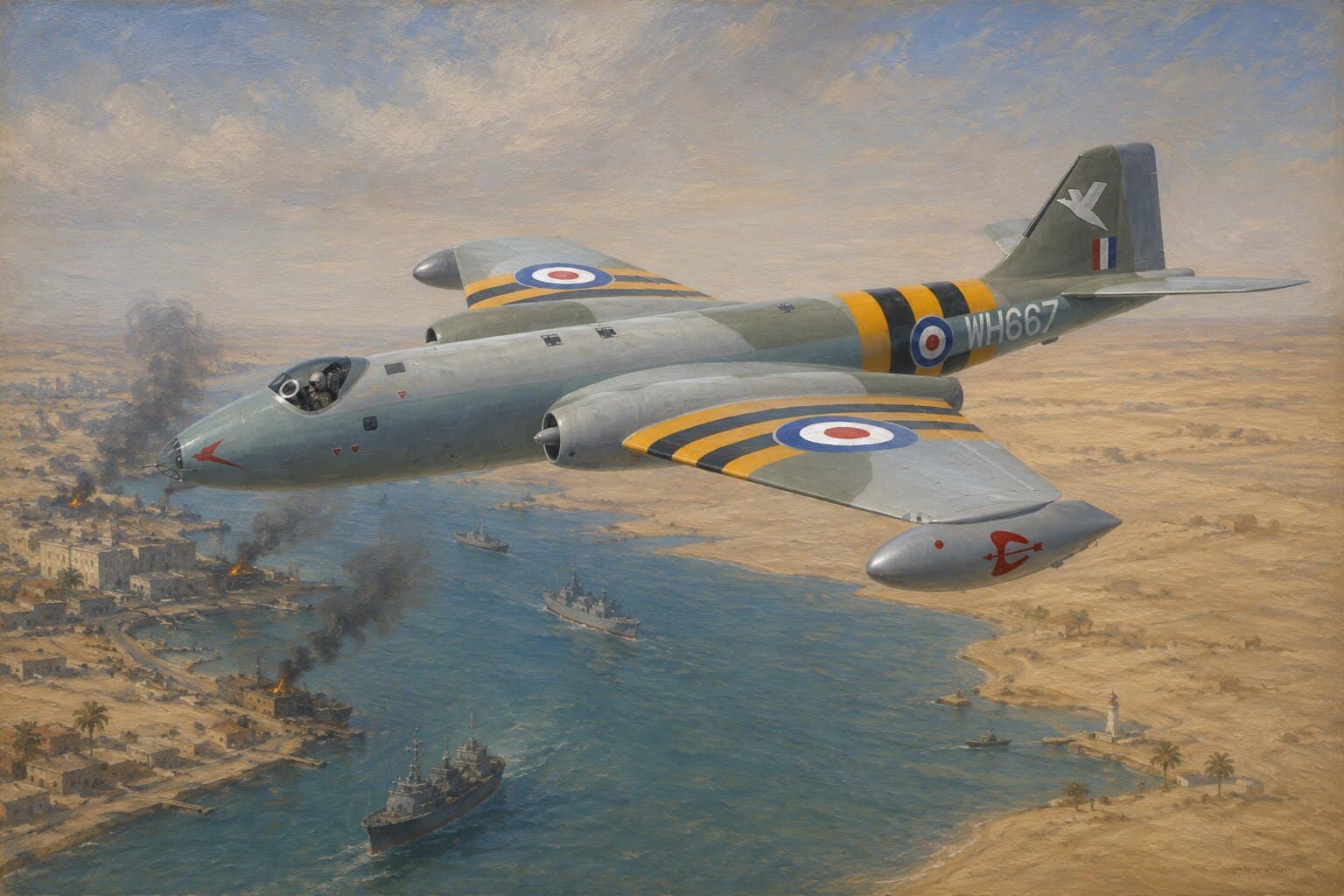
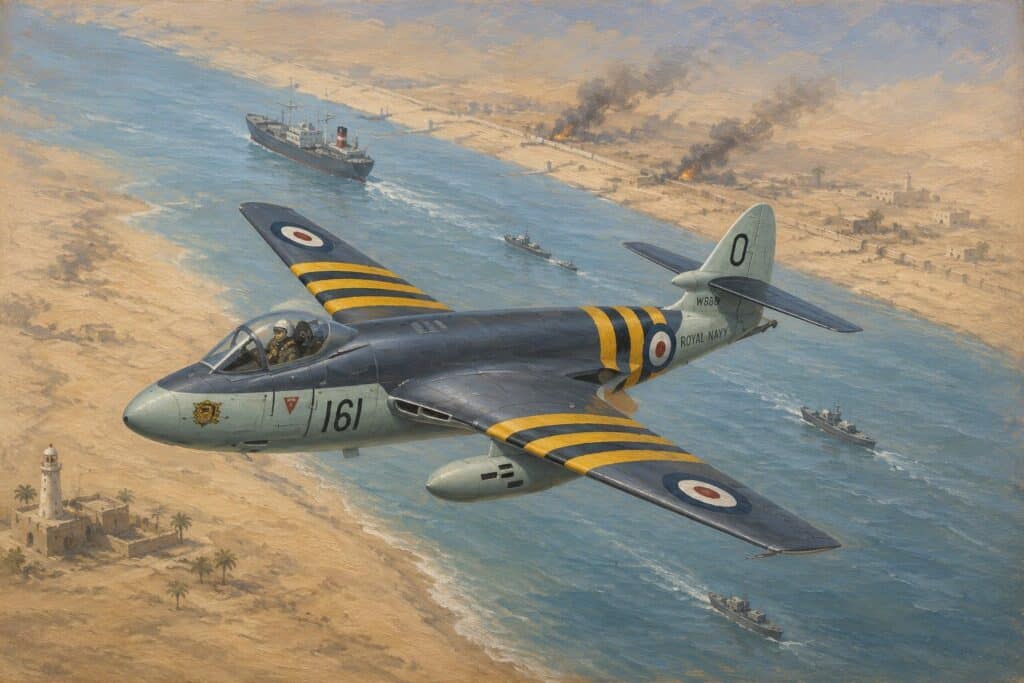
The force itself mixed newer jet power with lessons inherited from the recent past. English Electric Canberras provided the RAF with an effective light bomber capable of striking at range with speed and accuracy by the standards of the day. Valiants added heavier bombing capability and represented the more modern, high-level striking arm of British air power. Venoms supplied a fighter-bomber element suited to attacks on airfields and other tactical objectives. The composition of the force illustrated the transitional character of the mid-1950s RAF: a Service carrying wartime memories, operating globally from overseas bases, yet increasingly equipped with aircraft shaped by the jet age and by Cold War thinking.
As ever, the existence of aircraft on paper was only part of the story. A campaign launched from Cyprus and nearby positions placed great pressure on logistics, engineering, ground organisation and traffic management. Men, bombs, fuel and spares had to be moved and sustained under conditions of secrecy and political uncertainty. Squadrons had to adapt quickly to unfamiliar operating rhythms, to complex command relationships and to the simple physical burden of Mediterranean climate and dispersed basing. None of this produced the drama of a bombing raid, but it mattered enormously. The opening blows of Suez were possible only because the RAF could still generate an expeditionary system behind the aircraft.
There was also the question of coordination. Suez was never a purely RAF affair. Carrier-borne air power, French air participation, naval requirements and the sequencing of any later land operation all had to be reconciled. This called for the sort of inter-service management at which Britain could be highly competent in practice even when political direction above it was confused. Yet coordination problems also reflected a deeper weakness. Because the campaign had been politically contrived, its military timings were constrained by diplomatic theatre. Operational neatness and political honesty were moving in opposite directions.
The concentration in Cyprus carried a further implication. It signalled how far Britain’s Middle Eastern posture had shifted since the loss of the canal-zone base system. In earlier decades, Egypt itself had been a central hub of British air power. In 1956, Britain was preparing to bomb Egypt from outside Egypt, relying on a different regional geography and on lines of support that were serviceable but less secure. This did not make the operation impossible, but it gave Suez the character of a campaign mounted by a power already forced out of its former position, attempting to recover authority by force after authority had begun to slip away.
Gaining command of the air over Egypt
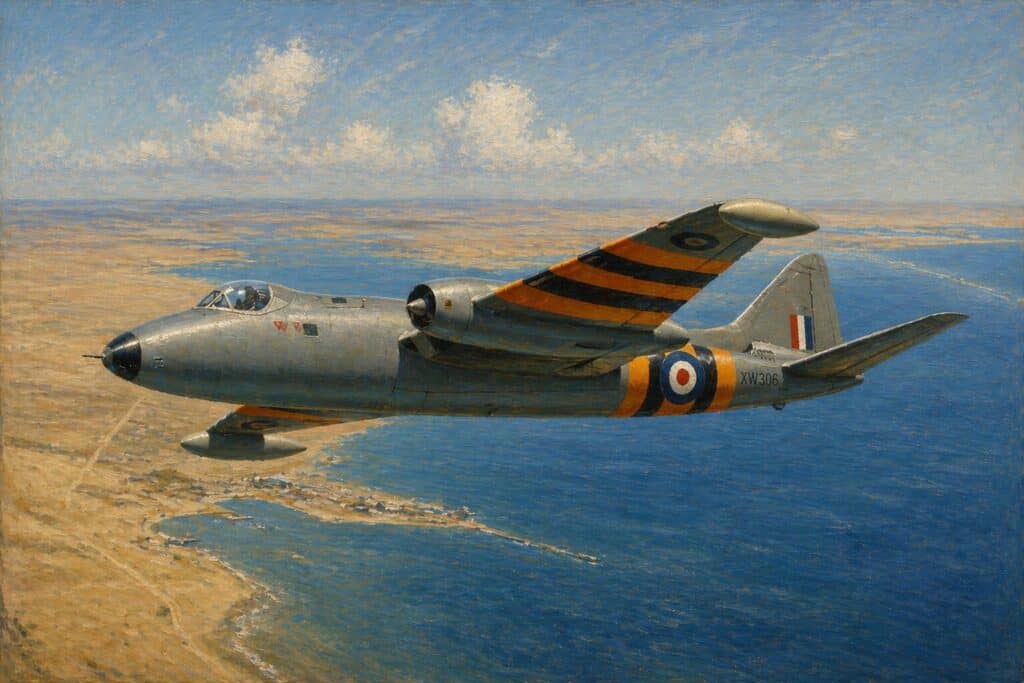
When the Anglo-French assault phase opened at the end of October, one of the RAF’s first responsibilities was to help neutralise the Egyptian Air Force and the infrastructure that supported it. In strictly military terms, this was the most convincing part of the campaign. Egyptian airfields, aircraft on the ground and radar-linked control arrangements were vulnerable to a well-organised strike effort, and the British and French moved hard against them. The objective was clear: remove the air threat before amphibious and airborne forces moved in strength.
Here the RAF demonstrated the value of preparation, modern aircraft and a force trained for rapid offensive action. Canberra and Valiant bombing, combined with lower-level attack by other aircraft and the contribution of allied naval air units, inflicted severe damage on Egyptian air assets. The Egyptian Air Force never imposed the sort of resistance that might have made a landing prohibitively costly. This mattered operationally and psychologically. It gave Anglo-French commanders a degree of air freedom and reinforced the belief that the military side of Musketeer was working.
The achievement deserves sober recognition. Air superiority is easy to praise in retrospect, but it is rarely automatic. It depends on intelligence, target selection, serviceable aircraft, disciplined execution and the ability to keep pressure on an opponent before he can recover. The RAF’s performance in that opening phase reflected professional competence rather than improvisation. Whatever the flaws of the wider enterprise, the Service executed its immediate tasks effectively.
Yet even this success contained the seeds of disappointment. Once the Egyptian Air Force had been suppressed, the core military problem changed. The RAF could dominate Egyptian airspace over the battle area more easily than Britain and France could convert that dominance into a politically sustainable result. Air power had done what air power could do: it had opened the way. What followed depended on a political strategy that was already coming apart.
There was another limitation too. Destroying air opposition did not remove the need for careful restraint. Targets near populated areas, shipping concerns and the ever-present danger of civilian casualties all bore heavily on decision-making. In an earlier imperial age, Britain might have accepted a harsher margin of damage. In 1956, such damage had immediate international consequences. Air power remained potent, but it operated under a moral and political glare that sharply reduced the freedom associated with earlier coercive expeditions.
Air power under political constraint
Suez is sometimes remembered as a simple case of military success sabotaged by diplomacy, but that is too easy. The military design itself was shaped and weakened by politics before the first bombs fell. Because Britain and France wanted to preserve the fiction of intervention rather than outright aggression, the sequence of moves was awkward from the start. Because they feared international reaction, they hesitated over timing and presentation. Because they needed quick results, they invested excessive hope in the idea that an air campaign and limited land action could force a strategic reversal before outside pressure became overwhelming.
For the RAF, this meant operating in a campaign where tactical effectiveness and strategic utility were no longer the same thing. Aircraft could strike airfields, communications and selected military positions. They could support the approach to Port Said. They could help isolate Egyptian forces in the immediate battle zone. What they could not do was solve the central political contradiction. The operation sought to overthrow or break Nasser’s position while publicly denying that this was the objective. That contradiction infected the use of force. Every military action had to serve a political narrative that almost nobody beyond the participating governments believed.
This was where Suez became a lesson in the limits of coercive air power. The RAF had long been associated with the idea that aircraft might impose order quickly and economically across imperial spaces. There had been historical reasons for that belief, even if its claims were often exaggerated. In Egypt in 1956, however, the decisive variables lay outside the reach of bombing. Nasser’s prestige in the Arab world was not simply a function of his airfields. American opposition was not something that could be bombed into silence. Sterling’s vulnerability on international markets could not be mastered from a cockpit.
The campaign therefore moved into an increasingly uncomfortable pattern. The air offensive had real military value, but each day also intensified diplomatic pressure. Far from producing a clean strategic decision, bombing accelerated the political clock against London and Paris. The operation became a race not merely against Egyptian resistance but against world reaction, and one Britain was poorly placed to win. In effect, air power was being used in support of a policy whose margin for success was collapsing faster than aircraft could exploit their battlefield advantage.
This does not mean the RAF was irrelevant. On the contrary, the Service made the later landing operations possible by reducing Egyptian capacity to challenge them from the air. But Suez showed that modern air power, however efficient, could not rescue an incoherent grand strategy. It could magnify the force available to government; it could not compensate for a government that had misread the strategic environment.

Port Said, the ceasefire and strategic humiliation
The landings at Port Said and Port Fuad brought the campaign into its most visible stage. Air power continued to cover the operation, strike selected objectives, and support the advance southwards along the canal corridor. In purely military terms, the intervention still seemed to possess momentum. Anglo-French forces were not being hurled back into the sea. Egyptian resistance was uneven, and the prior destruction of much of Egypt’s air capability had sharply improved the invaders’ freedom of action. If the campaign is judged only at the level of battlefield mechanics, it can appear oddly successful for an operation so often remembered as a fiasco.
But Suez was a fiasco because battlefield mechanics were no longer the measure that mattered most. International condemnation deepened. The United States refused to underwrite British assumptions, and financial pressure on sterling became acute. The Soviet Union added menacing rhetoric at a moment of already severe Western embarrassment. The United Nations became the arena in which the intervention rapidly lost legitimacy. What the RAF and the other services were enabling on the ground could not be sustained politically at the top.
The ceasefire therefore came not because the RAF had failed in its assigned work, but because the entire strategic object of the campaign had collapsed. Britain and France had launched an operation to preserve influence and demonstrate resolve; instead, they revealed dependence, isolation and diminished power. Nasser survived politically, which, in many respects, meant he had won. The canal question could no longer be treated as if nineteenth-century methods of enforcement remained available to Britain. Suez made that plain to allies, adversaries and to Britain itself.
For the RAF, the result was especially bitter because it threw into relief a serviceable military performance trapped inside a disastrous political enterprise. Air crews and ground staff had done much of what was asked of them. Bases in Cyprus had functioned as forward instruments of power. Aircraft had gained the necessary control of the air. Yet the campaign’s outcome attached no honour to that competence. Instead, the operation entered British memory as a marker of decline.
That memory can obscure an important truth. Suez was not evidence that the RAF had ceased to matter. It was evidence that Britain could no longer assume that effective force, even when competently applied, would deliver strategic freedom. The humiliation lay not in technical ineptitude but in the exposure of national limits.
What Suez meant for the RAF and British strategy
The long shadow of Suez fell over British defence thinking for years afterwards. In immediate terms, the crisis accelerated recognition that overseas intervention required political conditions far firmer than those on which Musketeer had been based. It also strengthened the view that Britain’s major operations could not safely be separated from American support. This was a profound change in the practical meaning of air power. The RAF still possessed global habits, modern equipment and experienced personnel, but its room for unilateral imperial action was narrowing sharply.
Suez also underlined the continuing importance of bases such as Akrotiri while simultaneously demonstrating their limits. Cyprus remained strategically valuable, not least because the RAF could use it to project force into the Middle East and beyond. But basing alone could not guarantee influence. A base is only as useful as the political coalition that allows its power to be employed to effect. In that sense, Suez transformed the meaning of Britain’s Mediterranean posture. Forward presence survived, yet its purpose increasingly had to be framed in terms of alliance, deterrence, and contingency rather than the older language of imperial enforcement.
There were doctrinal implications too. The crisis reinforced a trend in which British defence planning looked more towards NATO, the nuclear deterrent and carefully delimited expeditionary roles, and less towards the assumption that a show of force could preserve a fading imperial order. That did not happen overnight, nor did Suez alone cause it, but the crisis made the adjustment harder to avoid. For the RAF, whose post-war identity was already bound up with both conventional global reach and nuclear striking power, the lesson was especially sharp: modern aircraft could deliver effects at speed, but they could not substitute for strategic coherence.
Suez also shaped later memories of what air power could and could not do. It discouraged simplistic confidence in bombing as a political solvent, at least in responsible professional circles. The RAF’s experience in the crisis suggested that air superiority, precision and rapid deployment were indispensable tools, yet their value depended entirely upon a realistic understanding of political end states. This was a sobering lesson, but a useful one. It placed air power back inside strategy rather than above it.
More broadly, Suez stands as one of the episodes that separated the RAF’s imperial past from its later Cold War and post-imperial roles. The Service that flew over Egypt in 1956 still carried traces of the age of imperial policing and Mediterranean command. The Service that emerged afterwards belonged increasingly to a different world: alliance structures, nuclear doctrine, carefully managed overseas basing and interventions constrained by superpower politics. Suez did not create that transition on its own, but it forced Britain to confront it in the harshest possible way.
Conclusion
The RAF’s role in the Suez Crisis was marked by a paradox that explains why the campaign remains so important. At the operational level, the Service showed that Britain could still assemble a modern striking force, project it from Mediterranean bases and gain rapid control of the air over a regional opponent. At the strategic level, the same campaign demonstrated that such competence no longer guaranteed political success. Britain could still fight effectively; it could no longer act as though military effectiveness settled the larger question.
That is why Suez endures as a turning point. It was not simply a failed intervention or a diplomatic scandal, but a moment in which the real condition of British power was exposed. For the RAF, the lesson was lasting and unsentimental. Air power remained essential, but it had to serve a strategy rooted in political reality rather than imperial reflex. In 1956, the Service proved its reach. The crisis proved the limits of the world in which that reach could be used.