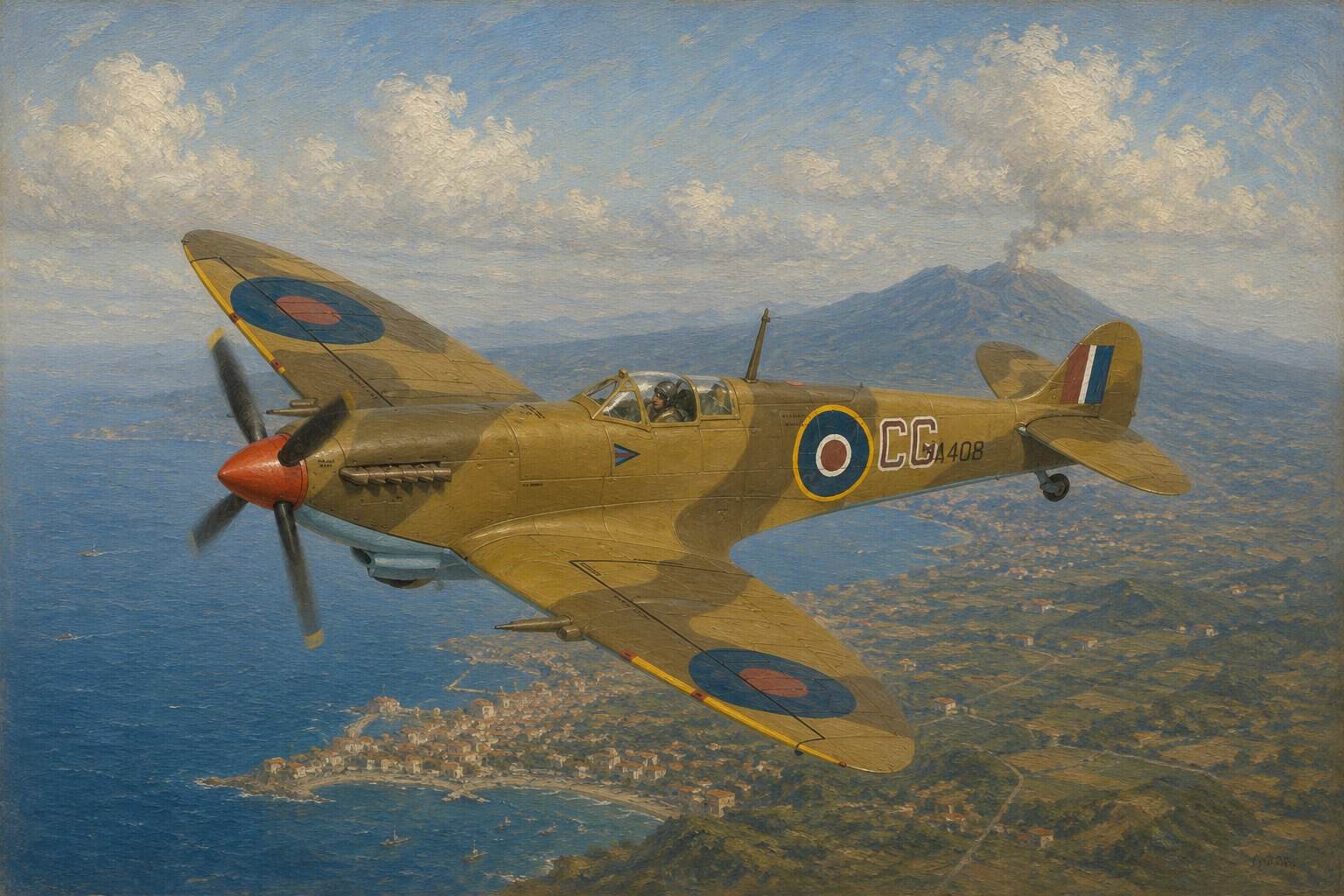
In July 1943, the Allied invasion of Sicily marked more than the next step after victory in North Africa. It was the first major attempt to carry the Mediterranean war onto European territory by combined assault, and it depended on a degree of air control that had been painfully absent in earlier campaigns. For the Royal Air Force, Sicily was not a side story to the landings. It was the culmination of lessons learned over Malta, the Western Desert and the long contest for convoy routes, ports and airfields across the central Mediterranean.
By the summer of 1943, the RAF had moved far from the overstretched position it had occupied in 1940 and 1941. It could now operate from a widening ring of North African and Maltese bases, work within a more coherent Allied command structure, and support a campaign built around air superiority, interdiction and close cooperation with sea and land forces. Operation Husky showed what that change meant in practice. Air power did not remove every difficulty, nor did it make the campaign tidy or painless. It did, however, help ensure that the landings were made against an enemy already weakened, isolated and denied the freedom to answer the assault on equal terms.
What gives Sicily its lasting importance in RAF history is that it brought several wartime developments together into a single campaign. It tested coalition air command, validated the use of sustained pre-invasion air pressure, and showed how tactical and maritime air action could shape events well beyond the immediate beachhead. In doing so, it helped open the route into Italy and confirmed that the Mediterranean had become one of the RAF’s most important theatres of operational learning.
From North Africa To Sicily
Victory in Tunisia in May 1943 transformed the Mediterranean balance. For the first time since Italy had entered the war, Allied commanders could consider moving from defence and recovery to an assault on Axis-held territory in Europe. That shift was not simply political. It rested on a new operational geography. Airfields in Tunisia, eastern Algeria and Malta brought Sicily within reach of sustained fighter cover, repeated bomber sorties and continuous reconnaissance. Earlier Mediterranean campaigns had often been fought under conditions of shortage and improvisation. Sicily was different because the Allies now had the bases, the aircraft and the accumulated experience to mount an air campaign before, during and after the landing itself.
That mattered because Sicily was chosen not only for strategic reasons, but because it was a target that Allied air power could help make vulnerable. The island sat astride the central Mediterranean, covered the route into mainland Italy and had served the Axis as a forward shield for North Africa. Once Tunisia was lost, the same central position became a liability. Sicily could be struck from several directions, its ports watched, its airfields bombed and its sea links harassed. It was close enough to be pressured every day, and important enough that such pressure would have consequences beyond the island itself.
By 1943, the command arrangements in the theatre were also stronger than they had been during the defeats in Greece and Crete. Air Chief Marshal Arthur Tedder had argued repeatedly for clearer command and better integration of air and land operations. Under the wider Allied framework in the Mediterranean, RAF experience from the desert air war helped shape a more functional system in which tactical, strategic, and coastal air tasks could be coordinated rather than competing blindly with one another. British and American air forces were not identical in doctrine or method, but Sicily showed that they could be organised around a common operational purpose.
For the RAF, this was especially important because so much of the preceding Mediterranean war had been about learning by necessity. The defence of Malta, the convoy battles at sea and the shifting battles across Libya and Egypt had taught hard lessons about range, maintenance, forward landing grounds, naval cooperation and the value of keeping enemy air forces under relentless pressure. In Sicily, those lessons were no longer separate episodes. They were fused into a single invasion plan. The campaign was therefore not just the next Mediterranean operation. It was the point at which earlier experience began to harden into a deliberate method.
Winning Air Superiority Before Husky
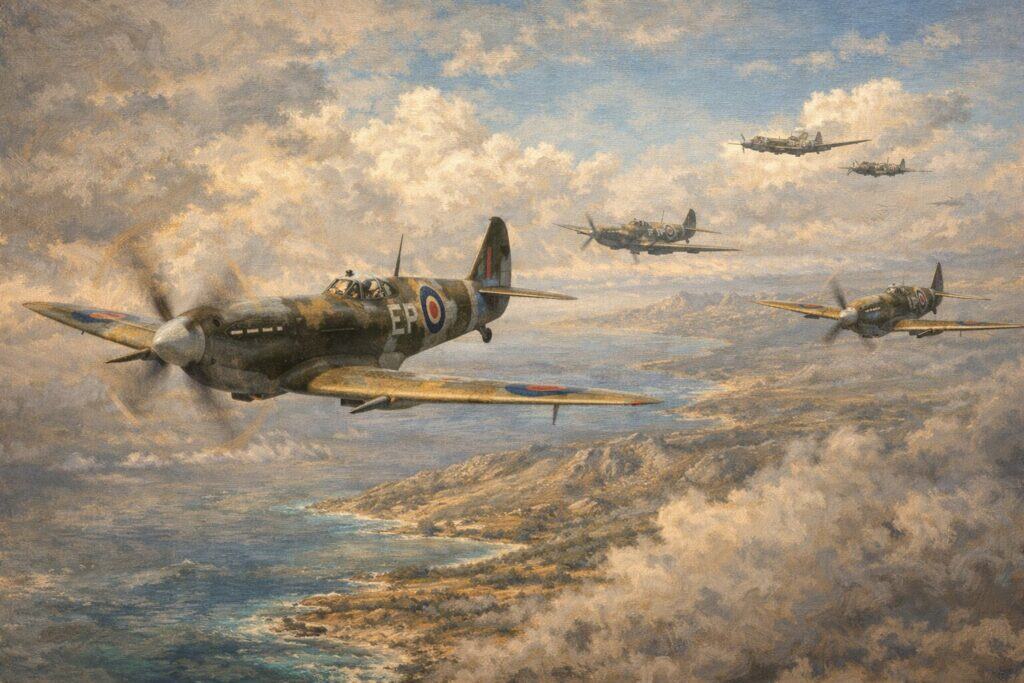
The invasion of Sicily required more than a large landing force and naval escort. It required the enemy’s air response to be reduced before the first troops went ashore. That made the preparatory air campaign central rather than supplementary. RAF and Allied aircraft attacked Sicilian airfields, port facilities and transport nodes in order to wear down the Luftwaffe and the Regia Aeronautica, disrupt repair and servicing, and force defending aircraft into a reactive posture. The object was not to produce a dramatic single-day collapse. It was to make sustained defence harder and coordinated counter-attack less likely when the invasion came.
This pressure was applied in several ways. Bombers struck air bases, harbour installations and communications by day and night. Fighters flew sweeps and escorts that imposed further strain on any attempt to contest the skies regularly. Reconnaissance aircraft fed the system by locating movement, identifying damage and showing where the enemy was trying to recover. The combined effect was cumulative. Axis air units could still fight, but they were increasingly compelled to disperse, conserve resources and operate under growing uncertainty. Every runway cratered, every workshop hit and every aircraft withdrawn to safer distance weakened the defence of Sicily at the decisive moment.
The assault on Pantelleria in June 1943 offered a stark demonstration of what concentrated air and naval pressure could achieve. The island’s surrender did not mean that every fixed position would yield in the same way, but it showed the psychological and practical force of bombardment when the defender was isolated and repeatedly struck. It also removed a forward obstacle and confirmed that pre-invasion air attack could do more than chip away at an enemy perimeter. It could force the enemy to spend time and attention on survival rather than preparation. In the weeks before Husky, that mattered greatly.
Air superiority over Sicily was never absolute in the sense of an empty sky. The Luftwaffe and its Italian partner still possessed the ability to strike, and Allied planners could not assume that the landings would pass without serious aerial interference. Yet the crucial point is that by July 1943, Axis air power was no longer free to mass at will over the objective. The weight of the preparatory campaign had reduced its room for manoeuvre. For an amphibious invasion, that was decisive. Landing ships, transport convoys and vulnerable beachheads could not be exposed to an enemy still capable of sustained and coordinated air assault.
The RAF’s contribution to this process rested on experience as much as on numbers. Mediterranean operations had shown repeatedly that the destruction of enemy air strength was rarely a matter of air combat alone. It depended on attacking bases, maintenance systems, fuel, transport and the wider infrastructure that allowed aircraft to keep flying. Sicily was one of the clearest wartime examples of that broader understanding. The battle for the air was fought not only above the island, but in workshops, dispersal areas, harbours and the transport network behind them.
Isolating The Island
If air superiority was one pillar of Husky, interdiction was the other. Sicily could not be treated as a sealed battlefield. It sat close to the Italian mainland, and the Axis retained the ability to move men, weapons and supplies across short sea routes and through an internal road and rail network that still functioned under pressure. The task of RAF and Allied air power was therefore to make the island harder to reinforce, harder to supply and harder to command. This was not merely a question of bombing obvious military objectives. It was an attempt to dislocate the entire operational system that sustained the defence.
Ports, docks and shipping were natural targets. So too were railways, marshalling yards, bridges and major road links. Coastal and maritime air operations were particularly important because they joined sea control to the land campaign. Aircraft scouting from Malta and North Africa could report movement, shadow shipping and attack the channels through which the Axis might try to restore momentum. Even when individual attacks did not produce dramatic destruction, they imposed delay, diversion and uncertainty. Supplies that arrived late, arrived scattered or arrived only at night did not serve the defence as efficiently as a regular and confident flow.
This pattern of pressure mattered because the defenders of Sicily needed not only ammunition and fuel, but time. Time was essential if reserves were to be concentrated, positions reorganised and counter-attacks prepared against the beachheads. Interdiction attacked that time directly. Air raids on rail and road movement made daylight travel dangerous and forced commanders to disperse columns, hide vehicles and accept slower movement between sectors. The military value of that pressure was often greater than the immediate physical damage visible after any one strike. It broke the rhythm. In a fast-moving campaign, broken rhythm could decide whether a reserve arrived as a formed threat or as a late and fragmented residue.
The RAF’s Mediterranean experience gave it particular authority in this kind of work. Desert campaigning had already shown that air attack against transport, supply columns and rear-area movement could weaken the enemy before the main ground encounter. Sicily brought those lessons into a more compressed environment where coastlines, ports and inland communications were crowded together. Maritime strike, tactical bombing, and reconnaissance all served the same purpose. Instead of treating sea, land and air as separate compartments, the campaign used air power to bind them into one operational picture.
The result was not perfect isolation. The Axis retained channels of movement, and some reinforcement and supply still got through. Sicily was too close to the mainland and the straits too narrow for any simple claim of total severance. But perfection was not the standard required. What mattered was that by invasion day the defenders faced a battlefield in which movement had become difficult, organisational recovery had become slower and any attempt at swift concentration had to be made under constant threat from the air. That condition gave the landing forces a far better chance than they would otherwise have possessed.
The Landings And The Battle Inland
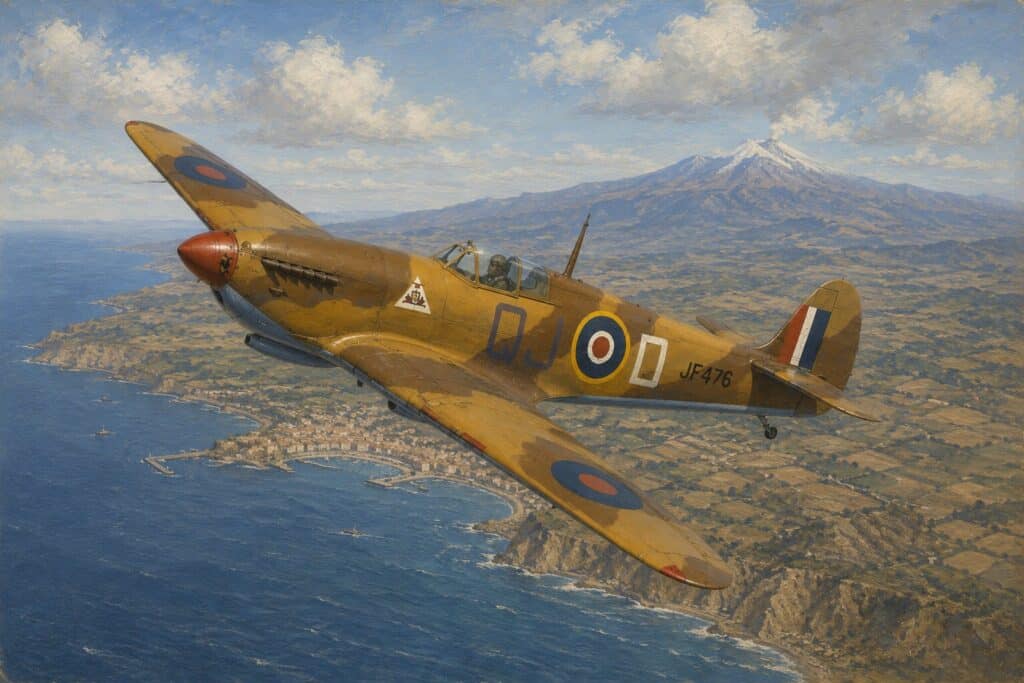
When the invasion began on 10 July 1943, the weather and the complexity of combined operations quickly showed that even the best prepared plan could not unfold neatly. Strong winds disrupted airborne operations, scattered men and equipment and contributed to confusion at precisely the point where timing mattered most. Yet the fact that such confusion did not become a wider disaster owed much to the earlier air campaign. The invasion fleet was not entering a contested sky on equal terms. It was moving under conditions that RAF and Allied air power had worked to shape over many preceding weeks.
During the assault phase, fighters and fighter-bombers helped protect the beaches, the anchorage areas and the shipping routes on which the invasion depended. Bombers and tactical aircraft were used against airfields, transport routes and troop concentrations that might support an immediate Axis response. Some of this work looked indirect compared with the dramatic image of aircraft attacking strongpoints close behind the shore. In practice, indirect pressure was often the more important contribution. The greatest value of air power lay in reducing the enemy’s ability to move, coordinate and sustain resistance, not in promising that every local obstacle would be blasted away on demand.
As the ground battle moved inland, the character of air support shifted with it. Sicily’s terrain did not always favour easy observation or clean target identification. Broken country, dust, smoke and rapidly changing front lines all complicated close cooperation. German forces in particular proved capable of stubborn local defence and disciplined withdrawal, especially when operating on terrain that restricted observation and channelled movement. This meant that air power could feel less immediately decisive to troops facing a well-sited position than grand strategic descriptions might suggest. Yet its operational effect remained substantial. Units moving by day, columns attempting to regroup, and supply systems trying to keep pace all did so under conditions of persistent threat.
The campaign also demonstrated how far the methods developed in the Western Desert could be adapted beyond open desert fighting. There had been much debate earlier in the war about how best to link aircraft to fast-moving ground operations. Sicily showed that tactical air support worked best when it was part of a wider campaign design: fighters seeking local superiority, bombers striking communications, reconnaissance supplying current information, and forward staffs helping translate ground requirements into air priorities. The RAF’s contribution lay not only in the aircraft overhead, but in the command habits that made those aircraft part of a coherent system.
By the later stages of the fighting, as Allied forces pressed westward and then towards the north-eastern corner of the island, air pressure continued to shape the terms of battle. Roads leading towards the Etna positions and the approaches to Messina came under repeated attention. The defenders were not paralysed, and the campaign remained a real contest rather than a procession. Even so, Sicily increasingly showed what happened when an army had to fight while its movement, supply and freedom of concentration were continually constrained from above. The landings were only the beginning. What followed was a campaign in which air power kept narrowing the enemy’s options.
Air Power, Friction And Coalition War
Sicily was a success, but it was not a flawless demonstration. One reason the campaign matters is that it revealed both the strengths and the limits of wartime air power at a moment of growing Allied confidence. The airborne operations exposed serious problems of navigation, timing and identification. Later friendly-fire incidents, rooted in tension, confusion and inadequate recognition under combat conditions, showed that even forces enjoying broad air superiority could still struggle badly with coordination. These were not marginal details. They were reminders that combined operations placed huge demands on training, discipline and communication.
The coalition framework added further complexity. RAF commanders and staff officers were now operating within a large Anglo-American system that had improved markedly since earlier Mediterranean failures, but still contained competing pressures, different habits, and unavoidable friction. Priorities had to be balanced between the immediate needs of the armies ashore, the continuing suppression of enemy air power, attacks on transport and the wider responsibilities of the Mediterranean theatre. The achievement of the campaign lay not in the absence of these tensions, but in the ability to manage them well enough to keep the air effort focused on its main operational purpose.
There were also hard limits to what interdiction could accomplish, most clearly seen in the campaign’s final phase. The Axis evacuation across the Strait of Messina was conducted under pressure, but not prevented outright. Geography helped the defenders. Short crossing distances, strong local flak, careful organisation and the difficulty of maintaining constant destructive pressure over every movement corridor allowed a substantial withdrawal to take place. This did not cancel the value of Allied air operations. It did, however, show that even powerful air forces could not automatically close every escape route or turn battlefield pressure into total destruction.
That point matters because it keeps Sicily in proportion. The campaign was not a simple morality tale in which air power solved all problems once the correct doctrine had been found. Rather, it showed that air superiority and interdiction created conditions in which a combined invasion could succeed more readily and at lower risk. They reduced enemy options, weakened enemy reaction and magnified the effect of Allied movement and mass. They did not abolish terrain, friction, error or the enemy’s remaining skill.
For the RAF, those lessons were valuable in themselves. By 1943, the Service had moved beyond the stage at which Mediterranean operations were dominated by emergency. In Sicily, it helped operate a mature campaign system that linked engineers, maintenance, intelligence, reconnaissance, mobile air staffs and tactical flying units. That institutional maturity was one of the most important results of the Mediterranean war. Sicily made it visible because the campaign demanded not isolated brilliance, but repeated competence across an entire combined theatre.

Sicily And The Road Into Italy
The capture of Sicily had consequences out of proportion to the island alone. It helped shatter the remaining sense of Axis security in the central Mediterranean and contributed directly to the political crisis that overtook Mussolini’s regime. More immediately, it opened the route to mainland Italy. Airfields on and around Sicily extended Allied reach over Calabria, southern Italy and the approaches to later landings. What had been an objective became a base. For the RAF, that change was crucial. Sicily did not conclude a campaign. It enabled the next one.
This was why the island mattered so much in the larger history of the war. North Africa had been a proving ground; Sicily was a transition. It showed that the air methods refined in the Mediterranean could support amphibious invasion against a defended European objective and then carry the offensive onward. The pattern would continue to evolve, but the essentials were already clear: command of the air as a condition of action, interdiction as a means of shaping the land battle before and during contact, and flexible cooperation among tactical, maritime, and wider-theatre air forces.
Sicily also confirmed that the RAF’s wartime effectiveness could not be reduced to a single famous front or a single aircraft type. The campaign depended on fighters, fighter-bombers, bombers, reconnaissance aircraft, transport support, signals, maintenance and the steady labour of ground organisation. It depended on Malta’s survival, on the lessons of the desert and on the command reforms that made those lessons usable in a larger Allied framework. In that sense, Sicily belongs not only to the story of invasion, but to the story of institutional growth within the wartime RAF.
The route into Italy would bring new problems: mountainous terrain, harsh weather, stubborn German defence, and the long grind of a campaign that never offered the clarity of a single decisive breakthrough. Even so, Sicily had already settled one crucial question. It had shown that Allied forces could use sustained air pressure to create the conditions for a major amphibious assault in the Mediterranean and then exploit the result. For a Service that had spent so much of the war learning through strain and reversal in the same theatre, that was a major point of arrival.
Conclusion
The invasion of Sicily was the campaign in which RAF and Allied air power translated Mediterranean experience into operational control. By reducing Axis air strength, isolating movement, protecting the landings and sustaining pressure inland, the RAF helped make Husky a practical success rather than an ambitious gamble. The island did not settle every argument about air power, and the escape through Messina showed what remained difficult. Yet the road into Italy was opened by forces that had learned, often painfully, how to turn command of the air into command of events below. In that sense, Sicily stands as one of the clearest Mediterranean proofs of what the wartime RAF had become by 1943.