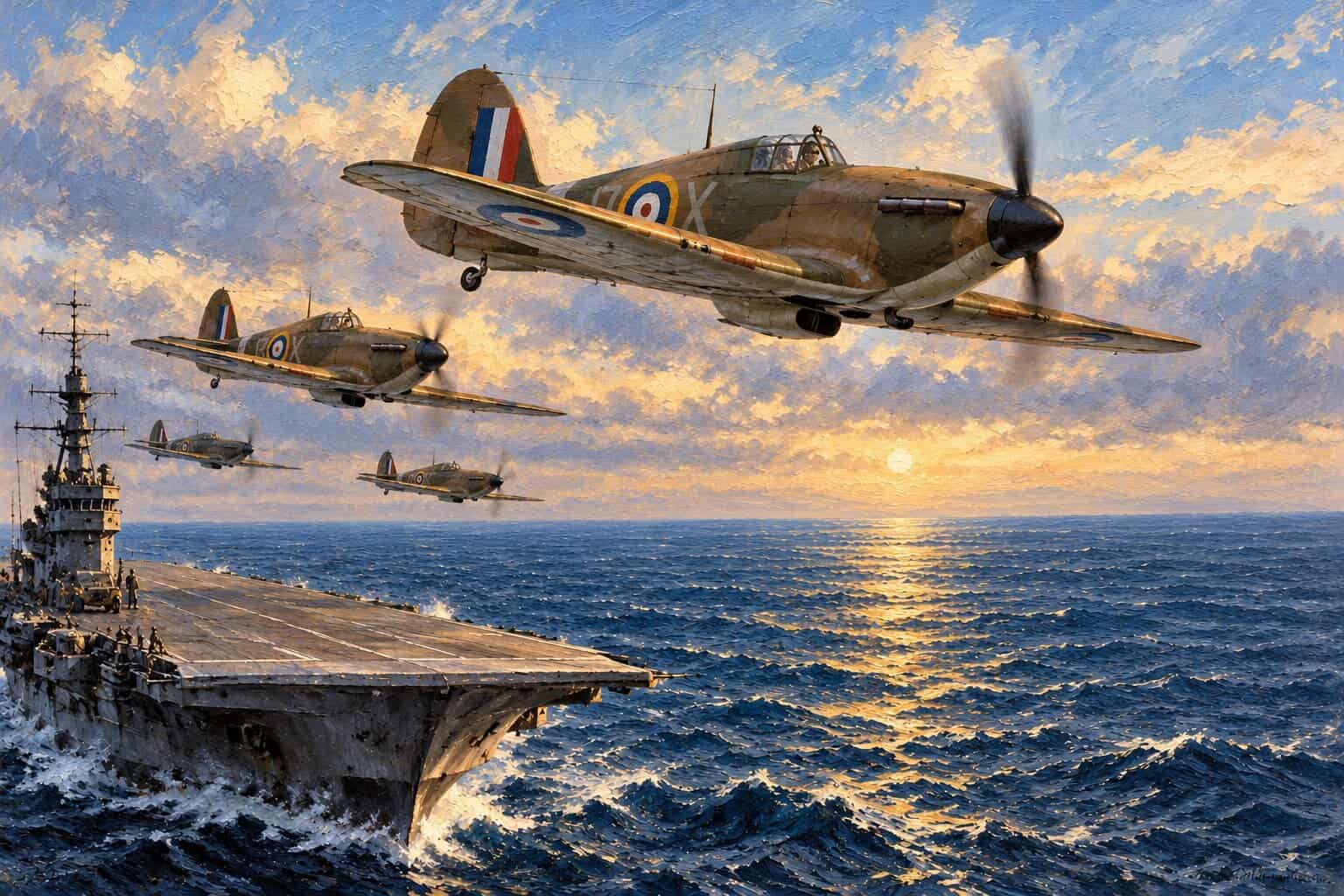
On 17 November 1940, Operation White launched twelve Hurricane fighters from HMS Argus towards Malta. Eight exhausted their fuel before reaching the island and ditched in the Mediterranean. Four arrived, bringing a small reinforcement to the island’s air defences after a delivery flight that had consumed substantial naval and air resources.
The operation joined RAF reinforcement needs to the Royal Navy’s ability to carry aircraft across the western Mediterranean. Its outcome exposed the narrow margins governing a long over-water ferry flight, where navigation, cruising speed and the carrier’s launch position all affected the prospect of reaching land.
A carrier route to Malta
Malta’s position offered Britain a base for reconnaissance and attacks against Italian communications with North Africa. Maintaining that role required fighters to protect the island and the facilities supporting its aircraft. In late 1940, strengthening Malta formed part of the wider effort to sustain British forces across the Mediterranean.
The collapse of France had closed a route previously used to send short-range aircraft southwards. For Malta, carrying fighters aboard an aircraft carrier and launching them within flying distance offered a practical means of delivery. HMS Argus had already demonstrated the method during Operation Hurry: on 2 August, all twelve Hurricanes dispatched from her reached the island.
The Hawker Hurricane was therefore both an urgently needed reinforcement and an aircraft whose transfer demanded careful coordination. Ships carried the fighters through the first stage of the journey; pilots then completed the final passage to Malta under their own power.
The launch on 17 November
Argus reached Gibraltar on 14 November with twelve Hurricanes aboard. Force H sailed the following day to cover their delivery. The original intention was to launch from a suitable position south of Sardinia, following the broad pattern established in August.
Reports of an Italian naval concentration south of Naples influenced Admiral James Somerville’s decision to release the aircraft farther west, within their assessed safe operational range. The chosen position added distance to the flight and reflected the competing demands of delivering the fighters and protecting the naval force.
Just before dawn on 17 November, the Hurricanes took off in two flights, each led by a Fleet Air Arm Skua. The Hurricanes were launched about 30–40 miles west of the positions used for Operation Hurry, leaving approximately 400 nautical miles to fly. HMS Ark Royal supplied fighter cover and anti-submarine patrols during the launch.
Fuel exhaustion over the Mediterranean
Additional navigation assistance had been arranged near Galita Island. A Sunderland was to meet the first flight, while a Glenn Martin reconnaissance aircraft was assigned to the second. The Glenn Martin waited for more than an hour at the rendezvous; the second flight continued without establishing contact, and its aircraft failed to reach Malta.
The first flight also suffered losses close to its destination. Two Hurricanes exhausted their fuel within 25 and 34 miles of Malta respectively. The Sunderland rescued one of their pilots. Four Hurricanes and one Skua reached the island with their fuel almost exhausted.
Across the delivery, eight Hurricanes were lost through fuel exhaustion and ditching. Faulty navigation and uneconomical cruising speeds contributed to the wider aircraft losses. Combined with the more distant launch position, route-finding difficulties and fuel consumption left little margin for error.
A reduced reinforcement
Malta received four of the twelve fighters dispatched. Operation White demonstrated how a naval movement and a successful carrier launch could still yield a severely diminished reinforcement at the destination.
The August delivery had established the value of carrier-assisted ferrying. November exposed the precision that the method required: the naval commander’s assessment of danger at sea had to remain compatible with the aircraft’s practical endurance and the pilots’ ability to find their route. For Malta’s defenders, the immediate consequence was concrete: eight expected fighters were lost during the journey, leaving four to strengthen the island’s air defence.