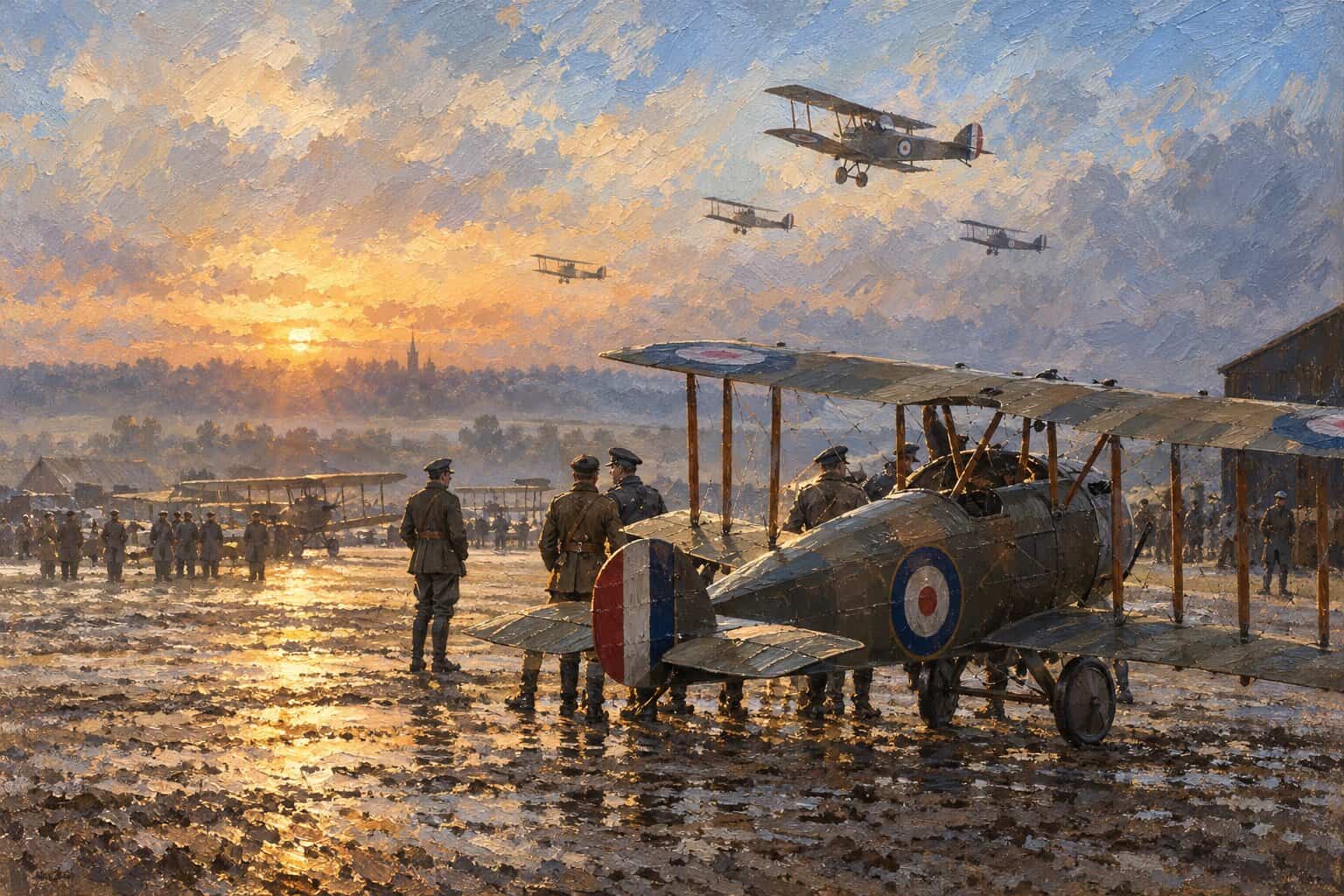
On 11 November 1918, at 11:00, the Armistice with Germany brought hostilities on the Western Front to an end. For the Royal Air Force, the cessation of fighting closed its first wartime campaign as an independent service. Created on 1 April, it had reached the Armistice after little more than seven months, carrying forward the experience of the Royal Flying Corps and Royal Naval Air Service.
The agreement signed at Compiègne established a ceasefire and terms for Germany’s military withdrawal and disarmament. The formal peace settlement followed with the Treaty of Versailles in 1919. For the RAF, 11 November marked the immediate transition from wartime operations against Germany towards the responsibilities and uncertainties of the post-war period.
The ceasefire takes effect
The appointed hour gave the Armistice a precise operational meaning: hostilities were to cease at 11:00. Across the Western Front, the campaign that had demanded reconnaissance, artillery observation, bombing and fighter patrols reached its conclusion. Aircraft had become part of the machinery through which armies found the enemy, directed fire and contested movement above the battlefield.
For air personnel, the date therefore ended a sustained period of combat service. The experience belonged to aircrew and to the ground organisation that kept aircraft supplied, repaired and available for operations. The Armistice also brought the losses of the wartime flying services into sharper focus, as survivors faced the return from war and families continued to live with its consequences.
Seven months of an independent service
The creation of the Royal Air Force as a separate service had united the Royal Flying Corps and Royal Naval Air Service on 1 April 1918. Their squadrons, personnel and accumulated operational knowledge formed the foundation of the new organisation.
That inheritance gave the RAF a history of wartime experience extending back to 1914. The Royal Flying Corps had developed close working relationships with the Army, while the Royal Naval Air Service brought experience of naval aviation, home defence and bombing. Their amalgamation placed these responsibilities within a single air service, supported by an Air Ministry.
The Armistice arrived while this institutional change was still recent. The RAF had demonstrated the breadth of its wartime responsibilities, and its future organisation would now be shaped by the demands of peace and reduced expenditure.
The scale of the RAF at the Armistice
At the Armistice, the RAF held 22,647 aircraft of all types at the Armistice, including about 3,300 on first-line strength, together with 103 airships. By this measure, the RAF stood as the world’s largest air force.
These figures describe different levels of strength. The total aircraft holding captures the scale of the entire organisation; the first-line figure identifies a much smaller operational component. Read together, they show the substantial resources required to sustain a fighting air service, with frontline aviation supported by a wider establishment.
The distinction is central to understanding the RAF’s position in November 1918. Its size represented the accumulated requirements of a major war and the expansion of aviation across several military functions. Peace would bring a rapid contraction of that establishment.
From wartime strength to a peacetime future
Demobilisation became an immediate part of the RAF’s aftermath. Personnel returned to civilian life, and the service faced decisions over the forces, training arrangements and administrative structures it would retain. Its continued existence as an independent organisation became a central institutional question.
The RAF emerged from the First World War with an extraordinary operational inheritance, but its wartime strength could not be maintained in peacetime. The Armistice began a period of rapid contraction in personnel and aircraft, accompanied by debate over the service’s future. Although its size and responsibilities would change dramatically, the RAF survived as an independent armed service, carrying the experience of the RFC and RNAS into a new era of British aviation.