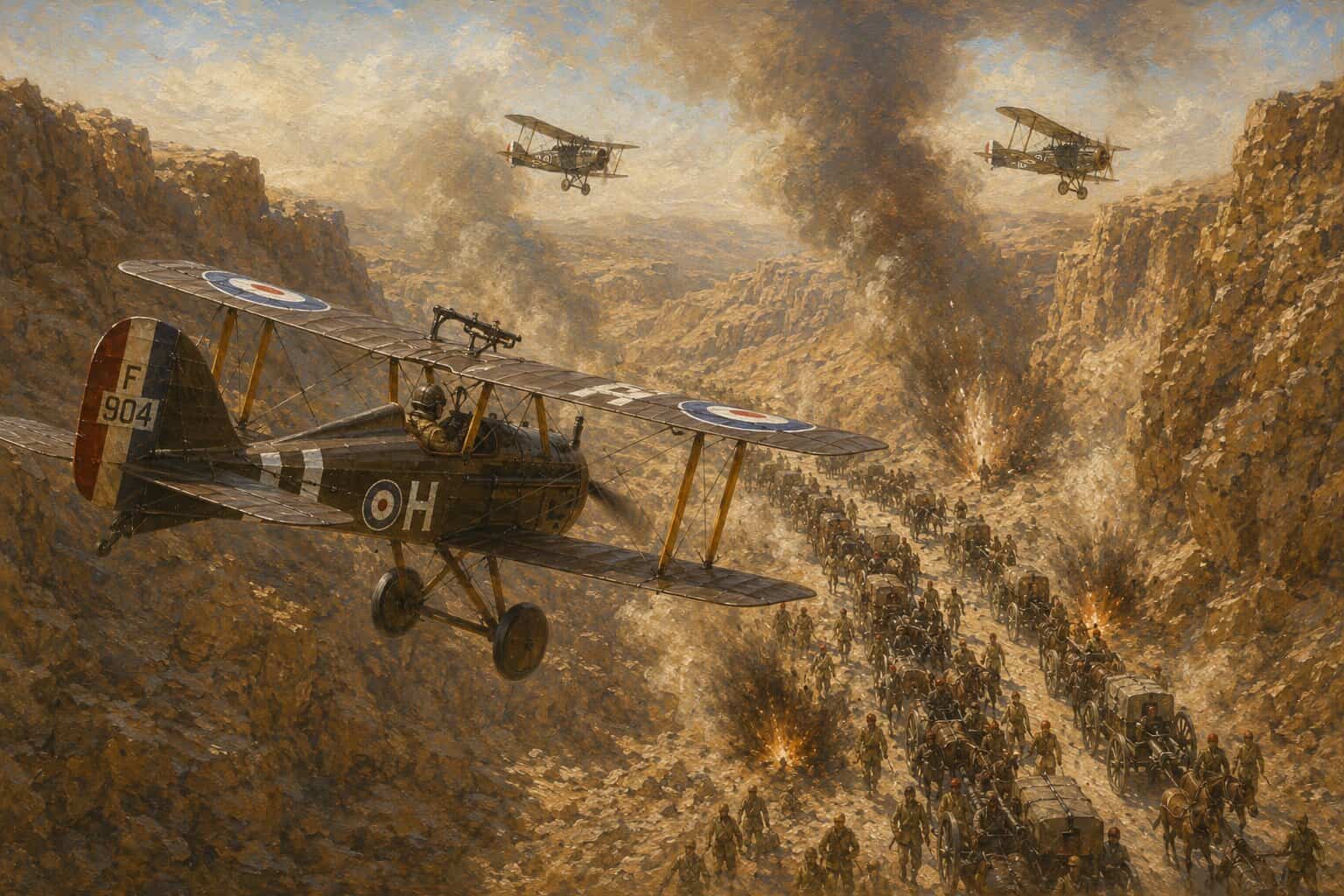
On 21 September 1918, Royal Air Force aircraft attacked the retreating Turkish Seventh Army at Wadi el Far'a during General Allenby's Palestine campaign. The road system there had become congested with troops, transport, and vehicles attempting to withdraw, creating an exposed target for repeated air attack. The result was more than local disruption. RAF action helped turn a retreat into a destructive rout and demonstrated how air power, when applied at the right moment against a vulnerable enemy column, could produce effects far beyond the immediate strike itself.
The Palestine Campaign Setting
The episode came in the closing phase of a successful Allied offensive in Palestine. Allenby's advance had placed Ottoman forces under growing pressure, and once retreat began, the problem was no longer simply one of movement to the rear. A retreating army depended upon roads, order, and timing. If those were broken, withdrawal could quickly become confusion.
Wadi el Far'a offered exactly the sort of bottleneck in which that danger was magnified. Men, animals, transport, and equipment moving along constrained routes were vulnerable not only because they were visible, but because congestion reduced their ability to disperse or recover. Under such conditions, aircraft could impose a kind of battlefield pressure disproportionate to their numbers, especially when attacks were repeated and coordinated.
Air Attack On A Retreating Column
The RAF strikes at Wadi el Far'a were effective because they hit an enemy already under strain. This was not a case of aircraft acting in isolation from the campaign around them. Ground success had forced the retreat; air attack intensified its consequences. By striking packed roads and transport, RAF crews helped convert military withdrawal into disorder and loss.
That distinction is important. A retreating force may preserve cohesion if it can continue moving, reform, and protect its communications. Once the route itself becomes a zone of attack and blockage, command and control begin to weaken. Transport is lost, movement slows, and panic can spread faster than orders. Aircraft were particularly suited to exploiting such a moment because they could revisit the target, identify concentrations, and strike where congestion made escape difficult.
A Demonstration Of Operational Effect
The action at Wadi el Far'a is often remembered because it showed the Royal Air Force exercising a growing operational influence during the First World War. Air power here was not merely observing the battlefield or harassing the enemy at the margins. It was helping to shape the outcome of a retreat within a wider campaign. That represented an important development in how aircraft could be used in combination with land operations.
By 1918, the value of air support was becoming clearer across several theatres, but this episode provided a particularly vivid example. A congested line of withdrawal was precisely the kind of target against which aircraft could multiply the effects of success already achieved on the ground. The RAF did not win the campaign alone, yet it contributed materially to the destruction of an enemy force already in difficulty.
Why Wadi el Far'a Matters
Wadi el Far'a deserves attention because it links tactical action to campaign outcome with unusual clarity. The strikes were not significant merely because they inflicted damage. They mattered because they helped prevent an organised retreat, thereby deepening the success of Allenby's offensive.
For RAF history, the episode stands as a strong illustration of the service's maturing wartime role. It showed that aircraft could do more than support operations at the edges. Used against the right target at the right moment, they could disrupt movement, break cohesion, and contribute directly to decisive results on the ground. That is why the attacks at Wadi el Far'a remain one of the clearest First World War examples of coordinated air power turning retreat into rout.