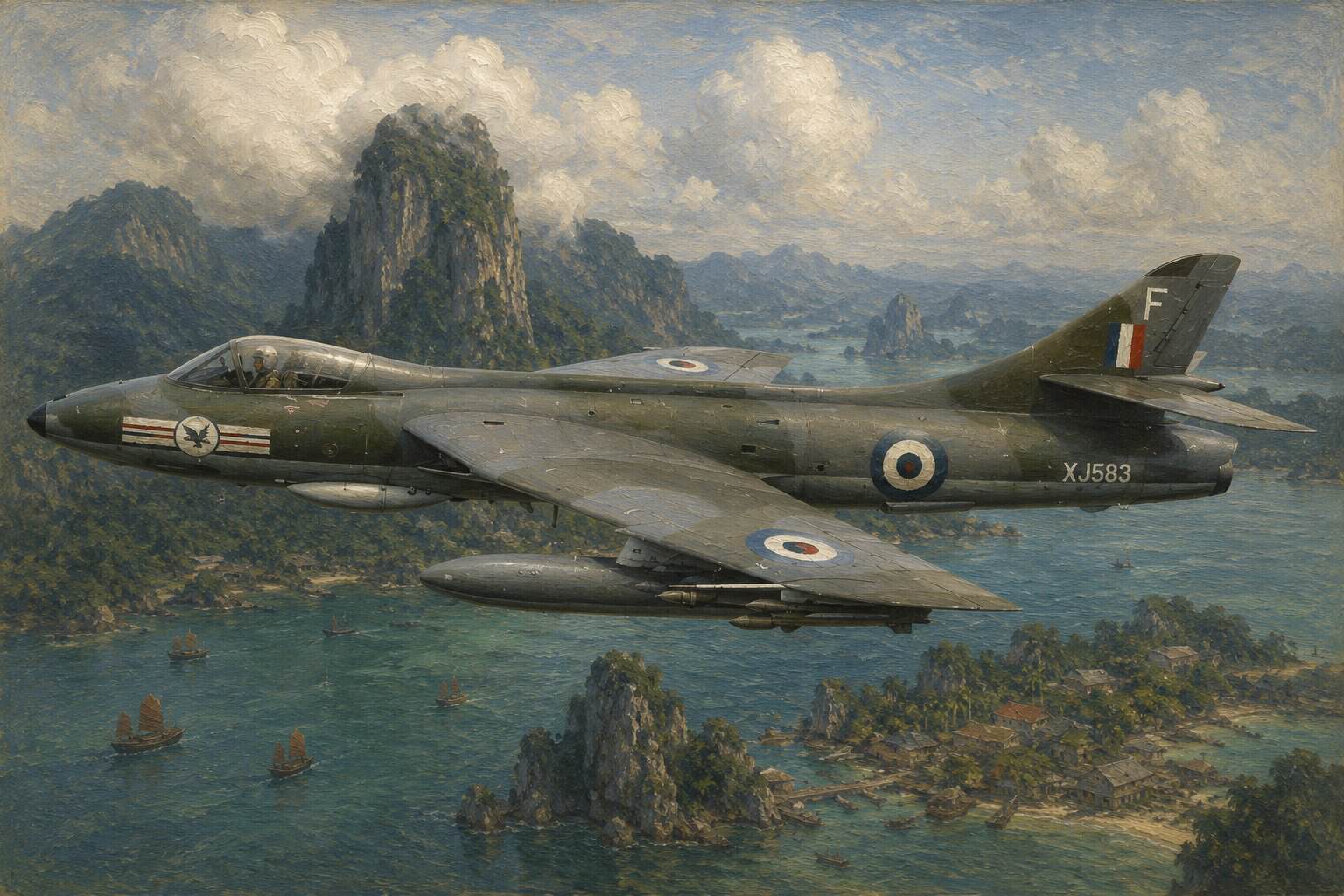
On 31 October 1971, the RAF’s Far East Air Force was disbanded at Changi, Singapore. Its closure marked a decisive stage in Britain’s withdrawal from its extensive permanent military establishment East of Suez. A command that had directed major post-war RAF commitments in South-East Asia reached its final day as regional defence passed into a new multinational framework.
The transition had developed over several years through the reduction of forces and the rundown of stations. By the time Far East Air Force closed, a joint air-defence system for Malaysia and Singapore was already operational. Britain’s continuing involvement would rest on cooperation with regional and Commonwealth partners.
A command shaped by regional conflict
Far East Air Force acquired its post-war title on 1 June 1949, when Air Command Far East was renamed. Its responsibilities brought together RAF forces serving across a wide region, supported by a substantial network of bases. The command provided the organisation through which Britain sustained air operations far from the United Kingdom.
The Malayan Emergency and the Indonesian Confrontation were central to its operational history. These commitments required sustained air support within demanding regional conditions and tied the RAF closely to the security of Malaya and, subsequently, Malaysia. They also gave the command a role extending across successive changes in the region’s political settlement.
During the Indonesian Confrontation, No. 20 Squadron operated Hawker Hunters from RAF Tengah, illustrating the fighter presence maintained under Far East Air Force during the regional crisis.
Its importance lay in the combination of operational forces, bases and headquarters that could maintain that commitment over time. The disbandment therefore represented a significant contraction of the RAF’s overseas command structure. The institution closing at Changi had embodied a period when Britain maintained a large permanent air presence in South-East Asia.
Withdrawal East of Suez
The wider East of Suez withdrawal reshaped the military establishment on which Far East Air Force depended. Changes to individual squadrons and stations took place during the preceding years, gradually reducing the scale of the British presence. The command’s final day provided a clear institutional milestone within that longer process.
For the RAF, the change concerned both the size of its overseas establishment and the way regional responsibilities were organised. A permanent British command was giving way to arrangements shared with other states. Malaysia and Singapore’s defence remained an active concern as the older headquarters structure approached closure.
Air defence under a new framework
Preparations for the successor system preceded the disbandment. Headquarters for the Integrated Air Defence System had been formed at Butterworth on 11 February 1971. On 1 September it assumed air-defence responsibility for Malaysia and Singapore, establishing an operational framework while Far East Air Force still existed.
The Five Power Defence Arrangements entered into force on 1 November 1971, the day after the command closed. They linked Britain with Australia, New Zealand, Malaysia and Singapore in a continuing defence relationship. The sequence placed the Changi disbandment between the assumption of air-defence responsibilities by the integrated system and the formal commencement of the five-power arrangements.
Far East Air Force’s closure thus marked a change in the organisation of British air power and regional security. The large permanent RAF command structure had reached its end, while the integrated headquarters at Butterworth and the five-power partnership provided a basis for continued cooperation. A much reduced RAF presence survived in the region, including commitments in Hong Kong and Singapore, but Britain’s former Far East Air Force command had ceased to exist.