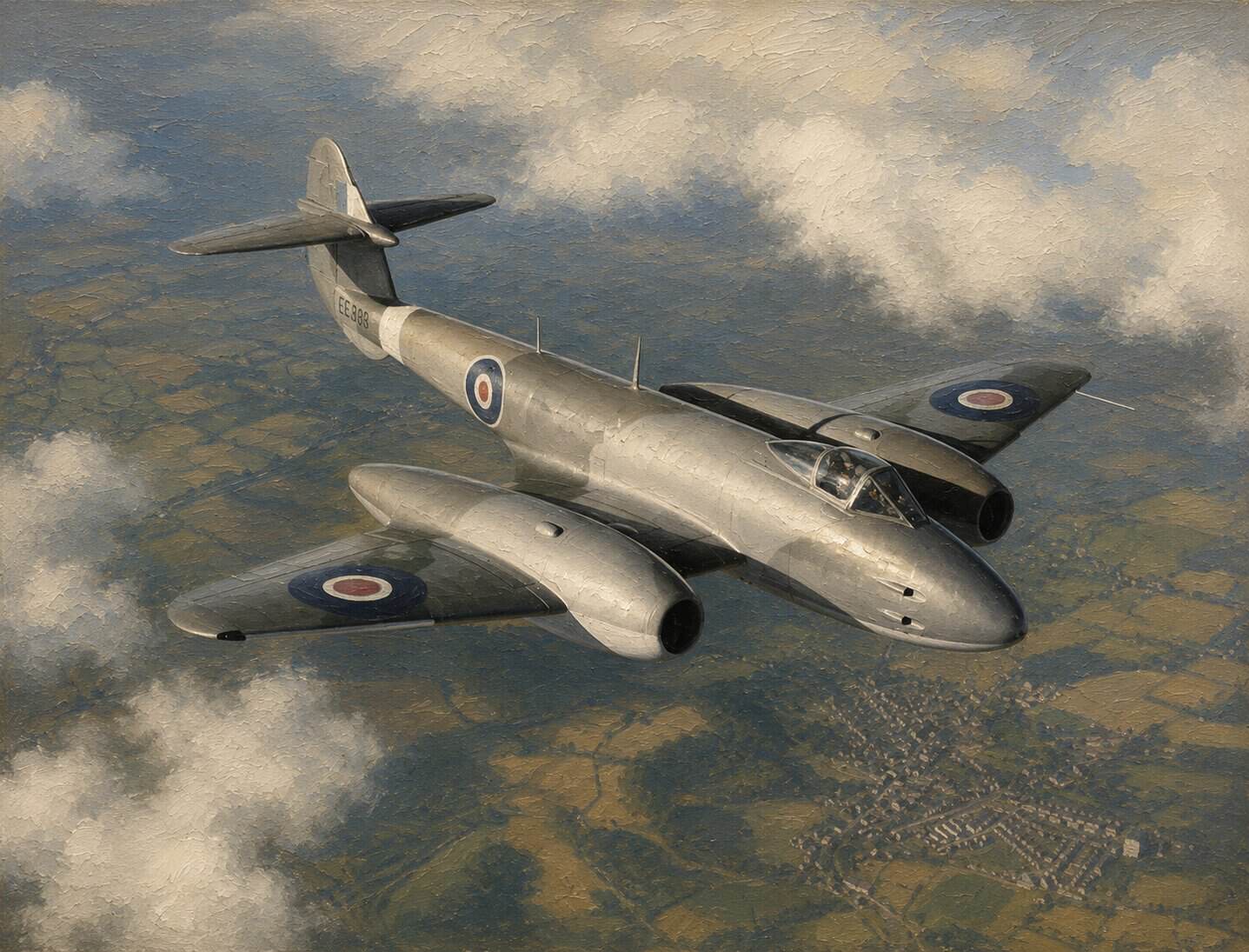
On 7 November 1945, Group Captain H. J. Wilson set a new world air speed record in a specially prepared Gloster Meteor over the Kent coast. Flying the specially prepared F.4, serial EE454, along the measured course between Herne Bay and Reculver, he achieved an officially recognised average of approximately 606 mph. The flight established the first officially recognised world speed record by a jet aircraft.
The achievement placed an RAF pilot and a British jet fighter at the head of the recognised international speed record. Only months after the end of the war in Europe, the Meteor was demonstrating how rapidly wartime jet development could be carried forward into higher performance.
Timed runs over the Kent coast
Wilson flew four timed runs over the official measured course, with passages in opposite directions to counter the influence of wind. His average of approximately 606 mph secured the record. Gloster chief test pilot Eric Greenwood also flew a Meteor over the course that day, averaging approximately 603 mph, demonstrating the performance achieved by both specially prepared aircraft.
This method gave the attempt a defined technical purpose. A favourable wind on one run would be balanced by the return direction, while the measured distance provided a common basis for calculating speed. Repeated passages over the course brought aircraft preparation, accurate flying and official measurement together in a single test.
The attempt drew on cooperation between the RAF and the Gloster Aircraft Company. Wilson’s flying translated the prepared Meteor’s performance into an officially recognised result, while the measured Kent coastal course provided the setting for a milestone in jet-powered flight.
From wartime fighter to record aircraft
The Meteor had entered service as Britain’s first operational jet fighter. Its development linked the wartime introduction of jet propulsion with the RAF’s emerging post-war equipment. The F.4 offered substantially greater performance than the wartime F.3, and the aircraft used for the record was specially prepared for high-speed flying.
EE454 therefore represented a particular stage in the type’s development. Its record demonstrated the performance available from a prepared example of the new generation. Squadron service involved a wider range of demands, including handling, endurance, armament and reliable operation, each of which shaped the practical value of a fighter.
For the RAF, the attempt also gave experienced service flying a prominent place in the development programme. Aircraft design and preparation supplied the capability; the pilot had to deliver it consistently over the measured course. The resulting average above 600 mph made the gains of jet propulsion visible in a widely understood form.
A new chapter in the world speed record
Wilson’s flight transferred the officially recognised world air speed record from piston-engined aircraft to jet propulsion. The previous record, set by Fritz Wendel in a Messerschmitt in April 1939, had stood at approximately 469 mph. Wilson’s Meteor raised the recognised figure by more than 130 mph, demonstrating the scale of the advance achieved by jet propulsion.
Development continued rapidly. In September 1946, Group Captain Edward Donaldson raised the record again in a Meteor, carrying the type’s high-speed programme into its next stage. Wilson’s November 1945 flight remained the first officially recognised jet world speed record, an identifiable achievement within that continuing progression.
The timed runs off Kent joined Britain’s wartime jet-fighter development to the post-war pursuit of higher speed. At approximately 606 mph, the Meteor had secured the world record and established jet propulsion as the means by which its next advances would be made.