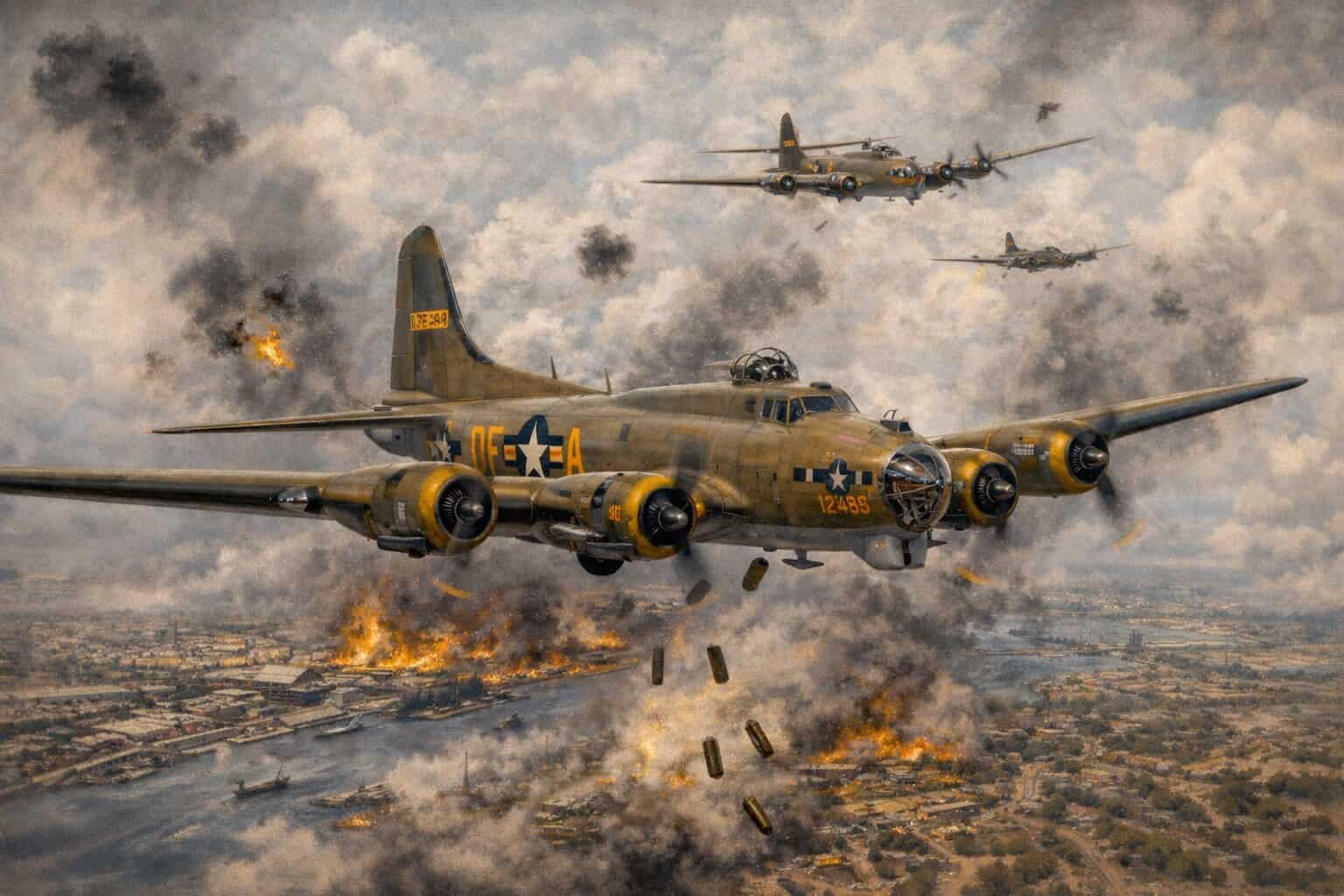
On 27 January 1943, heavy bombers of the United States Eighth Air Force carried out their first attack on targets within Germany itself, striking the port and industrial area of Wilhelmshaven. The raid marked the opening of America’s strategic air offensive against the Reich and represented a significant development in the Allied air war over Europe.
By early 1943, the Combined Bomber Offensive was taking shape. British Bomber Command had already conducted extensive night bombing operations against German cities and industrial centres. The arrival and expansion of American heavy bomber forces in the United Kingdom introduced a complementary approach: daylight precision bombing conducted by heavily armed formations.
The Casablanca Conference, which had concluded only days earlier, had formalised Allied commitment to intensified air operations against Germany. Within this strategic framework, the 27 January mission formed a practical beginning to sustained American participation in the strategic bombing campaign.
Planning and Objectives
Wilhelmshaven was selected as a target due to its naval and industrial significance. The port had long served as a base for German naval forces and housed shipyards and processing facilities that supported the war effort. Although the RAF had previously attacked the town, the 27 January raid represented the first time American heavy bombers struck a target within Germany proper.
The attacking force comprised Boeing B-17 Flying Fortress aircraft of the Eighth Air Force. These four-engined bombers were designed to operate at high altitude in tight defensive formations, relying on multiple machine guns for mutual protection against fighter attack. American doctrine emphasised daylight bombing with the expectation that concentrated defensive firepower would reduce vulnerability.
The mission required a long overwater flight across the North Sea before reaching the German coast. Weather conditions and navigational accuracy were important considerations, particularly given the distances involved and the need to maintain formation integrity.
The Attack on Wilhelmshaven
On 27 January, the bomber formation approached Wilhelmshaven and released its bomb load over the designated target area. German air defences responded with anti-aircraft fire and fighter interception. The raid resulted in damage to port and industrial installations, though the extent of the destruction was limited compared with later large-scale offensives.
American aircraft sustained losses during the operation. Several bombers were shot down or damaged by German fighters and flak, underscoring the risks inherent in daylight penetration of defended airspace. Nonetheless, the majority of the attacking force returned to base, and the mission was considered operationally significant.
The raid demonstrated that the United States Army Air Forces were prepared to carry the air war directly to German territory. It also provided early insight into the challenges of deep-penetration daylight bombing without long-range fighter escort.
Immediate and Longer-Term Consequences
The attack on Wilhelmshaven marked the beginning of an expanding American strategic bombing effort. In the months that followed, the Eighth Air Force would conduct additional raids against industrial, naval, and transportation targets within Germany and occupied Europe. The campaign would evolve as operational experience highlighted both the potential and the limitations of daylight bombing tactics.
The RAF and USAAF pursued complementary strategies: Bomber Command continued its large-scale night area bombing, while the USAAF sought precision strikes by day. Coordination between the two air forces became central to the Combined Bomber Offensive, which aimed to weaken German industrial capacity and degrade the Luftwaffe.
The losses experienced on 27 January foreshadowed the heavy casualties that would accompany unescorted daylight raids later in 1943. These experiences ultimately influenced the development and deployment of long-range escort fighters, which would prove decisive in gaining air superiority.
Significance in the Wider Air War
The events of 27 January 1943 represent a turning point in the European air campaign. With American heavy bombers now striking targets inside Germany, the strategic bombing offensive entered a new phase. The combined efforts of RAF Bomber Command and the USAAF increasingly subjected German industry and infrastructure to sustained attack.
For the RAF, the American entry into large-scale strategic bombing provided both reinforcement and partnership. The integration of daylight and night operations expanded the scale and continuity of pressure on the Reich.
In the broader history of the Second World War, the first USAAF attack on Germany signalled the full engagement of American air power in the European theatre. The raid on Wilhelmshaven stands as the opening act of a prolonged and intensifying air offensive that would shape the course of the war in the years to follow.