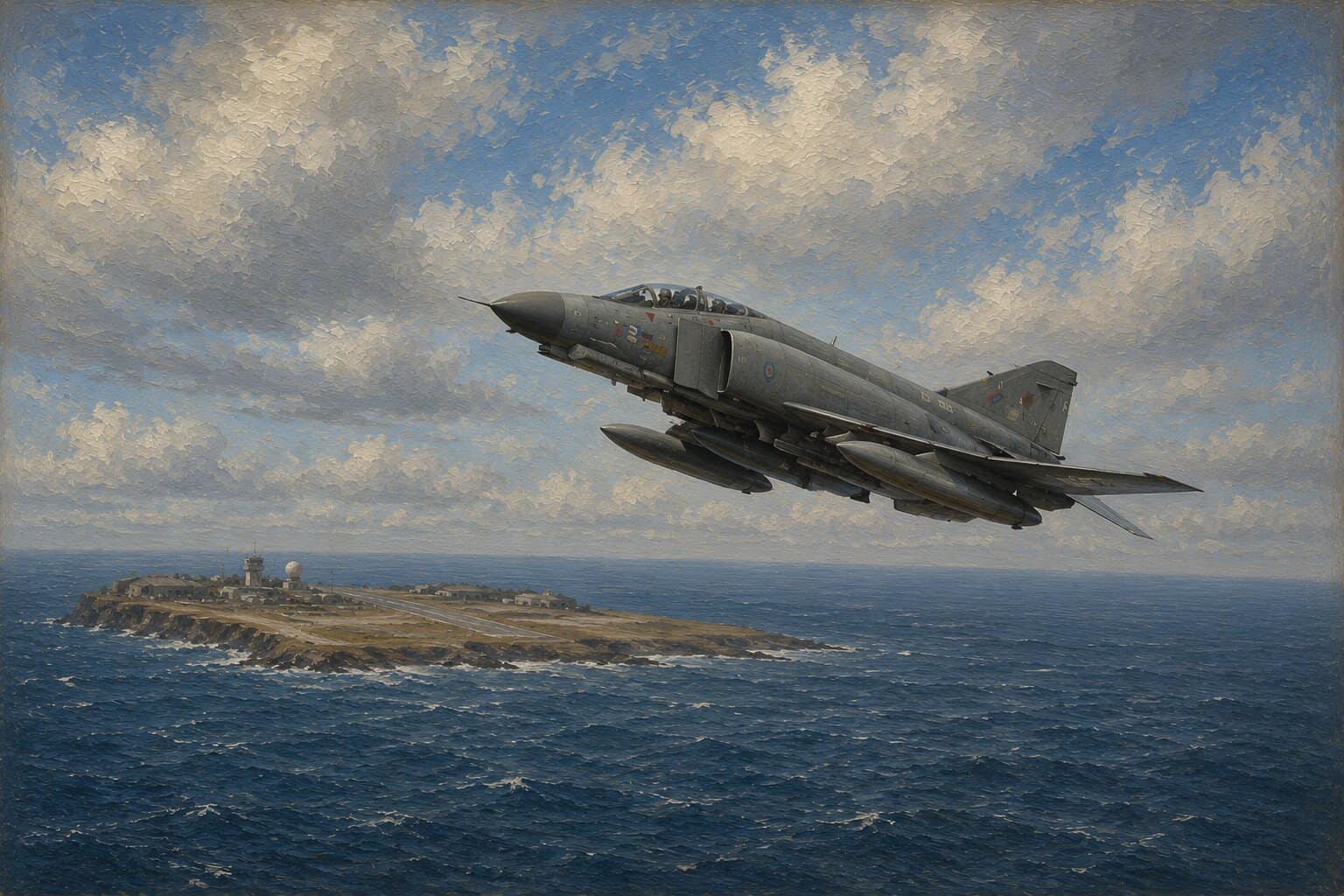
On 17 October 1982, the first McDonnell Douglas Phantom FGR2s of No. 29 Squadron landed at RAF Stanley in the Falkland Islands. Their arrival, four months after the Argentine surrender, began a sustained Phantom air-defence commitment over the islands. A further eight aircraft followed during the next week, completing the move of the squadron’s fighter force to the South Atlantic.
A Runway Built for Fast Jets
In the spring of 1982 Stanley airport had a runway of around 4,000 feet, sufficient for Hercules transports and Harriers and far too short for a heavy fast jet such as the Phantom. After the surrender on 14 June 1982, Harriers operating from Stanley held the air defence of the islands while engineers set about transforming the airfield.
Royal Engineers lengthened the runway with aluminium matting and installed arrester gear to bring landing aircraft to a halt. The enlarged airfield gave the RAF a base capable of supporting a dedicated interceptor force, and the Phantom was the obvious aircraft to fill that role.
From Ascension to Stanley
No. 29 Squadron, based at RAF Coningsby in Lincolnshire, already knew the South Atlantic well. During the conflict its Phantoms had flown to Ascension Island and stood on quick reaction alert at Wideawake airfield, guarding the vital staging post through which the Task Force was supplied.
In September and October 1982 the squadron’s aircraft gathered again at Ascension for the move south. The deployment, codenamed Operation Smelter, relied on Victor K2 tankers to refuel the Phantoms across thousands of miles of open ocean. The detachment was led by the squadron’s commanding officer, Wing Commander Ian Macfadyen, and the first aircraft touched down at Stanley on 17 October.
Holding the Air Defence Line
At Stanley the Phantoms assumed primary responsibility for the air defence of the Falkland Islands and the surrounding protection zone. Crews held aircraft at readiness for quick reaction alert and flew patrols supported by the RAF’s developing tanker capability. The wider defensive system also developed as radar coverage and supporting infrastructure were strengthened across the islands.
The detachment, known as “Phandet”, established the Phantom air-defence commitment at Stanley. On 30 March 1983 the Stanley element was redesignated No. 23 Squadron, continuing the Phantom presence established by No. 29 Squadron.
A Bridge to the Permanent Falklands Posture
The arrival of 29 Squadron converted the improvised air defence of the immediate post-war months into a sustained fighter commitment. It established the pattern of a permanently based interceptor force, held at readiness thousands of miles from the United Kingdom and supported by tankers, radar and a dedicated airfield.
That commitment endured. No. 23 Squadron later transferred the Phantom force from Stanley to the new RAF Mount Pleasant, and in 1988 responsibility passed to No. 1435 Flight. Phantoms were eventually succeeded by Tornado F3s and later Typhoons, continuing the permanent fighter defence whose immediate post-war foundations had been laid when No. 29 Squadron’s Phantoms arrived at Stanley on 17 October 1982.