On This Day, 1939: On 21 October 1939, 46 Squadron Hurricanes intercepted Heinkel He 115 floatplanes over the North Sea in the…
Read the entry →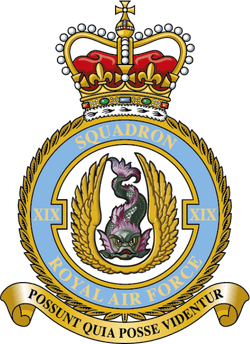
19 Squadron
“The Chosen Squadron; The Dolphins”
Possunt quia posse videntur — They can because they think they can
Explore 19 Squadron RAF from First World War fighters and the first Spitfires to Lightnings, Phantoms and RAF Boulmer.
Control and Reporting Centre squadron; historically a long-serving fighter squadron associated with the Spitfire, Cold War air defence and fast-jet training.
19 Squadron holds a distinctive place in Royal Air Force history because it links the early fighter arm of the First World War with some of the best-known milestones of twentieth-century RAF development. It fought on the Western Front, became the first squadron to receive the Spitfire in 1938, served through the Battle of Britain and later offensive fighter operations, then continued into the jet age on the Hornet, Meteor, Hunter, Lightning and Phantom. More recently, its number has been carried in training and, since 2021, in the RAF’s Control and Reporting Centre structure.
Its significance lies in the continuity across changing forms of air power. Few squadrons can connect SPAD fighters and Sopwith Dolphins with the Spitfire story, Cold War interception and a modern command-and-control role. 19 Squadron offers a particularly useful squadron-level view of how RAF identity could survive radical changes in aircraft, doctrine and operational purpose.
First World War service
19 Squadron formed at Castle Bromwich on 1 September 1915 from a nucleus provided by 5 Reserve Squadron. Training began on a variety of types before the squadron moved towards front-line service with Royal Aircraft Factory R.E.7s and then Royal Aircraft Factory B.E.12s. When it reached France in July 1916, it was already being shaped for the fighter role, though the B.E.12 proved an unsatisfactory aircraft for that purpose.
The squadron's effectiveness improved with re-equipment on the SPAD S.VII and later the SPAD S.XIII. In January 1918, it received the Sopwith Dolphin, the type later commemorated in the squadron badge. Flying these aircraft, 19 Squadron took part in the air fighting of the Western Front through the closing phases of the war before returning to Britain and disbanding at the end of 1919.
Duxford, inter-war fighter service and the first Spitfires
The squadron re-formed at Duxford on 1 April 1923 within No. 2 Flying Training School and soon became an independent fighter unit. Over the inter-war period, it flew the Gloster Grebe, Armstrong Whitworth Siskin, Bristol Bulldog and Gloster Gauntlet, remaining closely associated with Duxford and the professional development of the RAF fighter arm.
This long inter-war residence mattered because it placed 19 Squadron at the centre of Fighter Command's pre-war expansion. In August 1938, it became the first squadron to receive the Supermarine Spitfire, giving it a special place in RAF history beyond its earlier wartime record. The squadron was therefore linked not only to fighter continuity but also to one of the RAF's most important moments of technical and symbolic transition.
Battle of Britain and the offensive war
Operating in 12 Group from Duxford and Fowlmere, 19 Squadron fought on defensive duties through 1940. It covered the Dunkirk evacuation and served during the Battle of Britain, one of the central campaigns in the RAF's history. For a period, it also used early cannon-armed Spitfires, though the new armament proved unreliable at first, and the unit reverted to the standard eight-gun arrangement.
The squadron remained in Fighter Command on successive marks of Spitfire. It later took part in the offensive sweeps and cross-Channel operations that carried the air war back over occupied Europe. It was involved in the period that linked home defence to a more aggressive fighter campaign, including operations connected with Dieppe and, later, the run-up to the invasion of Normandy.
Mustangs, post-war fighters and the jet age
In February 1944, the squadron converted to the North American Mustang. These aircraft were used for escort and army-support work during the period around Operation Overlord and the Allied advance into north-west Europe. That change showed the squadron's adaptability, moving from the close defensive association of the early Spitfire years into a longer-range fighter role suited to the changing demands of the war.
After 1945, the squadron remained active and continued to evolve. Spitfires returned briefly before re-equipment with the de Havilland Hornet in 1946. Gloster Meteors followed in 1951, then Hawker Hunters in 1956. In 1962, at RAF Leconfield, 19 Squadron received the English Electric Lightning, placing it in the front line of Britain's Cold War air-defence system.
Phantom, Hawk and the modern role
A further major change came in 1977, when the number was transferred to a Phantom FGR.2 unit in RAF Germany. In this form, the squadron remained part of the central NATO air-defence structure until disbanding in 1992. It then reappeared as 19 (Reserve) Squadron on the BAE Hawk, first at Chivenor and later at RAF Valley, linking the squadron's long fighter heritage to advanced fast-jet training.
Since April 2021, 19 Squadron has existed in a different but still important form at RAF Boulmer as part of the Control and Reporting Centre structure. Although no longer a flying unit, it remains part of the RAF's wider air-defence system. That current role underlines one of the most interesting features of the squadron's history: a continuing contribution to national air power even when the means of service have changed completely.
Historical significance
19 Squadron matters because it sits at several important points in RAF history. It links First World War fighter development, the inter-war strengthening of the fighter arm, the arrival of the Spitfire, the Battle of Britain, offensive fighter operations, the post-war jet transition and the Cold War interceptor era.
It is therefore more than simply the first Spitfire squadron, although that distinction alone would make it notable. Its longer significance lies in the way it helps explain continuity across the RAF's changing fighter and air-defence story, from the Western Front to the command-and-control structure of the present day.
Western Front, 1916–1918
Somme, 1916
Arras
Ypres, 1917
Somme, 1918
Amiens
Hindenburg Line
Dunkirk
Home Defence, 1940–1942
Battle of Britain, 1940
Channel & North Sea, 1941–1942
Fortress Europe, 1942–1944
Dieppe
Normandy, 1944
Arnhem
France & Germany, 1944–1945
Western Front
Dunkirk evacuation
Battle of Britain
Dieppe Raid
Operation Overlord
Allied advance through France and Germany
Cold War air defence
Flying officer Alan Jerrard won the Victoria Cross in 1918 while serving with 19 Squadron, giving the unit one of its most notable First World War gallantry associations.
| Period | Station | Notes |
|---|---|---|
| 1915–1916 | Castle Bromwich | Formation and early training. |
| 1916–1919 | France and Western Front airfields | Fighter service in the First World War, followed by return to Britain. |
| 1923–1940 | RAF Duxford, with a brief period at RAF Henlow in 1935 | Inter-war fighter development and first Spitfire service. |
| 1940–1943 | RAF Duxford and RAF Fowlmere | Battle of Britain and Fighter Command operations. |
| 1943–1945 | East Anglia, Scotland and north-west European airfields | Mustang operations, escort work and support of the Allied advance. |
| 1946–1947 | RAF Peterhead and related post-war fighter stations | Brief Spitfire period before Hornet service. |
| 1947–1959 | RAF Church Fenton and RAF Leconfield | Hornet, Meteor and Hunter era. |
| 1962–1976 | RAF Leconfield and RAF Gütersloh | Lightning air-defence service. |
| 1977–1992 | RAF Wildenrath | Phantom FGR.2 service in RAF Germany. |
| 1992–2011 | RAF Chivenor and RAF Valley | Hawk reserve and training role. |
| 2021 onwards | RAF Boulmer | Control and Reporting Centre role. |
| Name | Dates | Notes |
|---|---|---|
| R. M. Rodwell | 1915 | First commanding officer on formation. |
| H. D. Harvey-Kelly | 1917 | Commanded during the First World War fighter phase. |
| Phillip Babington | 1924 | Associated with the early inter-war Duxford period. |
| Leonard H. Slatter | 1929 | Commanded in the established inter-war fighter era. |
| Henry I. Cozens | 1937 | Led the squadron into the immediate pre-war Spitfire period. |
| Geoffrey D. Stephenson | 1940 | Commanded at the outbreak of the Second World War. |
| B. J. E. Lane | 1940 | Associated with the Battle of Britain phase. |
| W. McM. Gilmour | 1944 | Commanded during the Mustang and north-west Europe period. |
| B. R. A. Cox | 1965 | Associated with the later Lightning era. |
| C. Misiak | 2021 | Commanded at the re-formation in the Control and Reporting Centre role. |
Battle of Britain
How the Battle of Britain saw RAF Fighter Command defeat the Luftwaffe’s attempt to gain the air superiority…
Operation Overlord
How the RAF helped shape Operation Overlord through strategic bombing, airborne delivery, air cover and sustained support in…

Battle of Britain and the evolution of RAF doctrine
How the Battle of Britain reshaped RAF doctrine in air defence, fighter tactics, command structure and…
19 April 2026 · 5 minFirst RAF Attack on Norway Opens Air Campaign at Stavanger
first RAF attack on Norway: How RAF Wellingtons and Blenheims attacked Stavanger-Sola on 11 April 1940,…
11 April 2026 · 3 minBattle of Berlin Ends with Bomber Command’s March Raid
On 22 March 1944, Lancaster and Halifax bombers joined a major Berlin raid often seen as…
22 March 2026 · 3 min