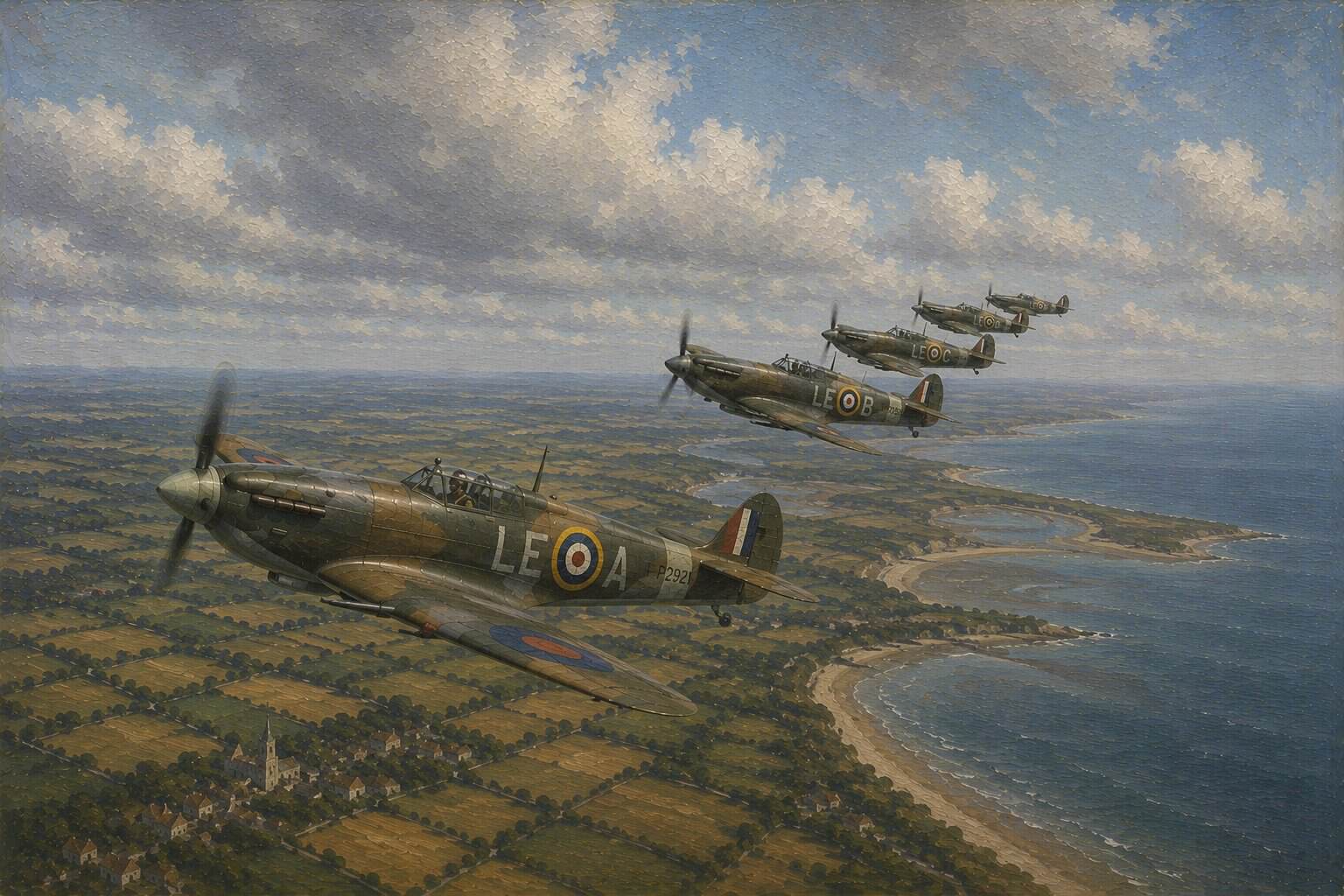
On 6 September 1939, only days after Britain entered the war, a radar and control error led RAF Hurricanes to be mistaken for enemy aircraft in what became known as the Battle of Barking Creek. Pilot Officer Hulton-Harrop was killed in the confusion. The incident was tragic, but its wider importance lies in what it exposed: Britain’s new air-defence system, though advanced, was still being learned in the strain of war’s opening days.
A system under pressure
The RAF entered the war with an integrated air-defence structure that was among the most sophisticated in the world. Radar stations, observation posts, command centres and fighter control had been developed to give Britain a real chance of meeting a large-scale air attack. In principle, the system offered a decisive advantage. In practice, however, it relied on coordination, judgement and rapid interpretation under pressure.
The Battle of Barking Creek showed how fragile that process could be in its early wartime use. Friendly aircraft were misidentified, information was mishandled and the resulting interception produced disaster instead of defence. The machinery designed to distinguish enemy from friend failed at the exact moment when precision mattered most.
Why the error mattered
This was not merely an embarrassing mishap. It carried operational and psychological significance. Operationally, it demonstrated that modern air defence could not be judged only by its technical promise. Radar and command systems were powerful, but they still depended on human interpretation. Mistakes in reporting, plotting or decision-making could turn an advantage into catastrophe.
Psychologically, the incident was a harsh early warning for Fighter Command. Britain had only just entered the conflict, and already the pressure of air-defence readiness had produced a fatal friendly-fire loss. That underlined the fact that the air war would demand not only courage in combat, but discipline and learning throughout the whole chain of control.
Learning in the opening days of war
The Barking Creek incident is significant partly because it occurred so early. There was no long period of wartime adjustment before lessons had to be drawn. The RAF’s defensive apparatus was tested almost at once, and one of its earliest real wartime episodes revealed serious procedural weakness. That knowledge was painful, but necessary.
As the war developed, Britain’s air-defence system became one of the great strengths of national survival. Yet its later success should not obscure the fact that it was refined through errors as well as achievements. Barking Creek belongs to that process of hard learning. It reminds the reader that even the systems later celebrated in the Battle of Britain had to be made reliable through experience, correction and repetition.
Significance
The Battle of Barking Creek matters because it exposed the human vulnerability inside a technologically advanced defence network. The loss of Hulton-Harrop was an early wartime tragedy, but the episode also served as a warning that the RAF’s new command-and-control system required discipline and refinement before it could perform as intended. In RAF history, it stands as one of the earliest lessons of the war: that modern air defence was powerful, but only if the people operating it could master its complexity under real pressure.