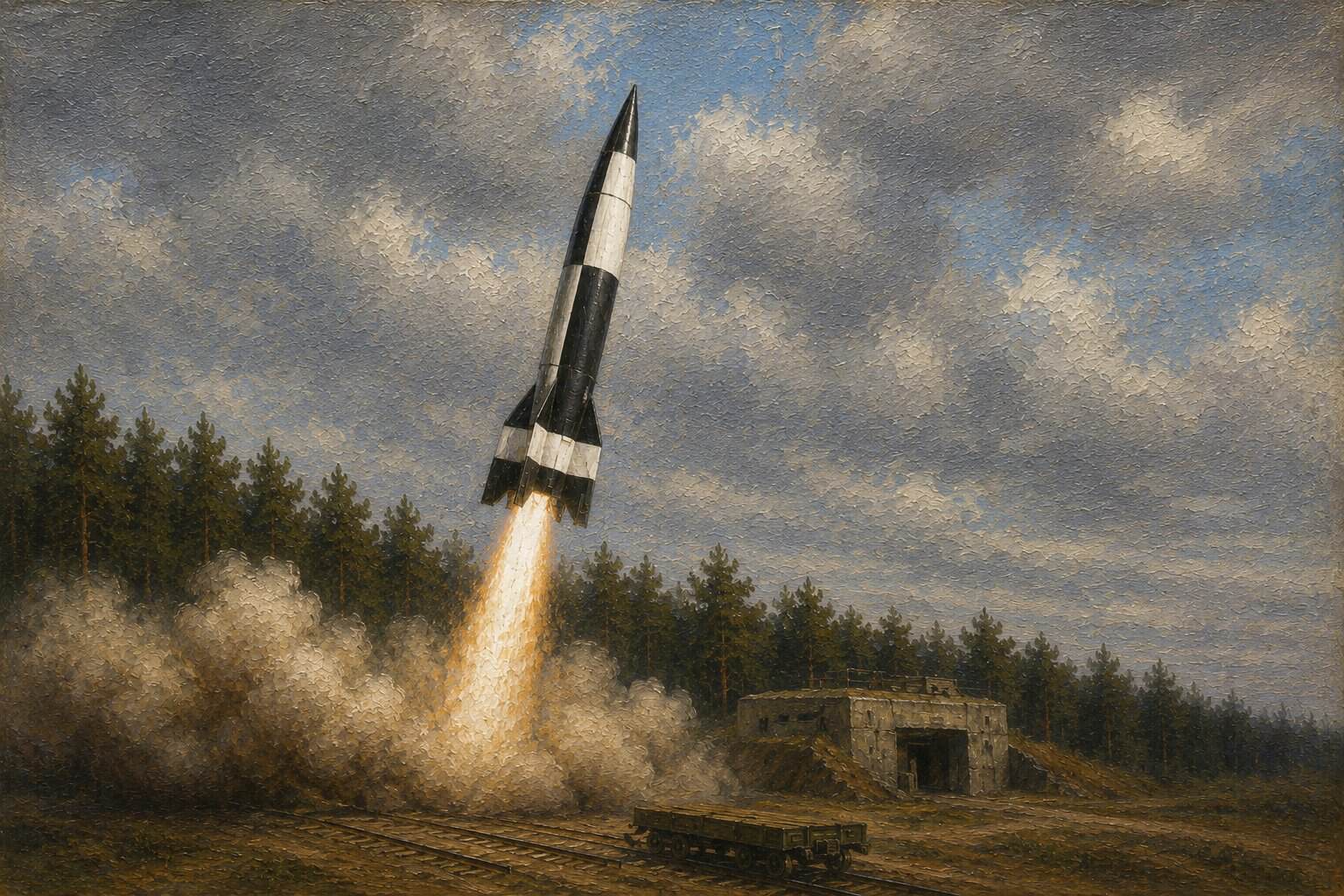
On 8 September 1944, the first V-2 rocket to hit London struck at Chiswick and opened a new phase in the bombing war against Britain. The attack was significant not only because of the damage it caused, but because it introduced a weapon against which there was no warning at the moment of impact and no practical defence once it had been launched. For Londoners and for the British state, the V-2 represented a grim escalation: a bombardment delivered not by aircrew who might be intercepted, but by a ballistic missile descending faster than sound.
A new kind of attack
By September 1944, Britain had already endured years of bombing, from the Blitz through to the V-1 flying bomb campaign. Those earlier forms of attack, dangerous though they were, still belonged to a familiar logic of air defence. Radar warning, fighter interception and anti-aircraft fire could all play a role, even if only imperfectly. The V-2 changed that relationship completely.
Once launched, the missile could not be stopped. It travelled at immense speed and struck without the audible approach that had made the V-1 at least briefly recognisable. The first London impact was more than another raid. It revealed that the war against British cities had entered a stage in which the usual instruments of defence could do little at the decisive moment.
The political and psychological effect
The physical scale of the first strike was less important than what it signified. British civilians, administrators and the military authorities all understood that a successful V-2 impact implied repetition. Germany had introduced a weapon intended not merely to kill but to sustain pressure and uncertainty through an attack that bypassed ordinary interception.
That mattered psychologically. Air raids had long produced fear, but they had also produced routines of warning and response. The V-2 disrupted those routines. There was no practical scramble, no visible dogfight, no siren followed by the tension of waiting. Instead, there was sudden destruction, followed only afterwards by recognition of what had happened. In this sense the missile intensified the sense of helplessness already associated with bombardment.
The RAF and the wider response
For the RAF, the first V-2 strike underlined both the power and the limits of air power in defensive war. Fighter Command and the anti-aircraft system had been built to contest aircraft and flying bombs, not ballistic missiles already in terminal descent. The answer to the V-2 had to lie elsewhere: in attacks on launch infrastructure, transport routes, production and the wider military system supporting the weapon.
This gave the event strategic significance beyond London alone. The missile campaign reinforced the need to strike the enemy’s capacity at source rather than expect a purely local defensive solution. It was another reminder that the bombing war involved technology, logistics and intelligence as much as immediate aerial combat.
Significance
The first V-2 strike on London matters because it marks the arrival of ballistic missile warfare in Europe. It brought the capital into contact with a weapon that removed warning and direct interception from the defensive equation. In RAF history, 8 September 1944 stands as a moment when the air war widened into the missile age, forcing Britain to confront a form of attack that foreshadowed later strategic realities far beyond the Second World War.