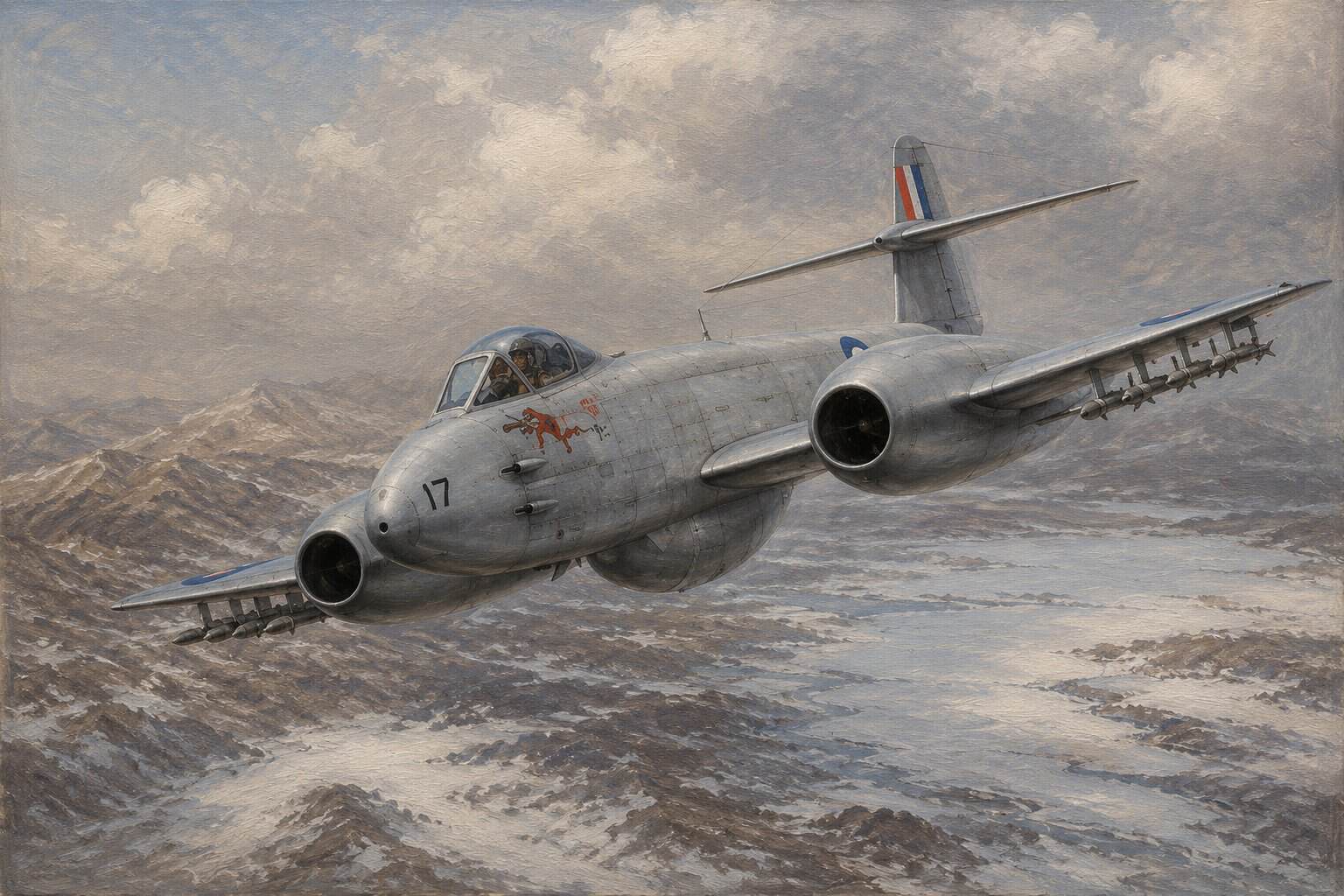
On 28 August 1952, Flying Officer M. O. Berg was shot down while serving with No. 77 Squadron of the Royal Australian Air Force in Korea and subsequently became the RAF’s only prisoner of war of that conflict. His loss was a stark reminder that, even in a war often overshadowed by the Second World War and by later Cold War crises, RAF aircrew faced a demanding and dangerous operational environment in which jet combat, ground attack and intense anti-aircraft fire combined to create new risks.
By 1952, the Korean War had entered a prolonged and often brutal phase. Armistice negotiations were underway, but the air war had not slackened into safety. United Nations air forces continued to strike supply routes, troop concentrations and transport targets in support of operations on the ground. The RAF contribution in Korea was relatively small in scale, but it was real and exposed. A number of RAF officers served on exchange or attachment with allied units, including the RAAF, entering a theatre where technology and tactics were changing rapidly.
Meteors in a Changing Air War
No. 77 Squadron RAAF had already undergone a difficult adaptation in Korea. Having moved from piston-engined Mustangs to the Gloster Meteor F.8, the squadron found itself operating an aircraft that had been a major British wartime achievement but which was no longer ideally matched to the latest swept-wing communist fighters in the theatre. As a result, the Meteor’s role increasingly shifted away from direct contests for air superiority and towards ground attack, armed reconnaissance and escort duties. That shift did not reduce the danger. If anything, it often brought aircraft lower and closer to concentrated enemy defences. RAF Museum accounts of the campaign note that ground fire became the principal hazard for many Meteor crews in this period. Berg’s aircraft was crippled by anti-aircraft fire, forcing him to leave it and descend into hostile territory. The transition from cockpit to captivity could occur in seconds.
Capture and Its Meaning
Berg’s capture stood out because it was singular. He was the only RAF member taken prisoner during the Korean War. That fact alone gives the event its place in RAF history, but its significance goes beyond the statistical rarity. It illustrates the reality of Britain’s participation in a United Nations air campaign that was multinational, technically advanced and far from risk-free.
The Korean Air War is often remembered for the duel between the North American F-86 Sabre and the MiG-15. Yet for many Commonwealth and RAF-connected crews, the daily reality was different. It involved strike missions, patrols over difficult terrain, exposure to heavy and persistent ground fire, and service alongside allied air arms in a complex coalition command structure. Berg’s loss belongs to that wider story rather than to the simpler image of pure jet-versus-jet combat.
A Marker of RAF Service in Korea
His capture also underlines an important point about RAF involvement in Korea. Britain’s role in the air campaign was not confined to policy, liaison or distant strategic support. RAF pilots were physically present in theatre, flying operational sorties and sharing the hazards of the campaign. Some RAF officers also served on attachment to United States Air Force Sabre units, further demonstrating the extent to which Britain remained engaged in front-line air operations during the conflict.
From a historical perspective, Berg’s ordeal marks the meeting point between old and new eras of warfare. The Gloster Meteor was a jet aircraft, the battlefield was Cold War Korea, and the command arrangements were multinational. Yet the enduring human facts of air war remained familiar: exposure, isolation, the chance of sudden damage, and the grim prospect of falling into enemy hands.
That is why 28 August 1952 remains notable. The event was not a large-scale battle or a famous victory, but it distilled the hazards of RAF service in Korea into one personal episode. Berg’s capture showed that the RAF’s post-war commitments could still carry the same hard consequences as earlier conflicts, even in a new age of jets, coalition warfare and limited war.