Operation Musketeer was the Anglo-French military operation launched during the Suez Crisis in late 1956. Air power was central to the concept from the beginning. For the Royal Air Force, Musketeer was a major post-war example of expeditionary air operations designed to establish air superiority, suppress Egyptian resistance and support airborne and amphibious action around Port Said and the northern canal zone.
The operation followed the nationalisation of the Suez Canal Company by President Nasser and formed part of the wider political and military crisis that culminated in direct Anglo-French intervention. In operational terms, Musketeer combined air strikes, transport flying, airborne assault and close support in a compressed timetable intended to force rapid results before international pressure curtailed military action.
Strategic Context And Planning
British and French planners regarded control of the Suez Canal as strategically important for shipping, oil movement and wider influence in the Middle East. Publicly, the intervention was framed as a means of separating opposing forces and protecting navigation, but its military design rested on the need for swift, controlled seizure of key ground around Port Said and the canal approaches.
Air power was therefore given a central place in the plan. The RAF and its allies were expected to strike Egyptian airfields and air-defence systems, reduce the effectiveness of local resistance and create conditions in which airborne and amphibious forces could be inserted with acceptable risk. The timetable was deliberately tight, reflecting concern that international political pressure would quickly narrow the operational window.
Airborne Assault And RAF Transport Support
A key RAF role in Musketeer was the transport of British parachute forces for the assault on El Gamil airfield near Port Said. RAF Dakota aircraft delivered 3rd Battalion, The Parachute Regiment, in a battalion-sized drop intended to secure the airfield quickly and establish a firm northern position for the broader operation.
This was a demanding task. The RAF had to deliver troops carrying substantial combat loads, under threat from ground fire and in conjunction with ongoing strike operations against Egyptian positions. The airborne element also had to be coordinated with French parachute tasks against key bridges and with marine landings from the sea.
The successful insertion of paratroops at El Gamil demonstrated the RAF’s continued ability to mount a major airborne lift in a defended environment, even though the operation took place in an era when radar-directed guns and faster aircraft had increased the risks facing transport formations.
RAF Strike Operations
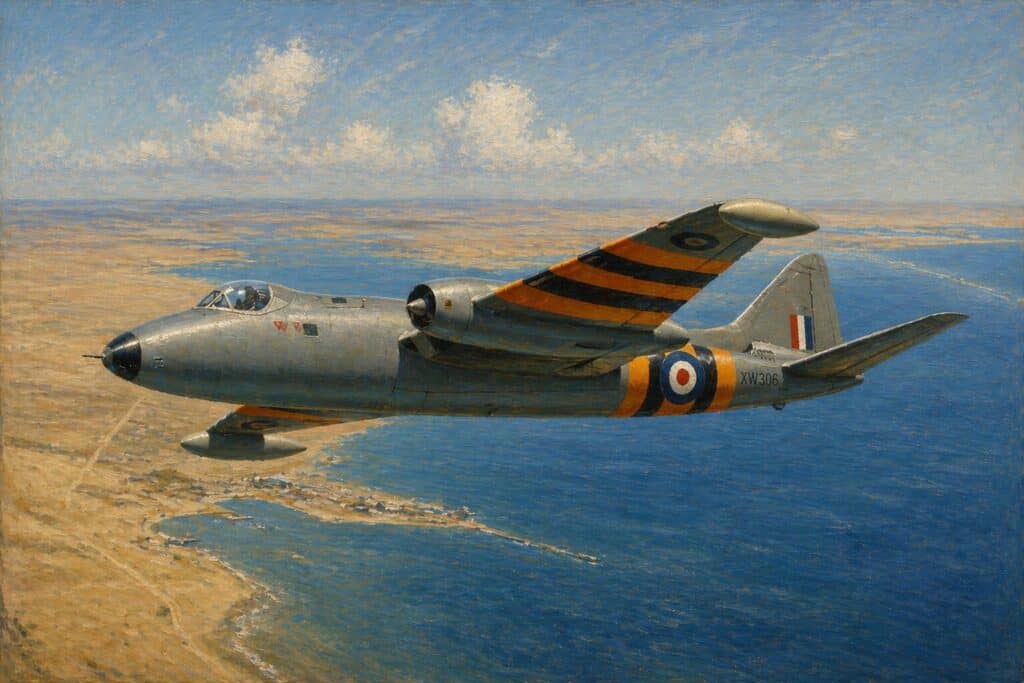
RAF strike aircraft played an enabling role in the operation by attacking Egyptian airfields, radar sites and defensive positions before and during the landings. The objective was to reduce the threat from the Egyptian Air Force, weaken anti-aircraft resistance and support the advance of airborne and amphibious troops.
These operations were part of a broader Anglo-French air campaign. Their effect was to create the degree of local air superiority required for the airborne assault and the movement of shipping towards the objective area. In this sense, Musketeer reflected the post-war view that air power could shape the tactical conditions under which the ground battle would be fought.
Ground Support And Operational Result
Once airborne and amphibious forces were ashore, RAF and allied aircraft continued to provide support against Egyptian resistance around Port Said. The seizure of El Gamil airfield, the securing of bridge objectives and the advance of marine forces formed the practical military achievements of the operation.
From a purely operational perspective, many immediate military tasks were achieved. Air superiority was obtained locally, the parachute assault succeeded in taking its main objective, and the initial advance made progress. Yet the wider campaign was overtaken rapidly by political and financial pressure, particularly from the United States and through the United Nations. As a result, operational success on the ground did not translate into a sustained strategic result.
Historical Significance
Operation Musketeer is significant in RAF history because it illustrates the post-war application of expeditionary air power, airborne doctrine and joint planning under Cold War conditions. It was one of the clearest demonstrations of how the RAF expected transport, strike and support functions to work together in a limited intervention.
It also showed the limits of military planning when wider political conditions shifted rapidly. In that sense, Musketeer was both an operational demonstration and a strategic warning. It revealed what the RAF could still do in terms of transport and support to a battalion-sized parachute assault, but also how quickly international circumstances could constrain battlefield success.
Conclusion
Operation Musketeer placed air power at the centre of Anglo-French military planning during the Suez Crisis. The RAF supported airborne assault, helped establish local air superiority and contributed directly to the seizure of key positions around Port Said.
The operation remains important in RAF history as the last major British battalion-sized parachute assault delivered under combat conditions and as a case study in post-war expeditionary air power working within, and ultimately limited by, the political pressures of the Cold War.