On This Day, 1999: On 5 June 1999 RAF Tornados flew their first combat missions from Solenzara in Corsica during Operation Allied…
Read the entry →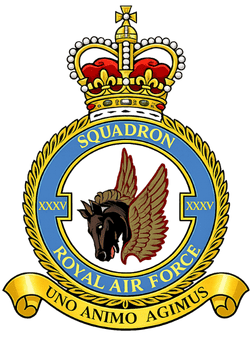
35 Squadron
Uno animo agimus — We act with one mind
How 35 Squadron moved from heavy-bomber operations into the Pathfinder Force and became part of Bomber Command’s specialist target-marking story.
Bomber Command heavy-bomber squadron and later Pathfinder unit, followed in the Cold War by V-bomber service.
35 Squadron occupies an important place in RAF history because its service extended well beyond the Second World War. Wartime bomber operations and Pathfinder work remain central to its reputation, but the squadron also belonged to the RAF’s post-war transition from heavy piston-engined bombers to the jet age and the nuclear deterrent. That longer history helps show how one unit could move from the mass night offensive over Germany to the strategic air posture of the Cold War.
The squadron is therefore significant not only for its wartime role, but for the continuity it provides across major changes in aircraft, doctrine and purpose. From bomber operations over occupied Europe and Germany to post-war service on the Avro Lincoln, English Electric Canberra, Avro Vulcan, and Handley Page Victor, 35 Squadron reflects several major phases of RAF development.
Bomber Command and the Second World War
35 Squadron served within Bomber Command during the period in which Britain increasingly turned to night bombing as the practical means of carrying the war into Germany. This was a demanding and dangerous form of warfare, shaped by poor early accuracy, heavy losses and constant pressure to achieve greater effect.
The squadron became associated with heavy-bomber operations, particularly on the Handley Page Halifax and later the Avro Lancaster. In this role, it formed part of the wartime transformation by which Bomber Command moved from a relatively limited force into a major strategic striking arm.
Pathfinder Force role
A major element in the squadron’s historical importance is its place within the Pathfinder Force. Created in 1942 to improve the concentration and accuracy of Bomber Command attacks, the Pathfinders used selected crews and specialised methods to identify and mark targets for the main bomber stream.
35 Squadron was among the units associated with this development. That mattered because target marking became one of the most important specialist skills of the bomber war. It shifted the squadron from participating in the offensive to a more exacting role in making the offensive function more effectively.
Post-war re-equipment and the jet era
The end of the war did not end the squadron’s significance. Like other Bomber Command units retained for major post-war duties, 35 Squadron moved into the new strategic environment that followed 1945. Service on the Avro Lincoln represented continuity with the heavy-bomber force that had emerged at the end of the war, while later re-equipment with the English Electric Canberra marked the shift towards faster, jet-powered bomber operations.
These post-war aircraft changes reflected a broader RAF transition. The service was moving away from the wartime pattern of mass bomber streams towards a force shaped by new technology, new strategic assumptions and the pressures of the early Cold War.
Vulcan, Victor and the Cold War deterrent
35 Squadron’s later association with the Avro Vulcan and Handley Page Victor placed it within the V-bomber era, one of the defining phases of post-war RAF history. In this period, RAF bomber squadrons formed a central part of Britain’s airborne nuclear deterrent and later adapted to changing strategic demands as missile systems, alliance structures and conventional tasks evolved.
That later service matters because it shows that 35 Squadron was not simply a wartime bomber unit preserved in memory. It remained part of the front line as the RAF moved into the atomic age and redefined the role of long-range air power.
Historical significance
35 Squadron matters because it links two major histories of the Royal Air Force. One is the story of Bomber Command’s wartime offensive and the specialist work of the Pathfinders. The other is the post-war evolution of strategic bombing, jet re-equipment and the Cold War deterrent.
Its significance lies in that continuity. Rather than belonging only to one dramatic wartime chapter, 35 Squadron helps explain how RAF bomber power developed from the Second World War into the much-altered strategic conditions of the post-war decades.
Fortress Europe 1941–1944
France and Germany 1944–1945
Ruhr 1941–1945
Berlin 1943–1944
Biscay Ports 1941–1944
Battle of the Ruhr, 1943
Battle of Berlin, 1943–1944
Pathfinder operations over Germany
Bomber support to the Normandy campaign, 1944
| Period | Station | Notes |
|---|---|---|
| 1916–1919 | Thetford, France and Netheravon | First World War corps-reconnaissance service and return to Britain. |
| 1929–1936 | RAF Bircham Newton, RAF Abu Sueir and RAF Worthy Down | Inter-war bomber service and Abyssinian crisis deployment. |
| 1940–1945 | RAF Linton-on-Ouse and RAF Graveley | Halifax, Lancaster and Pathfinder operations. |
| 1946–1958 | RAF Graveley, RAF Scampton and RAF Upwood | Post-war Lancaster and Lincoln service, then jet-bomber transition. |
| 1962–1982 | RAF Coningsby, RAF Akrotiri and RAF Marham | Vulcan and Victor V-bomber service. |
| Name | Dates | Notes |
|---|---|---|
| B F Vernon-Harcourt | 3 February 1916 | First commanding officer on the squadron’s formation in the First World War. |
| Gilbert S M Insall | 11 March 1929 | Commanded in the inter-war period and was a Victoria Cross holder. |
| H F Chester | 5 September 1938 | Led the squadron during late rearmament before the Second World War. |
| John N H Whitworth | 26 January 1942 | Commanded during the wartime bomber offensive and later became an air commodore. |
| D F E C Dean | 1 May 1943 | Led the squadron in its Pathfinder and later-war bombing role. |
| David B Craig | 16 April 1963 | Commanded in the V-bomber era and later became Marshal of the Royal Air Force. |

RAF Pathfinders and the Evolution of Target‑Marking
How RAF Pathfinders improved Bomber Command’s night offensive through specialist crews, navigation aids and disciplined target-marking.
22 April 2026 · 5 minBattle of Berlin Ends with Bomber Command’s March Raid
On 22 March 1944, Lancaster and Halifax bombers joined a major Berlin raid often seen as…
22 March 2026 · 3 minReinforcing Malta by Air: RAF Fighters and Survival
How repeated RAF fighter deliveries to Malta helped the island survive siege, contest Axis air attack…
12 May 2026 · 3 min