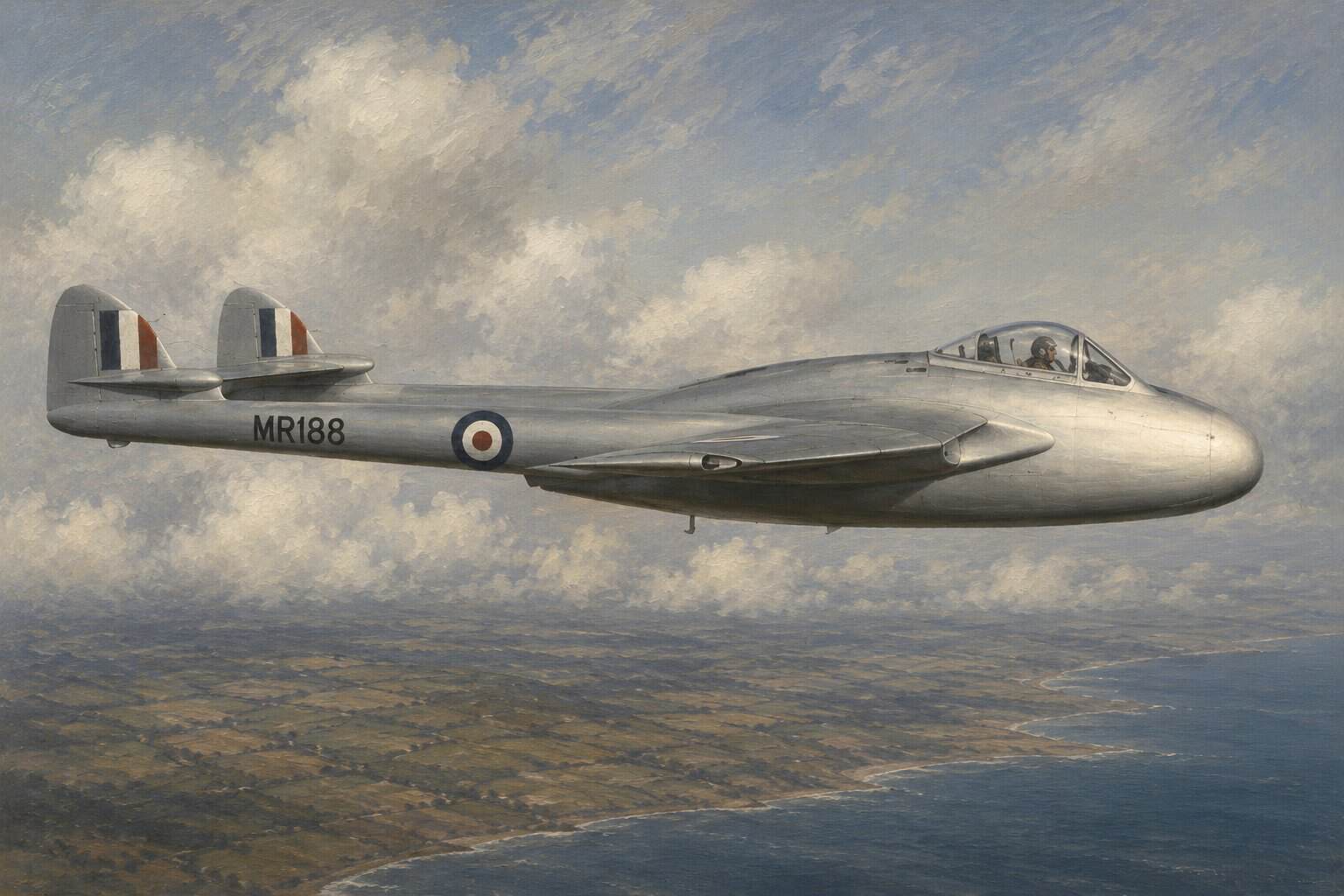
On 28 June 1952, No. 78 Wing of the Royal Australian Air Force arrived at Luqa, Malta, with Vampire FB.9 fighters to take up a role in Middle East air defence. The deployment was a clear expression of Commonwealth air cooperation in the early Cold War, bringing Australian jet aircraft and personnel into the RAF’s strategic system at a time when Britain and its allies were reassessing security across the Mediterranean and beyond.
A Commonwealth reinforcement for Malta
Malta remained one of the most important air positions in the central Mediterranean after the Second World War. From bases such as Luqa, air forces could support wider regional commitments, reinforce the Middle East and maintain a visible deterrent presence. By 1952, those responsibilities were set within an increasingly tense international climate shaped by the Cold War, the Korean War, and the growing importance of alliance planning.
The arrival of No. 78 Wing carried meaning beyond the movement of a single formation. It represented the willingness of a Commonwealth air force to integrate directly into Britain’s wider defence posture. For the RAAF, it was also an opportunity to demonstrate its ability to contribute to jet-era commitments well beyond the Australian region.
Vampires in RAF service conditions
The de Havilland Vampire FB.9 was a practical aircraft for this role. Though already being overtaken by newer jet designs, it was a reliable fighter-bomber for training, interception and general operational service in climates that demanded sturdy equipment and good maintenance discipline. At Luqa, the aircraft gave the Australian wing a credible front-line presence while fitting into the broader RAF environment in Malta.
The deployment also illustrated how post-war air power depended on interoperability. Aircraft, procedures, logistics and command relationships all had to align if a force from one Commonwealth service was to operate smoothly inside another’s strategic framework. That kind of cooperation mattered increasingly in the 1950s, when air defence was no longer purely national in character but part of wider collective arrangements.
Strategic and political significance
No. 78 Wing’s arrival helped strengthen the air shield available for Britain’s interests in the Mediterranean and Middle East. It also had political value. The deployment showed that Commonwealth defence ties still had operational substance, and that Australia was prepared to commit forces to shared security concerns far from home.
For the personnel involved, service in Malta was more than a ceremonial posting. It meant maintaining readiness in a demanding overseas environment, adapting to local conditions and sustaining jet operations on behalf of a broader allied purpose. That sort of commitment gave practical weight to the language of partnership that often surrounded Commonwealth defence policy.
A wider reflection on the early Cold War RAF world
The early 1950s were a transitional period in air power. Piston-engined experience from the Second World War still shaped many institutions, yet the reality of service was now increasingly jet-powered, multinational and politically framed by East-West rivalry. Luqa was one of the stations where that new world could be seen clearly.
Remembering 28 June 1952, means recognising an important moment in the RAF’s wider international story. No. 78 Wing’s arrival at Malta was not a battle in itself, but it was part of the structure of deterrence and cooperation on which Cold War stability depended. In bringing Vampire fighters to Luqa, the RAAF strengthened an RAF-led defence posture and demonstrated how closely linked Commonwealth air forces remained in the new strategic age.