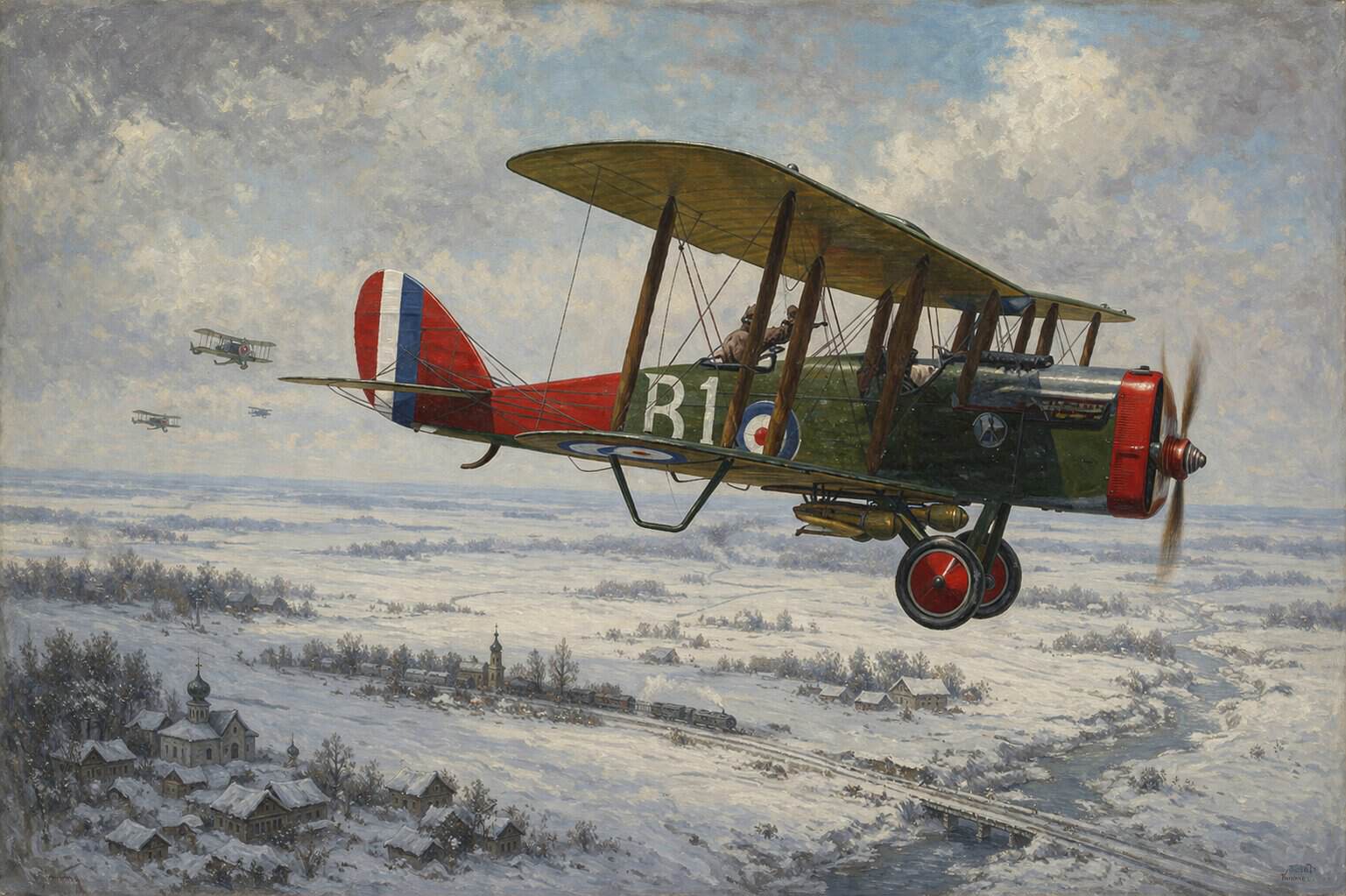
On 2 June 1918, the Allied Supreme War Council sanctioned joint intervention in northern Russia, and RAF units were intended to form part of that effort. The decision belonged to the unsettled final year of the First World War, when the collapse of Russia and the shifting balance of power in the east created both danger and uncertainty for the Allies. The immediate concerns included denying Germany opportunities for troop movement and influence, while also helping protect key northern ports through which stores and wider strategic interests might be affected.
This was a politically and militarily complicated moment. Intervention in North Russia was not conceived simply as a conventional campaign against a single front-line enemy. It emerged from the breakdown of the Eastern Front, the fear that German advantage might increase, and uncertainty about what would happen in territories now caught between revolution, foreign war aims and local instability. Air power entered that picture as one part of a combined expeditionary response.
Why air units were considered necessary
The proposed use of RAF units reveals how quickly air power had become woven into British planning. Aircraft could reconnoitre difficult terrain, maintain communications, support dispersed forces and apply pressure where roads, railways and waterways made movement uneven and uncertain. In a theatre such as northern Russia, with vast spaces, poor infrastructure and severe environmental conditions, those qualities carried obvious appeal. The sanctioning of intervention mattered because it recognised aviation as a practical component of remote operations, not merely as an experimental adjunct. RAF participation was intended to help shape events in a theatre far removed from the better-known air fronts of France and Flanders. That alone is historically significant. It shows the service’s predecessors being drawn into a widening geography of war and post-imperial instability.
From European war to interventionary conflict
North Russia also foreshadowed the more ambiguous conflicts in which British air power would later be employed. This was not a neatly defined campaign with clear fronts and a simple objective. It lay somewhere between a great-power war, an expedition, a security operation, and a political intervention. For that reason, the decision of 2 June 1918 can be read as part of the RAF’s early education in operating, where military and political aims were tightly entangled.
The immediate results of the sanction were administrative and strategic rather than dramatic on the day itself. Approval created the framework within which forces could be committed and organised. What followed would involve the practical difficulties of distance, climate and coordination in a region that was anything but straightforward. Yet these later difficulties only underline the significance of the original decision.
Why the moment matters in RAF history
For RAF history, the sanctioning of intervention in North Russia is important because it demonstrates the breadth of responsibility already being attached to British air forces before the RAF had even completed its first year as an independent service. Air units were expected to contribute not only to major offensives on the Western Front but also to expeditionary efforts at the far edges of Allied strategy.
What began as an Allied decision on paper would lead to a demanding and ambiguous campaign in practice. For the RAF, it was an early example of air power being drawn into intervention, coalition politics and remote operations all at once.