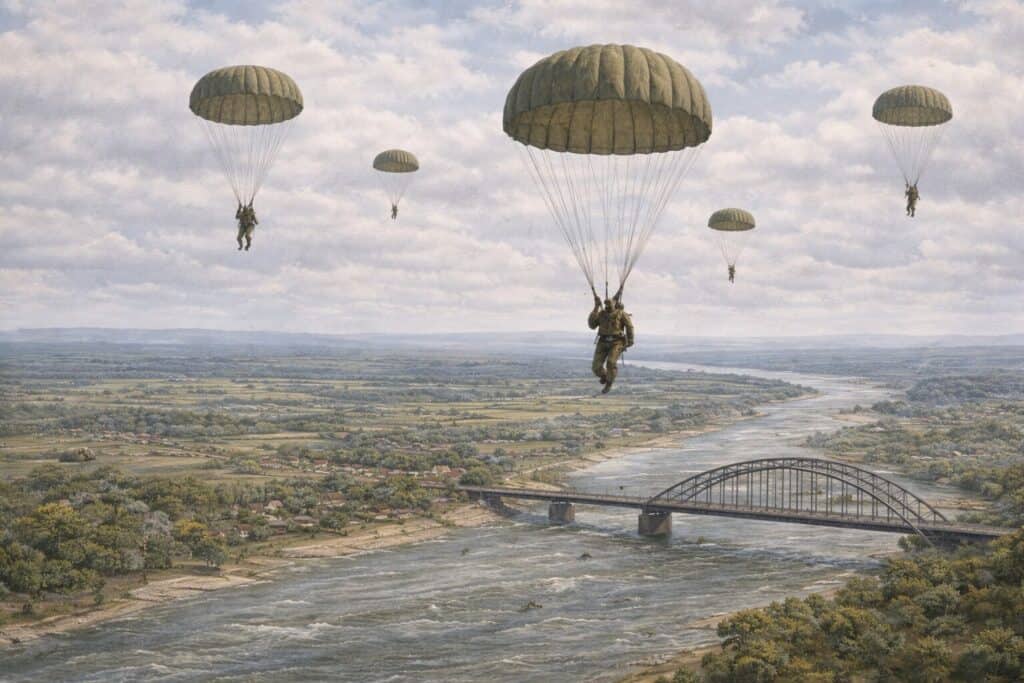
Operation Market Garden began on 17 September 1944 as an Allied attempt to seize a chain of bridges across the Netherlands, open a route into Germany and accelerate the advance in north-west Europe. Air support was central to the concept from the beginning. For the RAF, the operation involved transport aircraft, glider towing, fighter cover, radar control, reconnaissance and resupply, all within a campaign shaped by enemy fire, weather and acute time pressure.
The airborne phase, Market, depended on the rapid insertion of Allied airborne divisions near Eindhoven, Nijmegen and Arnhem. RAF involvement was substantial, but the operation also revealed the limits imposed by aircraft availability, weather conditions and the practical difficulty of sustaining isolated airborne troops once the battle developed.
Transport Aircraft and Airborne Deployment
RAF transport and glider-towing units formed a major part of the air armada that carried airborne forces into the Netherlands. Short Stirling aircraft, adapted as glider tugs, and Dakota transports were central to the RAF's role. The gliders they hauled carried men, guns, vehicles and other heavy equipment that could not be dropped by parachute.
Transport shortages, however, shaped the operation from the outset. There were not enough aircraft to deliver all airborne forces in a single lift, so the attack had to be staged over successive days. This reduced the speed and shock effect on which the concept depended, giving German forces valuable time to react.
Air considerations also influenced the selection of landing and drop zones. At Arnhem, concerns about anti-aircraft fire and the need for suitable open ground led to zones being chosen some distance from the main bridge objective. This reduced the immediate risk to aircraft but increased the burden on troops after landing.
The Glider-Borne Radar Effort
One of the more ambitious RAF-linked features of the operation was the attempt to deploy mobile radar capability by glider. Previous operations had shown the value of radar and fighter control near the front, and Arnhem lay beyond the effective reach of radar as ground forces advanced.
To address this, light warning radar sets were broken down for carriage in Horsa gliders. The intention was to assemble them after landing and extend fighter-control capability over the battle area. In practice, the plan failed. Enemy fire, damaged tugs, and misallocation of load components meant that the equipment required to assemble a complete radar station did not arrive in the right form or at the right place.
The result was that one of the more technically advanced support ideas in the operation could not be brought into effective service. This failure illustrates the vulnerability of complex airborne support plans when every stage depends on correct arrival under combat conditions.
Fighter Control, Air Defence, and Resupply
Although the Arnhem radar plan failed, mobile fighter-control units supporting the advancing ground forces elsewhere performed effectively. Fighter Direction Posts moving with XXX Corps helped direct Allied fighters over the corridor, contributing to the defence of key positions against German air attack.
Resupply, however, became one of the operation’s greatest difficulties. Transport aircraft flew repeated sorties to deliver ammunition, food, medical supplies, and anti-tank equipment to the airborne forces. Weather delays, anti-aircraft fire, target-marking problems and shrinking drop zones greatly reduced effectiveness, especially at Arnhem. Large quantities of supplies fell into German-held areas or could not be recovered efficiently by the troops who needed them.
This part of the operation shows that RAF support extended well beyond the initial lift. The problem was not a lack of effort, but the growing gap between what air transport could attempt and what battlefield conditions allowed it to deliver accurately.
Operational Outcome
Operation Market Garden failed to achieve its central objective of securing a rapid route across the Rhine into Germany. At Arnhem in particular, British airborne forces were isolated and eventually overwhelmed after prolonged fighting. Elsewhere, some objectives were held, but the overall operational concept broke down.
For the RAF, the operation demonstrated both capability and limitation. It showed that large airborne forces and heavy equipment could be delivered on a considerable scale, that fighter-control elements could effectively support advancing ground forces, and that extensive resupply efforts could be mounted. At the same time, it revealed how transport shortages, bad weather, anti-aircraft fire and communications problems could cumulatively undermine an airborne operation whose margin for success was already narrow.
Historical Significance
Operation Market Garden is significant in RAF history because it illustrates the breadth of air support required by an airborne offensive: transport, glider towing, control, reconnaissance and supply all had to function together. It also exposed the practical limits of air power when planning assumptions about speed, surprise and follow-up could not be sustained.
The campaign is therefore important not only for its failure at Arnhem but for the operational lessons it offered concerning airborne logistics, radar support, transport availability and the vulnerability of resupply to weather and enemy action.
Conclusion
Operation Market Garden air support formed a large and complex RAF contribution to one of the most ambitious airborne operations of the Second World War. Through transport aircraft, glider towing, fighter control and resupply efforts, the RAF helped make the operation possible in the first place.
Yet the campaign also showed that air support could not compensate for all the weaknesses in planning, timing and battlefield development. For RAF history, Market Garden remains a significant example of both the capabilities and the limitations of tactical air support in a major airborne operation.