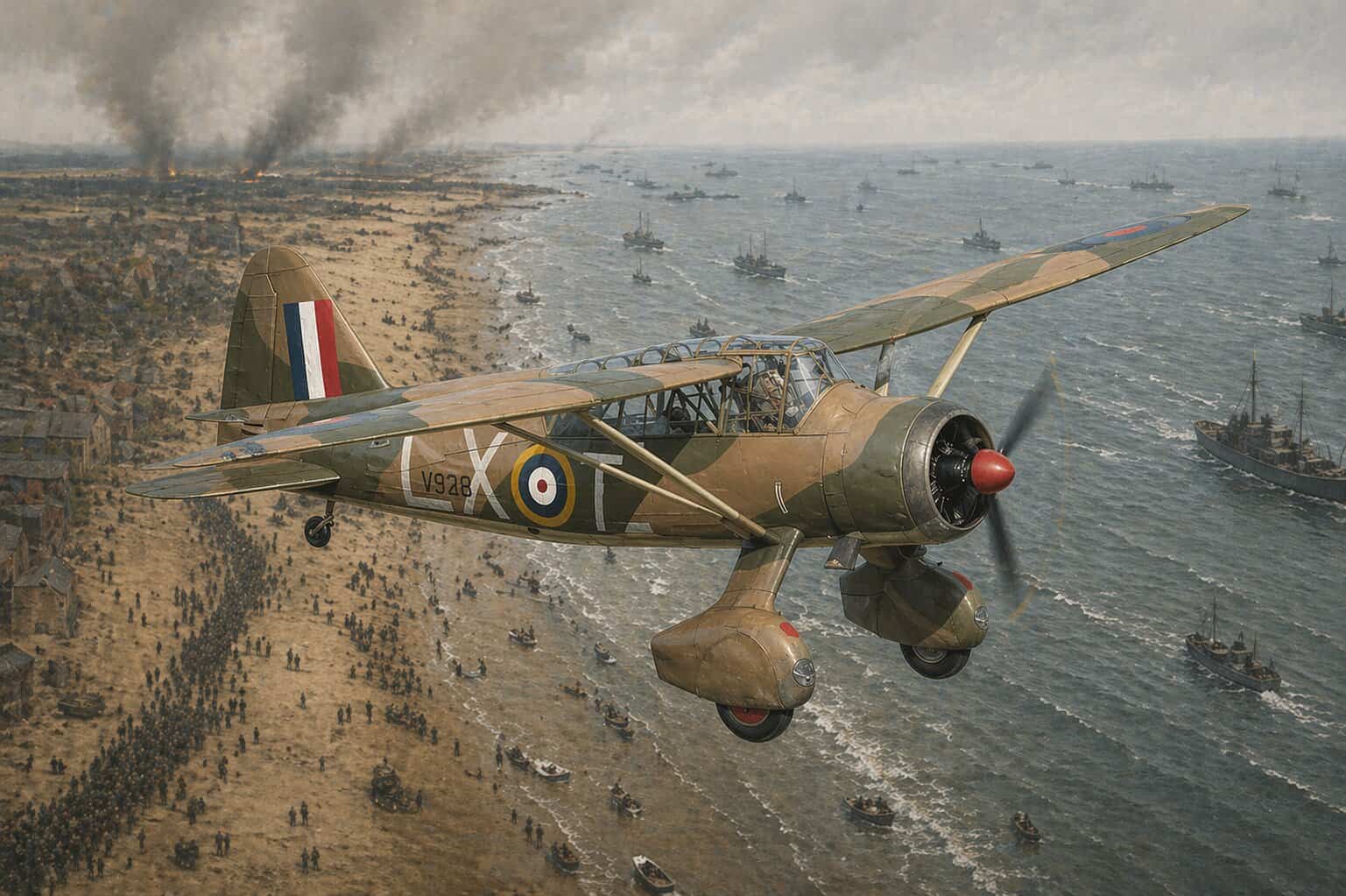
Operation Dynamo entered its final phase at Dunkirk under intense pressure from air attack, artillery and the shrinking space of the Allied perimeter. In those closing days of May and the opening days of June 1940, the RAF’s contribution was most often made away from the immediate view of the troops and civilians waiting on the beaches. Fighter Command could not remain continuously overhead in a form easily visible from the ground. Yet, its interceptions, patrols and losses were central to keeping the evacuation in being until the last lift could be completed.
Background
Operation Dynamo had begun as an emergency withdrawal from the Dunkirk pocket after the collapse of the Allied position in northern France and Belgium. Its success depended not only on the ships entering and leaving the harbour and beaches, but on limiting the Luftwaffe’s ability to break the evacuation by direct attack. That made air cover a practical necessity rather than an optional supporting effort.
The RAF faced a difficult operating problem. Fighter squadrons had to fly from bases in southern England, cross the Channel, find the threatened sector, engage German aircraft and then return under the limits imposed by range, fuel and operational fatigue. The short endurance of fighters over Dunkirk meant that air protection was provided in successive patrols and interceptions rather than in a single visible shield over the beaches. This later contributed to the enduring complaint among some soldiers that little or no air support was available, even though heavy fighting often took place inland or at altitude.
Fighter Cover Over Dunkirk
During the last stage of the evacuation, RAF fighter units continued to contest Luftwaffe attacks aimed at shipping, harbour facilities and the crowded shoreline. Hawker Hurricane squadrons bore much of this burden, while Supermarine Spitfire units also played a part in the defensive effort as Fighter Command committed its limited strength with increasing care. The objective was not to eliminate German air attacks altogether, which was beyond the means available, but to disrupt raids, reduce accuracy, and make repeated attacks more costly.
This was a demanding form of air defence. Pilots were operating at high tempo in a campaign already marked by attrition, and the RAF could not spend its entire fighter force over France without jeopardising the defence of Britain itself. Air Vice-Marshal Keith Park’s 11 Group had to balance the immediate need to protect the evacuation against the wider requirement to preserve an effective fighter arm for the battles that were expected to follow. In that sense, the air fighting over Dunkirk formed part of a larger command judgement about risk, endurance and strategic necessity.
Results and Losses
The Luftwaffe remained capable of inflicting serious damage during the final days of Operation Dynamo. Ships were sunk or damaged, embarkation points came under repeated attack, and the evacuation unfolded amid confusion, destruction and constant interruption. Yet German air power failed to stop the withdrawal. RAF intervention helped prevent the Luftwaffe from operating unchallenged over the beaches and approaches, and that alone materially improved the chances of bringing out large numbers of men.
The cost to the RAF was substantial. Fighter Command suffered aircraft and pilot losses at a time when every trained man and serviceable machine mattered. Those losses helped to shape the argument, both during the operation and afterwards, over whether more should have been committed. Seen from the beaches, the absence of a permanent umbrella could be mistaken for absence altogether; seen from the operational record, the RAF had been drawn into a sustained and expensive effort that it could not afford to conduct without limit.
Significance
The end of Operation Dynamo showed both the value and the limits of air cover in a compressed evacuation battle. The RAF could not make Dunkirk safe, but it could make the German attack less decisive. That distinction mattered. By contesting the airspace over the perimeter and sea routes, Fighter Command bought time and reduced pressure on the evacuation. It helped deny the Luftwaffe the freedom required to turn local superiority into final destruction.
The episode also foreshadowed the arguments that would reappear in the Battle of Britain. Control, timing, range and the husbanding of fighter strength were already proving decisive. Dunkirk therefore occupies an important place in RAF history not simply as an episode of rescue, but as an early demonstration that air defence was governed by command systems, readiness and calculated economy as much as by visible presence in the sky.