On This Day, 1939: On 21 October 1939, 46 Squadron Hurricanes intercepted Heinkel He 115 floatplanes over the North Sea in the…
Read the entry →Boeing E-3 Sentry
Boeing
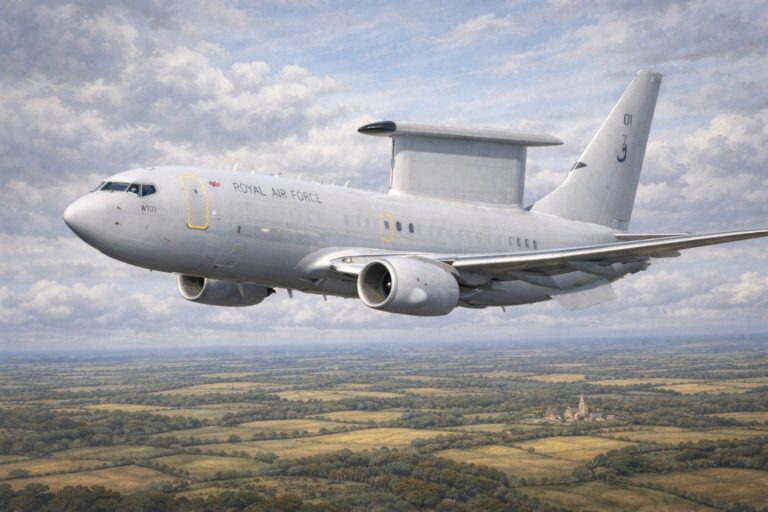
The Boeing E-3D Sentry gave the RAF a mature airborne early warning and control capability from 1991 to 2021, linking national air defence with NATO and expeditionary operations.
The Boeing E-3D Sentry gave the Royal Air Force an airborne early warning and control capability that became essential to British and coalition air operations. Entering RAF service in 1991, the aircraft combined long-range radar surveillance with the communications and specialist crews needed to build an air picture, direct fighters and coordinate complex missions. Its distinctive rotating radar dome made it immediately recognisable, but its real importance lay in the information and decisions produced inside the aircraft.
For three decades the E-3D served from RAF Waddington and on overseas deployments. It supported NATO air defence, operations over the Balkans, campaigns connected with Iraq and Afghanistan, the 2011 intervention in Libya and the later fight against Islamic State. Its retirement in 2021 ended a significant chapter in RAF command-and-control history and left the service awaiting the introduction of its E-7 Wedgetail successor.
The Need for Airborne Early Warning
Ground-based radar remains fundamental to air defence, but its view is limited by the curvature of the Earth and by terrain. Aircraft flying low may remain below a ground radar’s horizon until relatively close. An airborne radar operating at altitude can see over a much wider area and can reposition as the tactical situation changes. It also allows controllers to monitor aircraft and direct friendly forces from a position closer to the operating area.
Britain had recognised these advantages well before the E-3D entered service. The RAF had operated the Shackleton AEW.2 as an interim airborne warning aircraft while seeking a more capable replacement. The planned Nimrod AEW.3 was intended to provide that next generation of surveillance, using a British aircraft and radar system. Development proved exceptionally difficult, particularly in integrating the sensors and processing systems into an operationally reliable whole.
From Nimrod AEW.3 to the Boeing E-3D
The Nimrod AEW.3 programme was cancelled in 1986. By then the RAF still needed to replace its ageing Shackleton fleet, and continuing with an uncertain domestic programme risked extending the capability gap. The government chose the Boeing E-3, a type already established in United States and NATO service, and ordered seven aircraft in a British-specific configuration.
The decision was politically and industrially controversial because it ended a major British development effort. Operationally, however, the attraction of the E-3 was clear. It offered an existing radar, airframe and battle-management concept that could be adapted to RAF requirements. Buying a proven design did not remove every integration or support challenge, but it substantially reduced the risks of creating an entirely new airborne warning system.
The E-3D entered RAF service in 1991. It provided the service with a modern airborne command-and-control aircraft at a time when the Cold War was ending and coalition expeditionary operations were becoming increasingly important.
A Boeing 707 Airframe with a Specialised Mission
The Sentry was developed from the Boeing 707 airliner, extensively adapted to accommodate radar, communications, mission consoles and military operating requirements. Its most visible feature was the large rotodome mounted above the rear fuselage on supporting struts. The dome housed the rotating surveillance radar antenna and associated equipment.
The RAF’s E-3D differed in important respects from earlier American E-3 variants. British aircraft were powered by CFM International CFM56 turbofans, providing improved fuel efficiency and performance compared with the engines fitted to older examples. They also incorporated a British communications and equipment fit, including arrangements intended to support RAF and NATO operating practices.
Air-to-air refuelling extended the aircraft’s endurance and flexibility. The E-3D could receive fuel using a probe arrangement compatible with British tanker operations, while the fleet also had provision associated with boom refuelling. The ability to remain on station for long periods mattered because a surveillance aircraft becomes most valuable when it can maintain continuity of coverage and control through successive waves of friendly aircraft.
How the Rotodome and Radar Worked
The rotating radar antenna scanned the surrounding airspace as the aircraft orbited its assigned area. Operating at altitude gave the radar an extended horizon compared with surface installations, particularly against low-flying targets. Radar returns were processed into tracks that mission crews could examine, classify and monitor over time.
Detection range was not a single fixed number. It varied with target size, altitude, radar conditions, terrain and the wider electromagnetic environment. A high-flying large aircraft could be detected under very different circumstances from a small aircraft flying close to the surface. The E-3D’s value therefore came from the combination of wide-area surveillance, repeated tracking and the judgement of its operators.
The aircraft could monitor many contacts simultaneously, but radar data alone did not provide a complete understanding of the battlespace. Operators had to compare tracks with flight plans, identification information, reports from other sensors and instructions from command authorities. Building a reliable recognised air picture required continual interpretation rather than simply watching symbols move across a screen.
Inside the Airborne Command Post
The Sentry’s mission cabin contained workstations for surveillance and control personnel. The flying crew operated the aircraft while mission specialists managed radar information, identification, communications and tactical control. Their combined work transformed sensor returns into information that commanders and other aircraft could use.
Surveillance operators followed contacts, assessed their behaviour and helped maintain an accurate air picture. Fighter controllers could direct friendly aircraft towards assigned areas, help position interceptors and manage aspects of the air battle. Communications personnel maintained links with other aircraft, ground organisations and coalition headquarters. The precise composition of a crew varied with the task and operating period.
This division of labour explains why the E-3D was more than a radar aircraft. It was an airborne command-and-control centre, able to support decisions while the situation was changing. It carried no offensive weapons, but could influence the effectiveness and safety of numerous armed aircraft through timely information and coordination.
RAF Waddington and the Sentry Force
RAF Waddington in Lincolnshire became the E-3D’s principal British base. No. 8 Squadron was the main operational unit, maintaining the crews and aircraft needed for airborne warning and control duties. The specialist nature of the mission required extensive training in radar interpretation, communications, airspace procedures and the control of friendly aircraft.
No. 23 Squadron also operated the Sentry during part of the type’s RAF career, before its later disbandment as an E-3D unit. No. 54 Squadron contributed to training and conversion arrangements, while No. 56 Squadron undertook operational evaluation responsibilities. These supporting functions mattered because changes to equipment and tactics had to be tested, taught and incorporated into routine operations.
The Sentry fleet was relatively small, making aircraft availability and trained personnel especially important. A single aircraft could contribute to a large operation, but sustained coverage required crews, engineers, spare parts, mission planning and coordination with other forces. The RAF’s investment was therefore in an entire airborne surveillance system rather than seven airframes alone.
British Air Defence and NATO Integration
The E-3D supported the defence of UK airspace by adding an airborne surveillance and control layer to ground-based radar and command arrangements. It could monitor areas beyond the immediate reach of surface sensors, help identify developing situations and support the direction of fighters. Such missions were part of the broader system of national and allied air defence.
NATO interoperability was central to the aircraft’s role. Air operations across national boundaries require common procedures, reliable communications and an agreed understanding of which aircraft are friendly, neutral or potentially hostile. The E-3D could contribute to that shared picture and assist the control of aircraft from several nations during exercises or operations.
Much of this work took place away from public attention. Training sorties, readiness duties and large multinational exercises developed the procedures needed for wartime employment. They should be distinguished from combat deployments, even though the same skills and equipment supported both.
Operations over the Balkans
The conflicts that followed the break-up of Yugoslavia demonstrated the importance of airborne surveillance and control in multinational operations. Coalition and NATO aircraft operated in complicated airspace, often with different national rules, missions and supporting organisations. Maintaining awareness of aircraft movements and coordinating the use of airspace were essential tasks.
RAF Sentries contributed to the wider NATO airborne warning and control effort associated with operations in the Balkans. Their crews helped maintain the recognised air picture and supported the coordination of aircraft engaged in enforcement, patrol and combat missions. These operations illustrated the practical value of a shared command-and-control system when many nations were flying over the same region.
The aircraft did not deliver weapons. Its contribution was to help the force operate coherently, reduce confusion and provide commanders with timely information about the air situation.
Iraq and Coalition Air Operations
Iraq-related operations formed another major part of the Sentry’s post-Cold War service. Coalition aircraft required surveillance, control and coordination during periods of airspace enforcement and later combat operations. The E-3D’s ability to track aircraft and communicate with different elements of an air package made it valuable in this environment.
Complex strike operations might involve fighters, attack aircraft, tankers, electronic support and aircraft carrying out surveillance. Their movements had to be coordinated across large distances while maintaining separation and awareness of possible threats. An airborne command post could assist with these tasks and provide a common operating picture to crews and commanders.
Such missions showed that the E-3D’s significance extended beyond traditional fighter interception. Airborne warning and control had become an enabling capability for almost every aspect of a modern air campaign.
Afghanistan and Expeditionary Support
Operations connected with Afghanistan placed different demands on airborne command and control. The air threat differed markedly from that envisaged during the Cold War, but coalition aircraft still needed coordination, surveillance and communications across a geographically challenging theatre.
Aircraft conducting strike, reconnaissance, transport and support missions had to operate within a common airspace system. The Sentry could assist the wider coalition effort by contributing to airspace management and the recognised picture. The value of its mission therefore did not depend on the presence of large formations of hostile fighters.
Afghanistan underlined an important change in how airborne warning aircraft were employed. The same platform developed for monitoring air threats could also support the organisation of extensive expeditionary air activity.
Libya: Operation Ellamy and Unified Protector
The 2011 campaign over Libya brought the E-3D into another complex multinational operation. British participation began under Operation Ellamy, while NATO subsequently assumed command of the wider effort through Operation Unified Protector. Coalition aircraft undertook patrols, reconnaissance, strikes and support missions over and around Libya.
Airborne warning and control helped coordinate aircraft from different countries and maintain awareness of activity across a large operating area. Sentry crews contributed to the surveillance and battle-management arrangements required to keep the air campaign organised. The aircraft’s communications and control capability was particularly important when different aircraft types and national contingents needed to operate together.
The Libyan campaign reinforced the E-3D’s importance as a force multiplier. Its contribution was not measured in bombs dropped, but in its ability to help other aircraft carry out their tasks safely and effectively.
Ageing Aircraft and a Shrinking Fleet
By the later years of service, the RAF’s Sentry fleet was ageing. Keeping a specialised aircraft available required maintenance, trained engineers and continued support for its mission systems. As numbers declined, the remaining aircraft carried a greater burden of training and operational commitments.
The original order of seven aircraft did not translate into seven continuously available operational machines throughout the type’s career. Losses, withdrawals and changing support arrangements reduced the fleet. Decisions about whether to invest in further upgrades were influenced by cost, remaining service life and plans for a successor.
Ageing radar and communications equipment also had to be considered against the growing demands of modern networked warfare. The E-3D remained useful, but sustaining and modernising a small fleet became increasingly difficult.
Operation Shader and the Final Deployment
In its final operational period, RAF Sentries supported Operation Shader, the British contribution to operations against Islamic State. Aircraft operating from RAF Akrotiri in Cyprus provided airborne surveillance and control in a region where coalition aircraft were conducting numerous missions.
The Sentry’s contribution again centred on coordination rather than direct attack. Crews helped maintain an understanding of air activity and supported the organisation of friendly aircraft over a large area. Its presence was valuable even as the RAF prepared to withdraw the type.
During the final deployment in 2021, the E-3D also supported activity associated with the HMS Queen Elizabeth Carrier Strike Group in the Middle East. This illustrated the aircraft’s continuing usefulness to joint and coalition operations. The last operational sortie took place in 2021, shortly before the formal end of RAF Sentry service. The distinction matters: a final deployed mission and the administrative retirement of an aircraft type are related events, but not necessarily the same occasion.
Retirement and the E-7 Wedgetail
The RAF retired the E-3D in 2021 after approximately thirty years of service. The decision ended the operation of a distinctive Boeing 707-derived aircraft and the associated UK Sentry force. It also created a period in which the RAF did not have a direct fixed-wing replacement already established in operational service.
The Boeing E-7 Wedgetail was selected as the successor. Its modern radar and mission systems were intended to provide airborne surveillance and battle management for a new generation of RAF and allied operations. The E-7 is a different aircraft with a different radar arrangement, rather than simply an updated E-3D.
The transition raised questions about fleet size, readiness and the continuity of specialist skills. Airborne warning is not a capability that can be recreated instantly by buying aircraft. It also depends on trained mission crews, established procedures, engineering support and integration with national and allied command systems.
The E-3D’s Place in RAF History
The Boeing E-3D Sentry helped change how the RAF observed and controlled air operations. Its radar provided wide-area surveillance, but its greatest value came from combining that information with trained people and dependable communications. It linked individual aircraft to a wider understanding of the battlespace and made complex multinational operations easier to organise.
From the end of the Cold War through the Balkans, Iraq, Afghanistan, Libya and Operation Shader, the Sentry repeatedly demonstrated that command and control are operational capabilities in their own right. It did not need to carry weapons to influence the outcome of missions flown by other aircraft.
Its retirement marked the end of a major period in British airborne warning history. The E-3D’s lasting significance lies in the crews, systems and methods through which the RAF learned to manage the modern air battle from above.
| Dimensions | |
| Wingspan | 145 ft 9 in (44.42 m) |
| Length | 152 ft 11 in (46.61 m) |
| Height | 41 ft 4 in (12.6 m) |
| Wing area | 3,050 sq ft (283.4 m²) |
| Weights | |
| Empty weight | 171,000 lb (77,565 kg) |
| Max takeoff weight | 347,000 lb (157,398 kg) |
| Performance | |
| Maximum speed | 530 mph (853 km/h) |
| Cruise speed | 461 mph (742 km/h) |
| Service ceiling | 35,000 ft (10,668 m) |
| Range | 4,600 miles (7,400 km) |
| Powerplant | |
| Engines | 4 × CFM56-2 turbofan engines |
| Power | 22,000 lbf thrust each |

No. 29 Squadron Phantoms Take Ascension Island QRA in 1982
On 24 May 1982, No. 29 Squadron’s Phantom fighters took over Quick Reaction Alert on Ascension…
24 May 2026 · 3 minRAF Typhoons Join Allied Strikes Against Houthi Targets in Yemen
On 3 February 2024, RAF Typhoons joined allied strikes on Houthi targets in Yemen as part…
3 February 2026 · 5 minFirst Apache Delivered to the British Army Air Corps
On 15 March 2000, the first Westland-built WAH-64 Apache entered British service, marking a major step…
15 March 2026 · 3 min