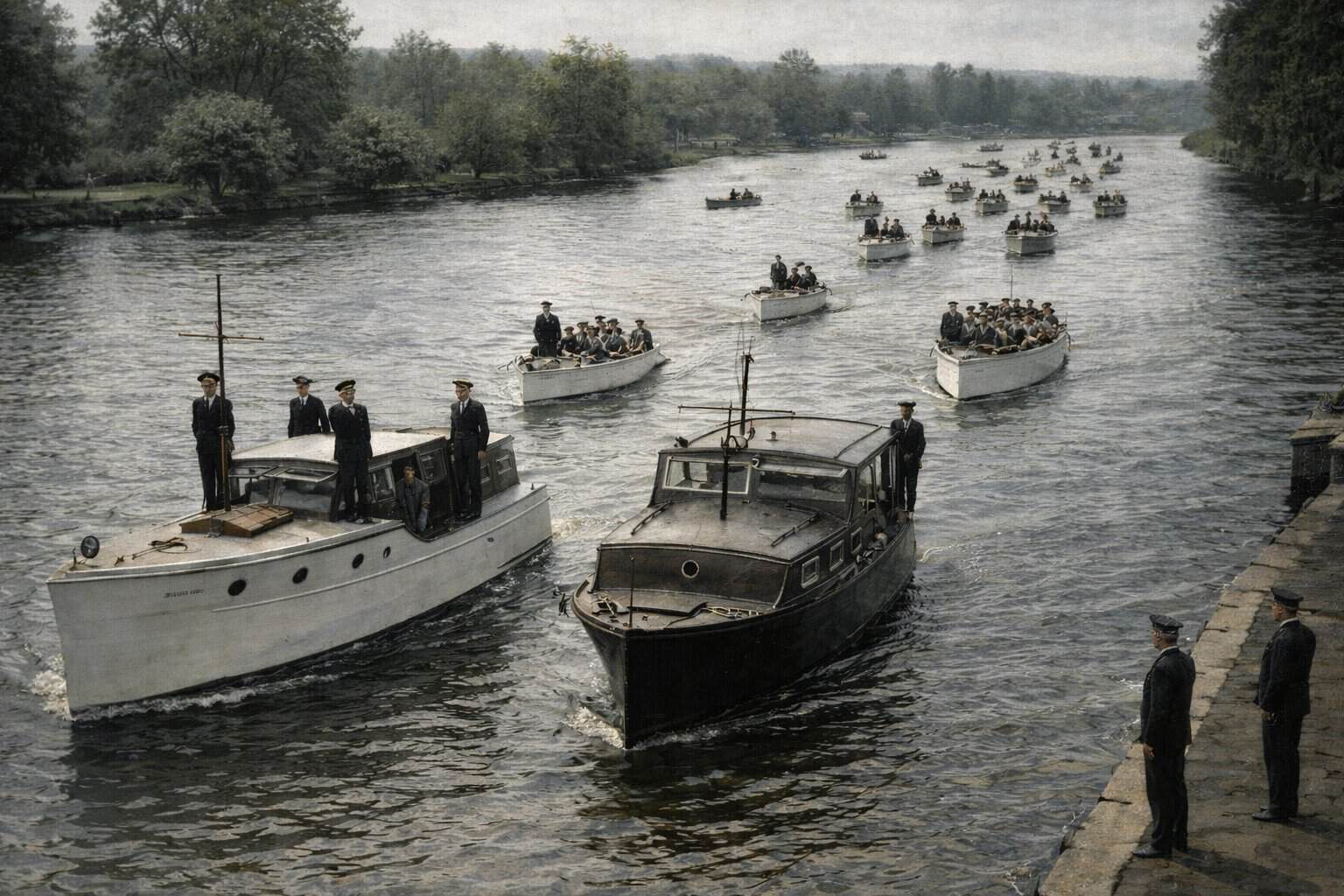
The Dunkirk evacuation in May and June 1940 is usually remembered for the defence of the beaches, the sea crossing, and the air battle fought above them. For the Royal Air Force, however, the crisis also exposed a different problem: the movement of men, information and urgent matériel under extreme pressure. Operation Dynamo was not an airlift, and aircraft could not evacuate an army from the beaches as ships and small craft could. Yet the emergency showed that air transport and rapid air movement would become increasingly important to the conduct of modern war.
In that sense, Dunkirk belongs not only to the history of Fighter Command and the Battle of France, but also to the longer development of RAF air mobility. The evacuation revealed both the limits of what aircraft could do in a crisis of this kind and the value of having a more organised transport capability for urgent movement, liaison and reinforcement.
Background
When the German offensive in the west broke through in May 1940, the Allied position in France deteriorated quickly. The British Expeditionary Force and other Allied formations were pushed back towards the Channel coast, and Dunkirk became the focus of a major evacuation effort. The RAF’s most visible role lay in providing fighter cover, contesting Luftwaffe attacks on the beaches, harbour and shipping routes, and trying to preserve the air conditions in which evacuation could continue.
At this stage of the war, however, the RAF was not organised around large-scale transport operations in the latter sense. Transport flying existed, but it remained a relatively limited and secondary function compared with air defence, bombing and reconnaissance. The emergency in France placed great strain on communications, coordination and the rapid movement of key personnel and supplies. Even where aircraft could not solve the main evacuation problem, they highlighted how much modern operations depended on the speed of movement.
Evacuation Under Pressure
Operation Dynamo remained overwhelmingly a maritime operation. The physical removal of large numbers of troops depended on destroyers, naval craft, merchant vessels and the small boats that entered the evacuation story so prominently. To present Dunkirk as an example of mass RAF air transport would therefore be misleading.
What the episode did show was something narrower but still important. In a collapsing operational situation, air power offered a means of urgent movement that surface communications could not always match. Aircraft could carry messages, liaison staff, small high-priority loads and selected personnel with a speed that mattered when roads were congested, rail movement was disrupted and command decisions had to be taken quickly. In such circumstances, the difference between bulk transport and priority transport became especially clear.
This distinction mattered in RAF terms. Air transport was not a substitute for shipping, but it could still affect the efficiency of a wider evacuation or withdrawal. The pressure of Dunkirk demonstrated that mobility in war did not only concern the movement of armies in the aggregate. It also concerned whether commanders, staff, technical specialists and urgent stores could reach the right place at the right time.
The wider air battle reinforced that lesson. Fighter Command’s Hurricanes and Spitfires helped to keep evacuation routes contested rather than abandoned to the Luftwaffe, while other RAF efforts supported the struggle in different ways. Yet beneath the visible combat lay the quieter problem of sustaining contact, passing information and moving what could be moved quickly enough to matter. The emergency exposed how heavily modern operations depended on flexible systems of movement, even when those systems were still underdeveloped.
From Improvisation To Organisation
Dunkirk did not by itself create RAF Transport Command, nor did it instantly transform British doctrine. The lesson was cumulative rather than sudden. Even so, the evacuation formed part of the early wartime experience that showed why transport flying could no longer be treated as a marginal activity.
As the war widened, the RAF faced theatres and tasks that made organised air movement far more important. Reinforcement over long distances, casualty evacuation, movement of specialist personnel, rapid delivery of urgent cargo and support to difficult theatres all demanded a more coherent transport structure. What had appeared at Dunkirk as an improvised necessity became, in later campaigns, an established operational requirement.
This development can be seen in the later wartime rise of dedicated transport organisations and in the growing importance of aircraft such as the Douglas Dakota. Such aircraft represented a stage beyond the emergency conditions of 1940. They gave the RAF a practical means of carrying troops, freight and casualties on a scale and with a regularity that early-war conditions had not yet allowed. The movement from improvised wartime expedients to organised air mobility was therefore not a break from Dunkirk’s lessons, but an extension of them.
Significance of Dunkirk
The historical importance of Dunkirk in this context lies in what it revealed. It exposed the limits of air transport during a major coastal evacuation, clearly showing that aircraft could not replace sea lift when mass movement was required. At the same time, it demonstrated the growing importance of speed, coordination and selective movement by air within a much larger operation.
For the RAF, that was a meaningful distinction. The Service’s future effectiveness would depend not only on fighters, bombers and reconnaissance aircraft, but also on its ability to move people, information and vital stores rapidly across theatres and between commands. Later wartime developments, and the post-war growth of organised air mobility, rested on that broader understanding of what air power had to sustain.
Dunkirk stands as an early warning as much as a triumph of endurance. It showed that modern evacuation and reinforcement depended on more than courage, sea power or air cover alone. They also depended on the capacity to organise movement under pressure. In RAF history, that helped point the way from emergency improvisation towards the more mature transport capability that later became a permanent part of British air power.