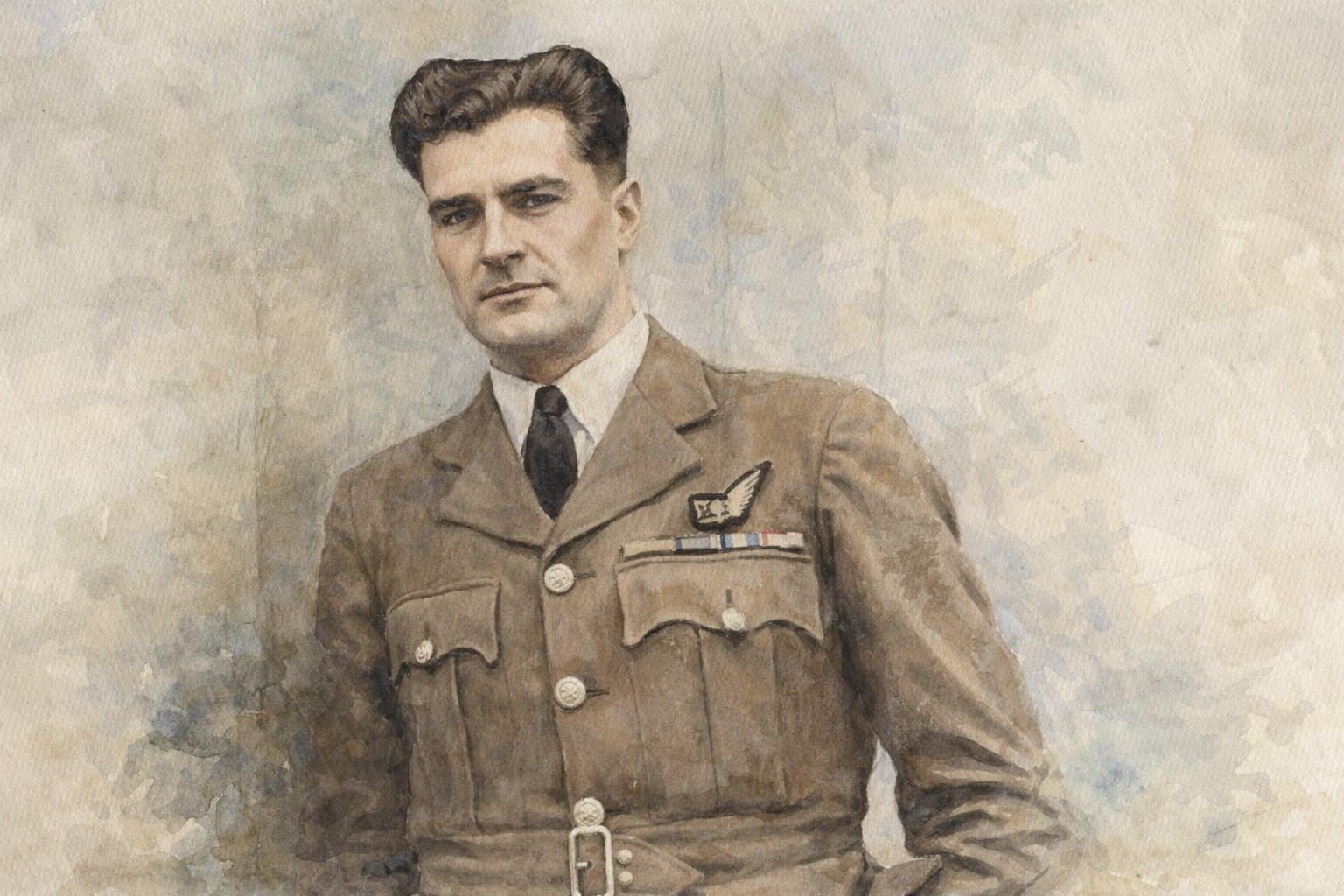
On 26 April 1944, Sergeant Norman Cyril Jackson carried out one of the most extraordinary acts of courage recorded in Bomber Command. During an operation over Germany, his Avro Lancaster caught fire after enemy attack. With the aircraft in mortal danger and the flames threatening the wing, Jackson climbed out onto the aircraft itself and tried to beat out the fire while the bomber was still in flight. He later escaped by parachute, only to fall into captivity. For that action, he was awarded the Victoria Cross.
Courage in the middle of catastrophe
Air war gallantry is often described in terms of pressing home attacks through flak or fighter opposition. Still, Jackson’s deed stands apart because it was so physically immediate. This was not an act of command from the cockpit, nor a brief split-second decision behind armour and Perspex. It was a deliberate move out into the slipstream, onto the wing of a burning heavy bomber at height, in darkness and under extreme stress. Few situations could be more exposed.
The danger was not abstract. A fire in a bomber’s wing could quickly destroy lift, reach fuel or ammunition and doom the entire crew. Jackson’s action was therefore both selfless and practical. He was trying to preserve the aircraft and save the men aboard it. The Victoria Cross has always recognised not only bravery, but bravery in circumstances where the outcome may affect others as much as the individual concerned. That principle is very clear here.
The reality of Bomber Command operations
This episode also captures the grim vulnerability of Bomber Command crews in 1944. By that stage of the war, the RAF’s night offensive against Germany had reached a scale and intensity unimaginable a few years earlier, but the dangers remained acute. Heavy bombers flew long routes into defended airspace, and a single burst of enemy fire could turn an aircraft from a machine of offence into a trap of flame, metal and smoke.
Jackson’s ordeal reminds us that survival in such conditions depended not only on training and discipline, but sometimes on sheer personal nerve. Bomber crews lived with the knowledge that if their aircraft were hit, choices would have to be made in moments: whether to fight the damage, whether to abandon the aircraft, and how to give comrades a chance to live. His conduct belongs to that harsh world, in which heroism and desperation were often inseparable.
Why Jackson’s action endures
The later award of the Victoria Cross confirmed that this was bravery of the highest order. Yet the story is memorable for more than decoration. It endures because it shows the moral character that wartime aircrew could display when everything was breaking down around them. Jackson did not act because success was assured. He acted because there was still something to be attempted on behalf of others.
In RAF memory, 26 April 1944 stands as a date that illustrates the human dimension of the bomber war with unusual clarity. It was an air campaign measured in tonnages, routes and targets, but it was also fought by individuals facing moments of almost unimaginable fear. Sergeant N. C. Jackson’s climb onto a burning wing remains one of the clearest examples of courage under impossible conditions.