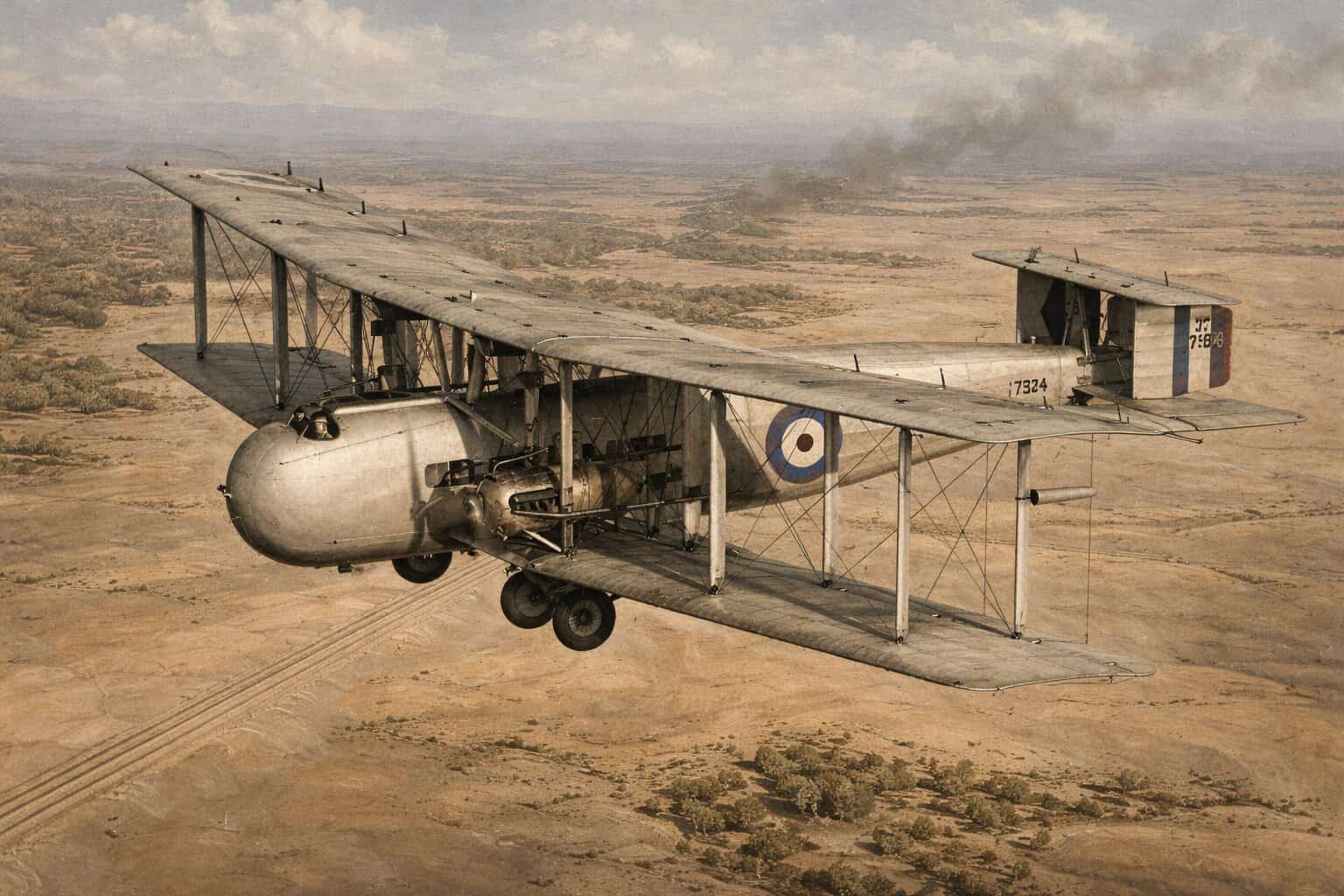
On 25 April 1932, the Royal Air Force employed airborne loudspeakers and leaflet drops in north-east Iraq while supporting Iraqi government forces against a revolt associated with Sheikh Ahmad of Barzan. The episode belongs to the inter-war history of imperial air control, when the RAF was expected not only to strike from the air but also to influence events on the ground through speed, reach and psychological pressure. In that setting, aircraft were used as instruments of both communication and coercion.
Air power beyond bombing
Inter-war RAF operations in the Middle East were shaped by the belief that aircraft could respond faster than large ground columns and could exert pressure over difficult terrain at lower political and financial cost. That idea was controversial then and remains so now, but it formed an important part of British policy in the region. Air action was therefore not limited to attacking hostile positions. It also included reconnaissance, warning, demonstration and attempts to persuade opponents that resistance would bring only heavier consequences.
The use of loudspeakers and leaflets on this date shows how seriously the RAF took that wider role. Messages delivered from the air had an obvious practical purpose. They could carry warnings, announce demands, urge dispersal or make clear that further resistance was likely to provoke stronger action. In remote districts where ordinary civil channels were weak or absent, aircraft could project authority quickly and visibly. Their appearance overhead was itself a statement; the spoken and printed message gave that appearance political meaning.
The Iraq operation in context
The outline of the event places 30 Squadron, 55 Squadron and 70 Squadron in support of Iraqi forces. That matters because the operation was not presented simply as an isolated British action. It sat within the framework of Britain’s treaty position and its continuing military involvement in Iraq during the mandate and early independence period. RAF units were being used to assist a local government confronting a regional rising, and air methods were adapted accordingly.
Leaflet dropping had become an established military tool by this period, but airborne loudspeakers gave the effort a more immediate quality. Spoken warnings could be repeated, altered, and delivered at a speed that printed material alone could not match. They also reflected an attempt to shape behaviour without relying entirely on destruction. That did not make the campaign bloodless or gentle, yet it shows that RAF commanders recognised a spectrum of air-power methods between mere presence and direct attack.
Why the episode is significant
This was a small episode in comparison with the great air campaigns of the Second World War, but it is historically revealing. It illustrates how the inter-war RAF saw itself: not only as a fighting service, but as a flexible imperial instrument capable of surveillance, communication and punishment across wide spaces. It also reveals an early understanding of what would later be called information operations. The aim was to affect decisions, morale and compliance, not simply physical targets.
For RAF history, 25 April 1932 marks more than a curious technical experiment. It shows the service applying aviation to political warfare in an era when aircraft were still comparatively young tools of state power. The loudspeaker and leaflet mission in Iraq reminds us that air power has long involved words as well as weapons. That control of events from the air was often pursued through a combination of persuasion, warning, and intimidation rather than through bombing alone.