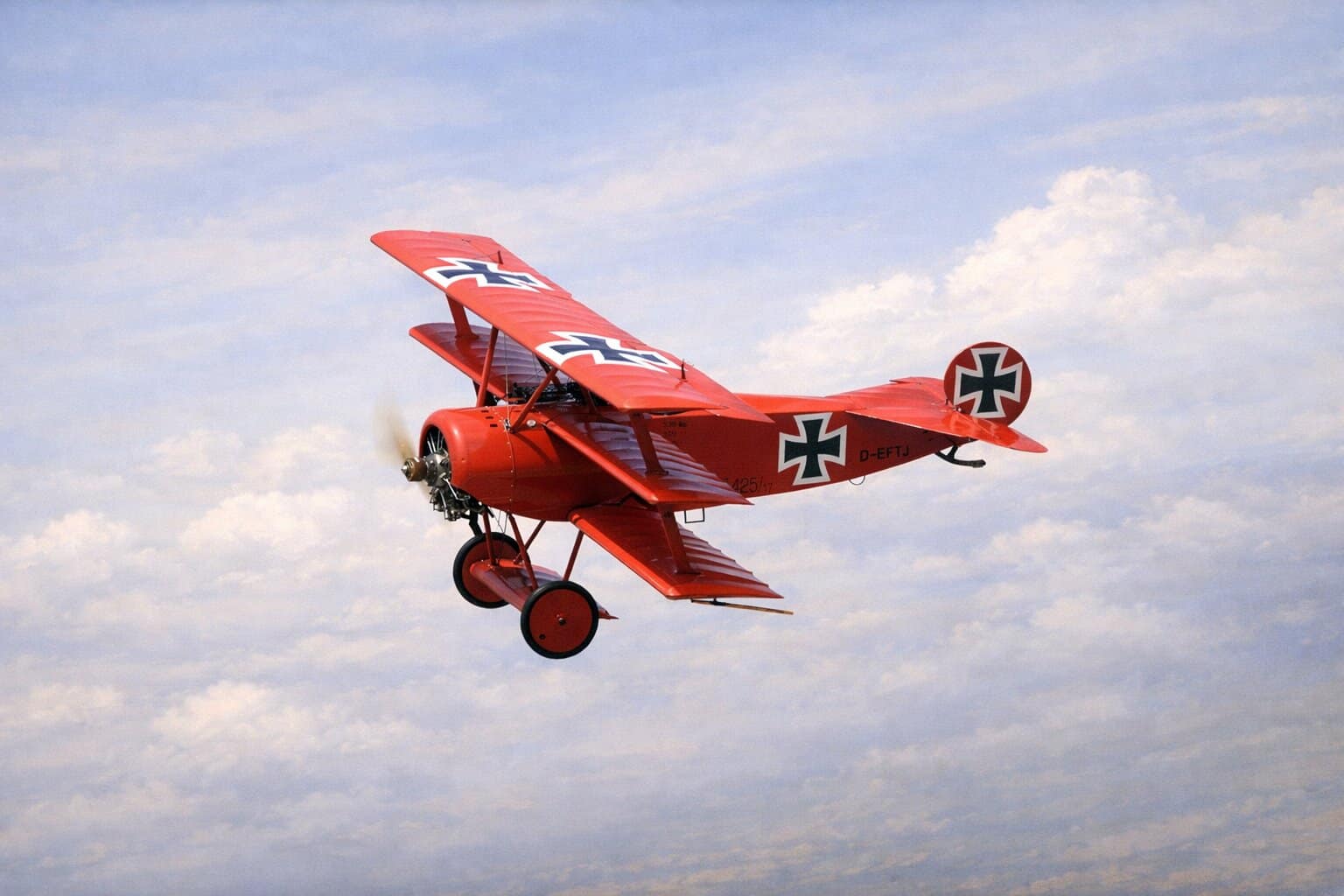
On 21 April 1918, Manfred von Richthofen, better known as the Red Baron, was shot down and killed during aerial combat on the Western Front. By then, he was Germany’s most celebrated fighter pilot, officially credited with 80 victories, and his death was immediately recognised as a moment of real significance in the air war. Captain Roy Brown of No. 209 Squadron, flying a Sopwith Camel, received official credit for the attack, placing the episode firmly within the early history of the newly formed Royal Air Force.
The combat and its immediate meaning
Richthofen’s death came at a time when air fighting over the Western Front had become both intense and highly visible. Fighter pilots were expected to do more than protect their own side’s aircraft. They also had to contest control of the skies above the battlefield, disrupt enemy reconnaissance, and prevent opposing airmen from shaping events on the ground. In that setting, the loss of a leading ace carried weight far beyond a single engagement.
The official account gave Brown credit, and that version was accepted at the time. Even so, the incident has long attracted close historical scrutiny because it involved a celebrated opponent, a confused combat situation and the inevitable uncertainty that often followed First World War air fighting. What remains beyond doubt is the central fact remembered on this date: one of the war’s most famous airmen was brought down, and an RAF officer was officially credited with the victory.
Outcome and historical significance
The immediate result was both military and symbolic. Richthofen’s death removed an experienced and influential German fighter leader at a stage when air power was becoming ever more important to operations on the Western Front. It also had obvious propaganda value. In Britain and across the Allied world, the event could be read as proof that even the most formidable enemy airman was vulnerable. In Germany, the loss was a powerful propaganda value, but the incident's historical importance rests even more on its role in the evolution of air warfare. It demonstrated how central fighter combat had become by 1918 and how quickly the reputations of individual pilots could assume national importance.
Significance for early RAF history
Because the Royal Air Force had been formed only weeks earlier, Brown’s credited victory also entered the service’s earliest institutional memory. Whether later historians continue to debate every aspect of the action does not alter the date's importance within RAF heritage. The death of the Red Baron was immediately seen as a major event in the war in the air, and an RAF squadron was associated with it from the start.
That is why the episode remains so enduring. It brings together combat, reputation, propaganda and historical controversy in a single moment. For the RAF, it stands as one of the best-known events of its opening year and a reminder that the service’s early identity was shaped amid the dangerous, uncertain and highly personalised fighting of the First World War skies.