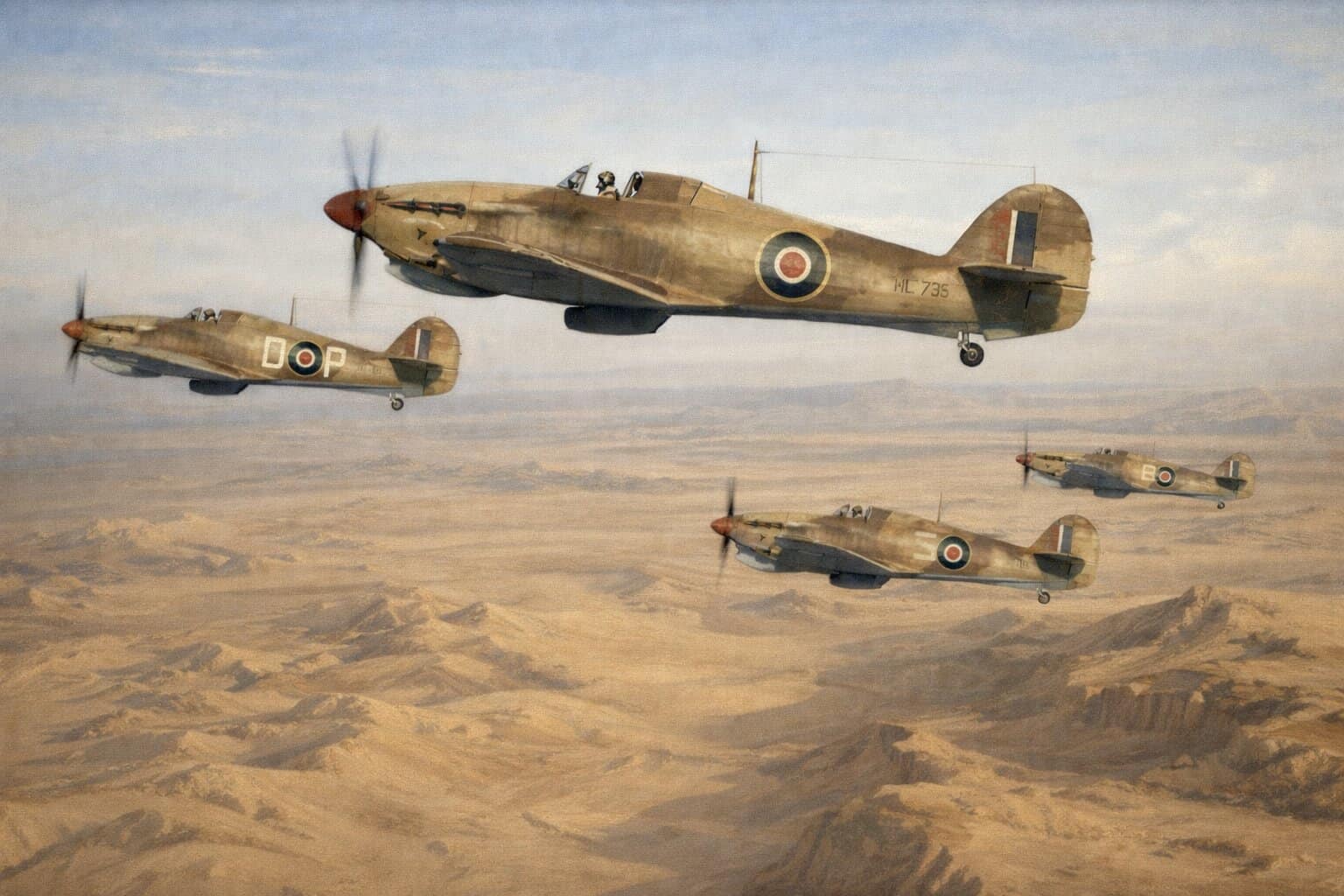
The desert air war was one of the most important theatres in which the RAF developed modern tactical and operational air methods during the Second World War. Fought across North Africa and the Mediterranean, it forced British and Allied air forces to adapt to distance, climate, supply strain, and rapidly changing battle conditions. For the RAF, the campaign was not only a struggle for air superiority but also a laboratory for mobile air-ground cooperation, interdiction and evolving command methods.
The desert war matters in RAF history because it sits at the intersection of operational necessity and doctrinal development. Aircraft had to support army operations, attack transport and supply, maintain local air superiority and operate from rough conditions over immense distances. In doing so, the RAF helped shape a more flexible approach to tactical air power than had been common in the earlier stages of the war.
Conditions and operational challenge
North Africa presented unusual demands. The distances involved were vast, airfields could be primitive, and maintenance was made harder by heat, dust and supply difficulty. Aircraft performance, reliability and endurance all became practical operational issues rather than abstract technical details.
These conditions forced adaptation. The RAF could not fight in the desert exactly as it had fought over France or southern England. Instead, commanders and crews had to learn how to support fast-moving operations in a theatre where the front could shift rapidly and where logistics mattered as much as combat.
Air superiority and battlefield effect
A central requirement of the desert campaign was the struggle for local air superiority. Without it, army movement, supply and concentration were all far more vulnerable. RAF fighters had to protect friendly forces while also pressing enemy aircraft whenever possible.
Yet the Desert Air War was not simply about fighter combat. One of its broader lessons was that air power could influence the battlefield through interdiction, disruption of transport, and attacks on supply lines. Roads, columns, depots and communications all became legitimate and important targets. Air attack could therefore shape land operations beyond the immediate front line.
Coningham and tactical development
The campaign is closely associated with Arthur Coningham and the broader development of tactical air methods. The important point is not simply the name of one commander, but the principle that air power should be used flexibly and centrally to achieve operational effect across the battlefield as a whole.
In the desert, this meant that aircraft were not treated as isolated adjuncts to individual ground formations. Instead, air assets could be concentrated where they would do the greatest damage or provide the greatest protection. That approach, refined in North Africa, became highly influential in later Allied campaigning.
Aircraft and versatility
The desert war also illustrated the value of versatility in aircraft employment. Types such as the Hawker Hurricane and, later, the Supermarine Spitfire were used in difficult and changing conditions, while other aircraft contributed to reconnaissance, strike, and maritime duties in the Mediterranean sphere.
The campaign sits within a broader RAF story in which aircraft had to be adapted not only to enemies, but to climate, range and supply realities. The desert war was a contest in which practical flexibility often mattered more than ideal theoretical doctrine.
Historical significance
The RAF in the desert air war is historically important because the campaign helped mature the British understanding of tactical air power. North Africa demonstrated that air superiority, interdiction, and support to ground forces were most effective when treated as parts of a single coordinated system.
It also showed the RAF operating under some of the war's harshest practical conditions, in a theatre of real strategic importance. The lessons learned there fed into later Mediterranean and north-west European operations. For that reason, the desert air war deserves to be seen as one of the key RAF development theatres of the Second World War, not merely as a secondary sideshow to the better-known campaigns in Britain or over Germany.