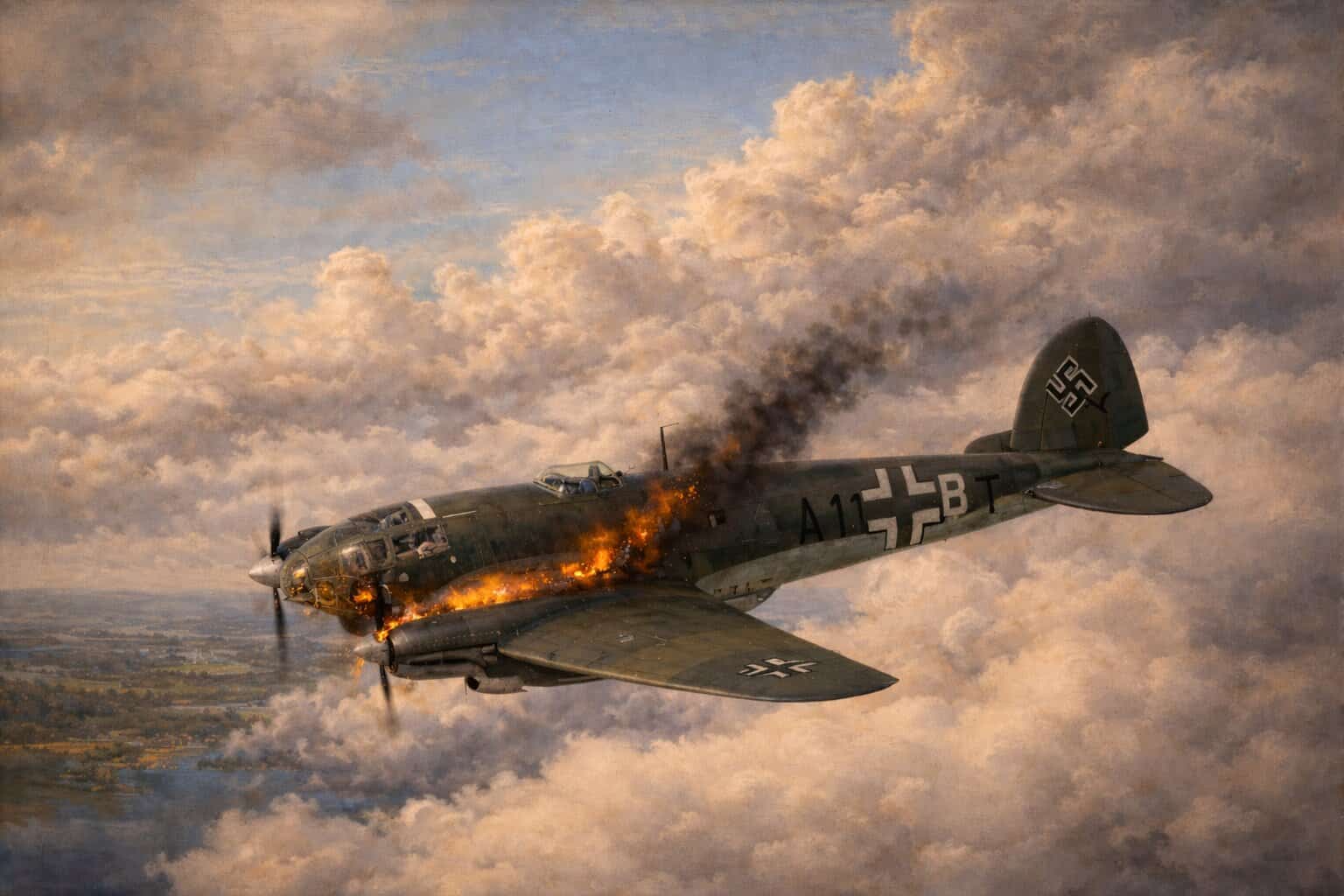
On 16 March 1940, the air war reached one of Britain’s most important naval anchorages when German aircraft attacked Scapa Flow in the Orkneys. The raid came during the opening phase of the Second World War, at a moment when both sides were still testing the reach, accuracy and strategic value of air power. Although the physical damage to the Royal Navy’s base was limited, the attack had significance far beyond the bombs actually dropped. It demonstrated that the Luftwaffe was prepared to strike deep into British home waters, and it is widely remembered for causing the first British civilian casualty of the war.
The Attack on the Anchorage
Scapa Flow had long been central to British maritime strategy. In the First World War, it had served as the Grand Fleet’s main base, and in 1940 it again represented a vital concentration point for major warships guarding the North Sea approaches. That importance made it an obvious target for German reconnaissance and, when opportunity offered, for direct attack.
The Luftwaffe’s raid targeted the anchorage and the ships lying there. German bombers approached the area and released their weapons against naval objectives around Scapa Flow. As with many early-war air operations, results fell short of the attacker’s larger hopes. The Royal Navy did not suffer a crippling blow, and the raid did not alter control of the surrounding seas. Even so, the operation showed that fixed assumptions about the safety of British bases were already under pressure.
Bombs also fell beyond their intended military effect. In Orkney, a civilian was killed, giving the raid a grim place in the chronology of the war. That fact alone ensured that the attack would be remembered not merely as an unsuccessful strike on a fleet anchorage, but as an early warning that the war was no longer confined to distant fronts or to purely military communities.
Results and Immediate Meaning
Measured in strictly operational terms, the raid was limited. Scapa Flow remained in use, the Royal Navy was not neutralised, and the attack did not produce the sort of decisive result German planners would have wanted from a blow against such a prominent naval base. Yet air warfare need not be tactically decisive to be strategically revealing. The raid showed that British naval concentrations, however strongly placed in geographical terms, were vulnerable to modern air attack.
For the RAF and for Britain’s wider air-defence system, such attacks reinforced an uncomfortable lesson from the first months of the conflict. Defence was not simply a matter of guarding London or the Channel coast. Remote bases, naval facilities and civilian communities across the United Kingdom also had to be considered within the same expanding air-war map. The threat was national, not regional.
A Wider Air-War Reflection
The March 1940 raid on Scapa Flow belongs to that transitional stage of the war before the great air campaigns of 1940 and 1941 fully developed. It occurred before the Battle of Britain, before the sustained Blitz, and before RAF Bomber Command’s offensive reached its later scale. For that reason, its historical value lies partly in what it foreshadowed. It illustrated the growing interdependence of sea power and air power, and it showed how quickly civilians could become part of the reality of industrialised war.
Scapa Flow itself remained important, and the Royal Air Force‘s role in defending Britain’s maritime lifelines would only grow as the conflict widened. The raid did not decide a campaign, but it marked a revealing moment in the early contest between German offensive air power and British home defence. In RAF terms, it formed part of the broader story of how the war pushed air strategy beyond individual raids and towards a continuous struggle over warning, interception, protection and endurance.
That is why 16 March 1940 still matters. The Luftwaffe’s attack on Scapa Flow was a limited operation, but it signalled that even Britain’s most famous naval sanctuary was within reach of enemy aircraft. In doing so, it offered one of the clearest early indications of the kind of war that lay ahead.