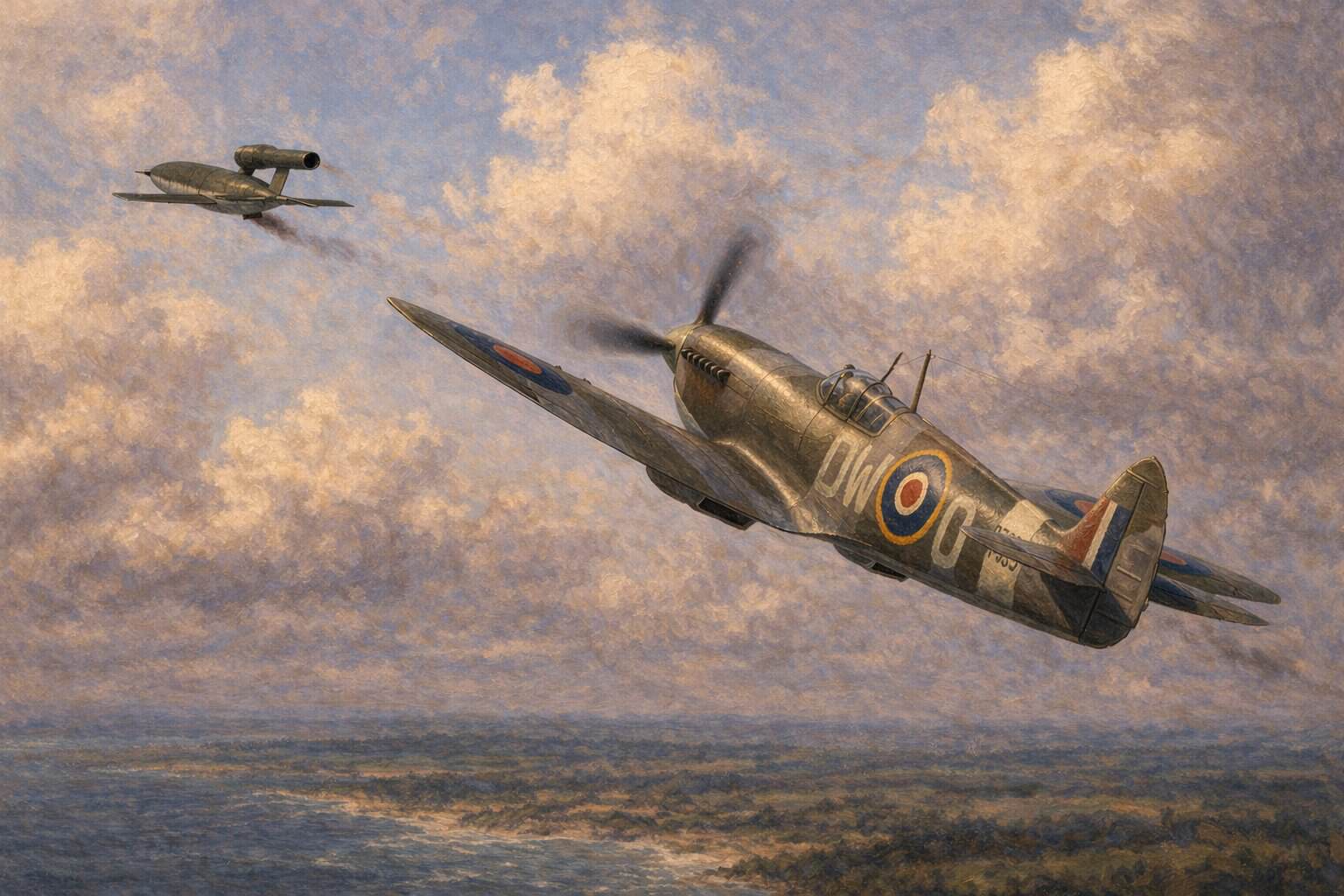
On 29 March 1945, the final V1 flying bomb to reach England was shot down near Sittingbourne, bringing a symbolic close to one of the most unsettling air threats faced by the British public during the Second World War. By that late stage of the conflict, Germany’s capacity to sustain such attacks had been greatly reduced, yet the V1 still carried a particular psychological charge. Its destruction marked not only a successful interception but the end of a campaign that had fused modern technology with terror against civilians.
The V1 Threat to Britain
The V1 was unlike the conventional bomber raids with which Britain had already become grimly familiar. It was an unmanned flying bomb, small in comparison with bomber aircraft but capable of causing death, destruction and fear out of all proportion to its size. Its distinctive engine note became dreaded by those living beneath its route. Even worse was the moment when that sound stopped, because silence often meant the weapon was descending to impact.
For communities in southern England and especially around London and the south-east, the V1 campaign created a new form of anxiety. It was industrialised bombardment that seemed impersonal, relentless and difficult to reason with. The weapon was designed to bypass the moral and operational constraints associated with manned attack. In that sense, it foreshadowed later forms of standoff warfare directed chiefly at civilian morale.
The RAF and the Defence Against Flying Bombs
Britain’s defence against the V1 combined fighter interception, anti-aircraft fire, barrage balloons and a wider system of warning and control. The RAF played a prominent and highly visible part in that struggle. Intercepting a fast, pilotless target demanded skill, concentration and courage. Pilots often had only a brief window in which to engage, and every successful destruction meant lives potentially saved on the ground.
Over time, the air defence system improved, and the rate of successful interceptions increased. This was not simply a matter of bravery, though bravery mattered greatly. It also reflected adaptation: tactics, equipment and organisation were refined in response to a novel threat. That capacity to learn under pressure was one of the defining strengths of Britain’s wartime air defence.
Why the Final V1 Matters
The last flying bomb to reach England carries importance beyond its immediate tactical meaning. By March 1945, the war in Europe was clearly moving toward Allied victory, yet the appearance of one final V1 was a reminder that danger persisted until the very end. Wars do not conclude neatly on the battlefield alone. They linger in the skies, in homes and in the memories of civilians who have endured prolonged attack.
Its destruction near Sittingbourne stands as a moment of closure. It marked the effective end of a specific menace that had haunted ordinary life, interrupted sleep, damaged homes and killed civilians far from any front line. The V1 campaign was not solely a military problem; it was a test of public endurance, civil defence and confidence in Britain’s protective systems.
The End of a Campaign of Terror
Remembering 29 March 1945 is important because it draws attention to the kind of warfare the RAF was helping to defeat. The V1 was a weapon intended to spread fear cheaply and continuously. Countering it required not only aircraft and guns, but also a determination to deny the enemy the psychological victory he sought.
When the final V1 to reach England was shot down, the event closed a chapter in the air war over Britain that had begun with alarm and uncertainty but ended in effective defence. The moment symbolised more than the fall of a single weapon. It represented the defeat of a campaign aimed at the spirit of the civilian population, and it stands as a testament to the persistence of those who defended the skies and endured life beneath them.