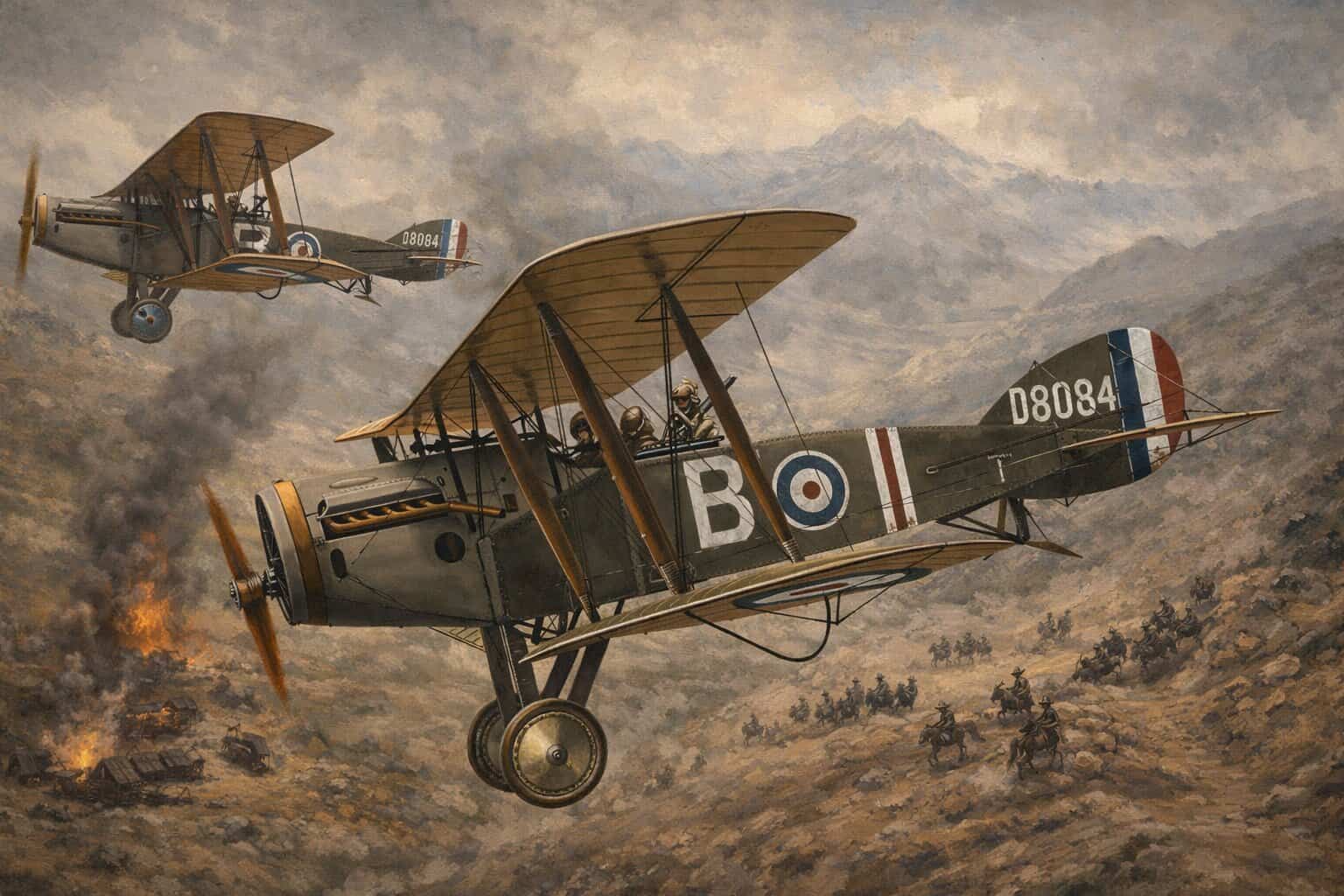
On 9 March 1925, the Royal Air Force opened what became known as “Pink’s War”, a sustained air campaign against Mahsud tribesmen in South Waziristan. Directed by Wing Commander Richard Pink, the operation lasted 54 days and has often been cited as one of the clearest early examples of the RAF attempting to achieve a political and military objective by air action alone. For the inter-war service, it was a significant test of the doctrine of air control on the imperial frontier.
The Opening of the Campaign
The campaign began after unrest in the region and the refusal of the Mahsuds to submit to British authority by the means expected by the Government of India. Rather than launching a large conventional ground expedition, the authorities turned to the RAF as the principal instrument of pressure. That choice reflected both the strategic thinking of the period and the economic pressures of the post-war years. Air power appeared to offer a quicker and cheaper alternative to the costly frontier campaigns that had so often absorbed men, money and time.
Pink’s War was therefore important from the outset not simply because aircraft were used, but because they were used independently. The intention was to apply sustained air pressure to compel compliance, rather than merely to support an army’s advance. That distinction made the operation notable in RAF history.
Air Control in Practice
The fighting in South Waziristan was very different from the air operations that would later define the Second World War. There were no great bomber streams, no integrated air defence system and no industrial targets in the European sense. Instead, the RAF was operating over a remote and difficult frontier environment in support of imperial policy. The campaign showed both the reach and the limitations of aircraft in such a setting.
What Pink’s War demonstrated was that air power could maintain pressure over a prolonged period against opponents who had little capacity to challenge it in the air. Aircraft could strike, return quickly and continue the campaign without the heavy logistical burden that accompanied a major land force. At the same time, the operation also revealed the blunt character of inter-war coercive air policy. The idea of compelling submission from the air was central to imperial policing in this era, but it remained controversial both morally and politically.
Outcome and Significance
After 54 days, the campaign ended with the Mahsuds agreeing to terms, and the operation was widely presented as evidence that independent air action could succeed in a frontier conflict. For the RAF, this mattered greatly. The service was still defending its institutional independence in the years after its creation, and operations such as this were used to argue that air power was not merely an adjunct to the older services, but could achieve results in its own right.
Yet Pink’s War should be understood with care. It did not offer a universal model for every future conflict, nor did it settle broader debates about the effectiveness of bombing as a policy instrument. What it did provide was an early case study in the RAF’s inter-war search for purpose, economy and strategic relevance.
A Wider Reflection
Seen in the longer history of the RAF, Pink’s War belongs to the formative period in which doctrine was being tested in real operations on the imperial periphery. It stands as a reminder that the service’s development between the wars was shaped not only by technological progress, but also by the demands of policing the empire and justifying the independent use of air power. On this day in 1925, the RAF began a campaign whose significance lay less in scale than in what it suggested about the possibilities — and the ambiguities — of air control.