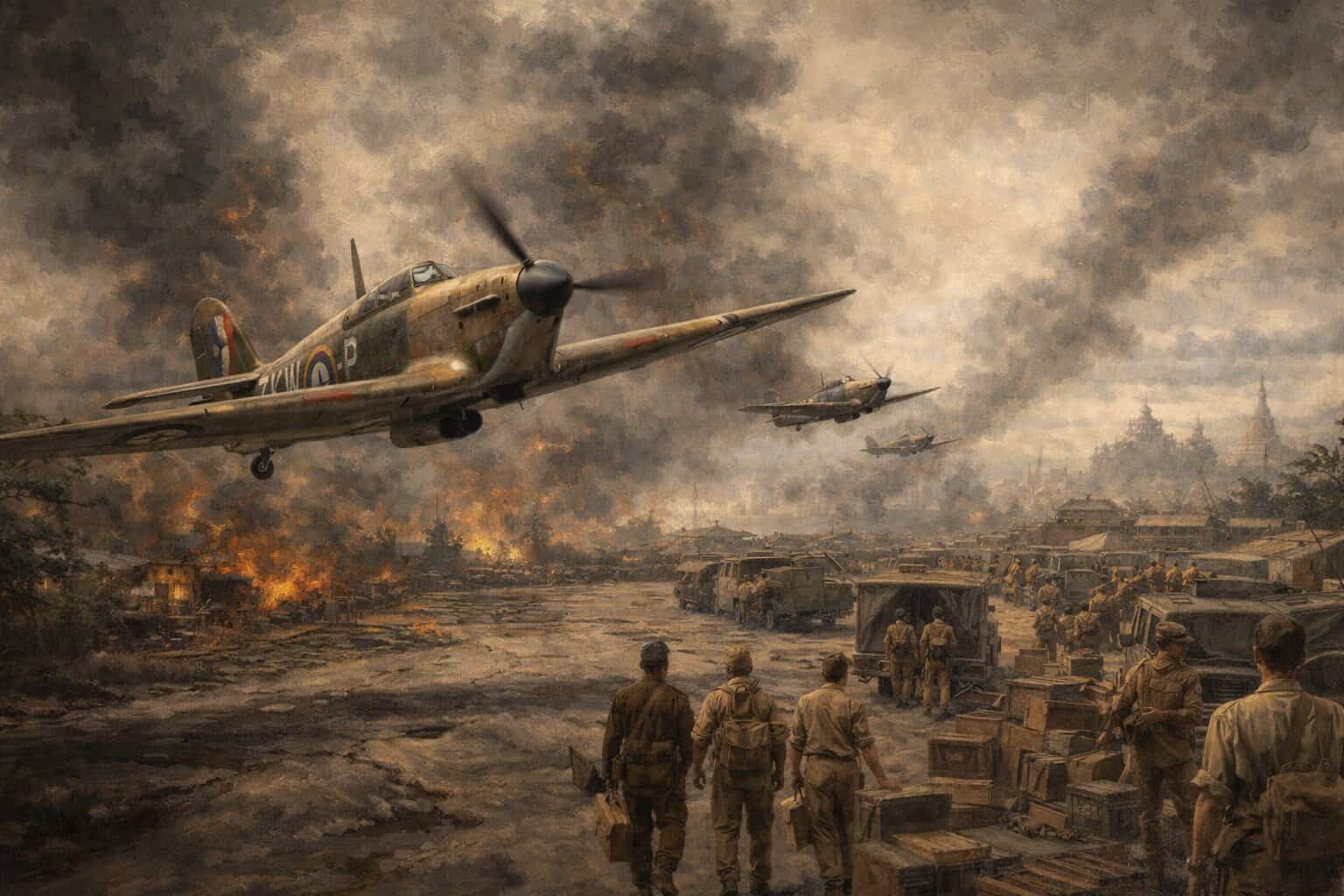
On 8 March 1942, Japanese forces entered Rangoon, a day after British and RAF units had evacuated the already-doomed city and withdrawn north. The loss of Burma’s capital forced the survivors of the RAF’s Burma command into a hurried reorganisation that shaped the air war over Burma for months to come.
The Japanese 15th Army had advanced from Thailand into Burma in January 1942, and by early March its forward units were closing on Rangoon from the east. Rangoon’s fall followed weeks of retreating ground fighting further south, including the disaster at the Sittang Bridge in late February, where much of the 17th Indian Division was cut off east of the river. It completed the collapse of the RAF’s forward base structure in southern Burma, a structure the service had never had enough aircraft or infrastructure to hold securely.
Rangoon’s Strategic Importance
Rangoon was Burma’s principal port, and supplies landed there were carried by rail to Lashio, where the Burma Road began its overland route into China. Fuel, ammunition, replacement aircraft and reinforcements all passed through the city before reaching squadrons further north, and its docks, warehouses and oil terminal made it the only realistic base for sustaining an air campaign in the country.
When the Japanese advance on the city gathered pace in early March 1942, its capture threatened to sever these supply lines entirely. Holding Rangoon was essential to keeping the whole Burma campaign, and the RAF’s part in it, supplied.
The RAF’s Defence and Withdrawal
When Japanese air raids on Rangoon began in December 1941, the city’s air defence rested on a small force: the Brewster Buffaloes of No. 67 Squadron and the Curtiss P-40s of the American Volunteer Group, the unit better known as the Flying Tigers. Reinforcements reached the city in January 1942, among them the Hawker Hurricanes of No. 17 Squadron, but the combined force remained heavily outnumbered by the Japanese Army Air Force.
Even so, RAF and American Volunteer Group pilots fought a sustained defence of Rangoon through December 1941 and into February 1942, contesting repeated Japanese air raids on the city and its docks. The defence bought time for reinforcements and for the evacuation of much of the civilian population, but it could not be sustained indefinitely against a numerically superior and increasingly confident opponent.
By early March, sustained pressure on the ground made Rangoon’s position untenable. On 7 March, British forces evacuated the city after demolishing its docks and oil terminal to deny them to the Japanese, and the surviving fighters, by then reduced to a handful of Buffaloes, Hurricanes and P-40s, flew north from Mingaladon to a hastily prepared strip at Zigon, covering the long column withdrawing from the city by road. Japanese forces entered Rangoon the following day.
Burwing and Akwing: Reorganising at Magwe and Akyab
After the evacuation of Rangoon, the surviving RAF force was reorganised around Magwe and Akyab. Burwing and Akwing were formed on 10 March to continue operations as the retreat moved north.
Burwing, formed at Magwe under Group Captain S. Broughall, brought together No. 45 Squadron’s bombers, No. 17 Squadron’s Hurricanes, the last serviceable aircraft of the American Volunteer Group and the personnel of the RDF (radar) station. Akwing, established at Akyab under Air Vice-Marshal Stevenson, held No. 67 Squadron’s Hurricanes, a handful of communication aircraft and a general reconnaissance flight of No. 139 Squadron’s Hudsons.
Neither wing had the aircraft, fuel or ground organisation to operate at anything like the scale Rangoon had allowed. Both continued to support the retreating army as best they could, but Japanese attacks on Magwe and Akyab later in March inflicted further heavy losses on the squadrons based there, and both airfields were themselves abandoned within weeks. No. 17 Squadron’s Hurricanes, worn down further by the fighting at Magwe, were among the units later cut off as the retreat continued towards Lashio and the border with India.
The Aftermath of the Retreat
The fall of Rangoon marked a turning point in the Burma campaign. It ended any prospect of holding southern Burma and forced the RAF into a fighting retreat conducted with dwindling resources over difficult terrain, far from its normal lines of supply.
The port’s loss also severed the seaward end of the Burma Road supply chain, closing the main overland route into China.
Geography compounded every problem the retreat created. Distances between usable airfields were long, roads and rail lines were few, and the monsoon season was only months away. Each move north left the RAF further from its main depots in India and closer to the limit of what its remaining aircraft and ground crews could sustain.
The retreat from Rangoon continued toward India, and the RAF had to rebuild its position in Burma almost from nothing at bases across the border. The experience of March 1942, of operating with too few aircraft, too little warning and too little infrastructure, shaped how the RAF and its Allies rebuilt for the campaigns still to come.
The retreat that began at Rangoon continued for another two months, ending only when the last Allied forces reached India in May 1942. It would be more than two years before Allied air power returned to Burma in strength.