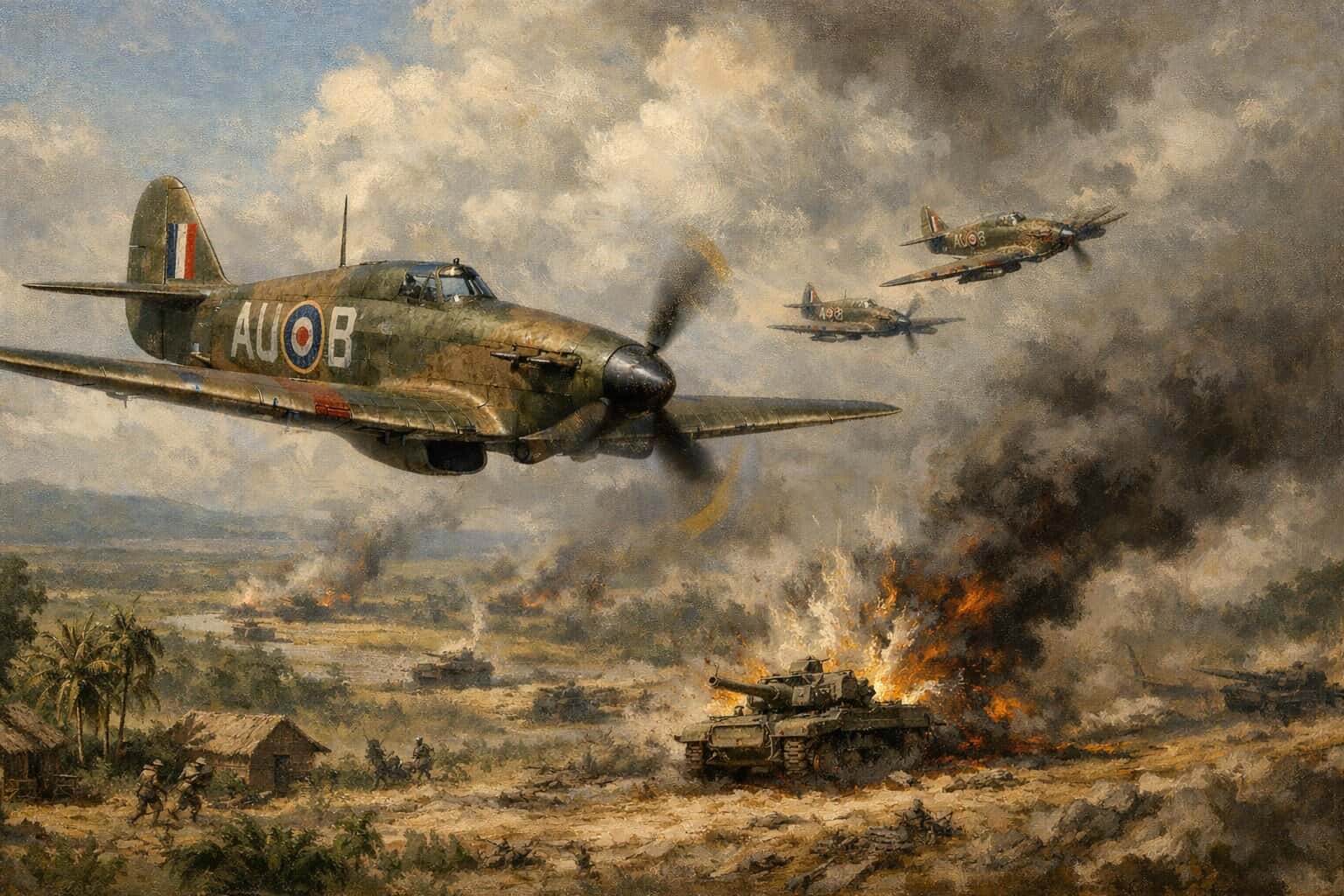
On 19 February 1945, the Battle of Talingon formed part of the hard fighting west of Mandalay as Allied forces pushed deeper into central Burma. The immediate issue was not simply the capture of a single village, but the wider effort to break Japanese resistance along the Irrawaddy front and keep the advance moving. In that setting, air power and ground action were closely linked. No. 20 Squadron RAF, flying Hawker Hurricane ground-attack aircraft, was called upon to support the Army during a difficult engagement in which Japanese armour posed a serious local threat.
Planning, Forces and Execution
By early 1945, the Burma Campaign had entered a decisive phase. Allied strategy depended on forcing crossings of the Irrawaddy, unsettling Japanese defensive plans, and opening the way for operations against the major communications and administrative centres of central Burma. That meant infantry formations advancing over difficult ground against an enemy still capable of sharp local counter-attacks. Talingon, west of Mandalay, became one of the places where that wider campaign was tested in close and costly combat.
The RAF contribution came from No. 20 Squadron, which had by then developed extensive experience in the tactical air support role in Burma. Its Hawker Hurricane Mk IID and Mk IV aircraft were well suited to attacks on strongpoints, transport and armour. In the Talingon fighting, the squadron was employed in direct support of the Army’s 20th Division. Rather than operating at a strategic distance, these aircraft were being used as battlefield weapons, intended to disrupt Japanese movements and relieve pressure on troops engaged at close quarters.
The most important feature of the air action was the attack on Japanese tanks threatening the battle area. During the engagement, No. 20 Squadron destroyed 12 tanks and damaged a thirteenth. In a campaign where terrain, movement and supply often imposed severe limits on both sides, the loss of that many armoured vehicles was more than a tactical inconvenience. It sharply reduced Japanese freedom of action at a critical moment and demonstrated how destructive well-directed tactical air power could be in the Burma theatre.
Results and Losses
The battle itself was severe. The fighting for Talingon imposed heavy strain on the forces engaged on the ground, reflecting the tenacity of Japanese resistance in central Burma even at this late stage of the war. The RAF’s intervention did not remove the cost of the action, but it materially altered the balance on the battlefield.
The destruction of 12 tanks, with another damaged, represented a serious blow to Japanese resources in the area and deprived local commanders of valuable support for counter-attack or defence. Precise losses for all participants are not always presented in the same detail in brief campaign summaries, but the broad outcome is clear enough. Japanese armour suffered heavily, while Allied ground troops continued their advance in the face of determined opposition. For the RAF, the episode stands as an example of effective battlefield support rather than an independent air action conducted for its own sake.
Wider Significance in the Air War
Talingon matters because it shows the RAF performing a role essential to victory, yet often less celebrated than the major air battles over Europe. In Burma, success depended not only on air superiority in the abstract but also on the practical ability to strike enemy positions, disrupt movement, and assist troops fighting across long distances in difficult country. No. 20 Squadron’s action on 19 February 1945 illustrated that relationship with unusual clarity.
Within the wider air war, the battle also demonstrated how mature tactical air support had become by the final year of the conflict. Aircraft were no longer merely observing the battlefield or attacking targets of opportunity; they were integrated into land operations to shape the immediate outcome. At Talingon, RAF Hurricanes helped turn local air power into a direct battlefield advantage and, in doing so, contributed to the broader Allied advance through Burma in the closing months of the war.