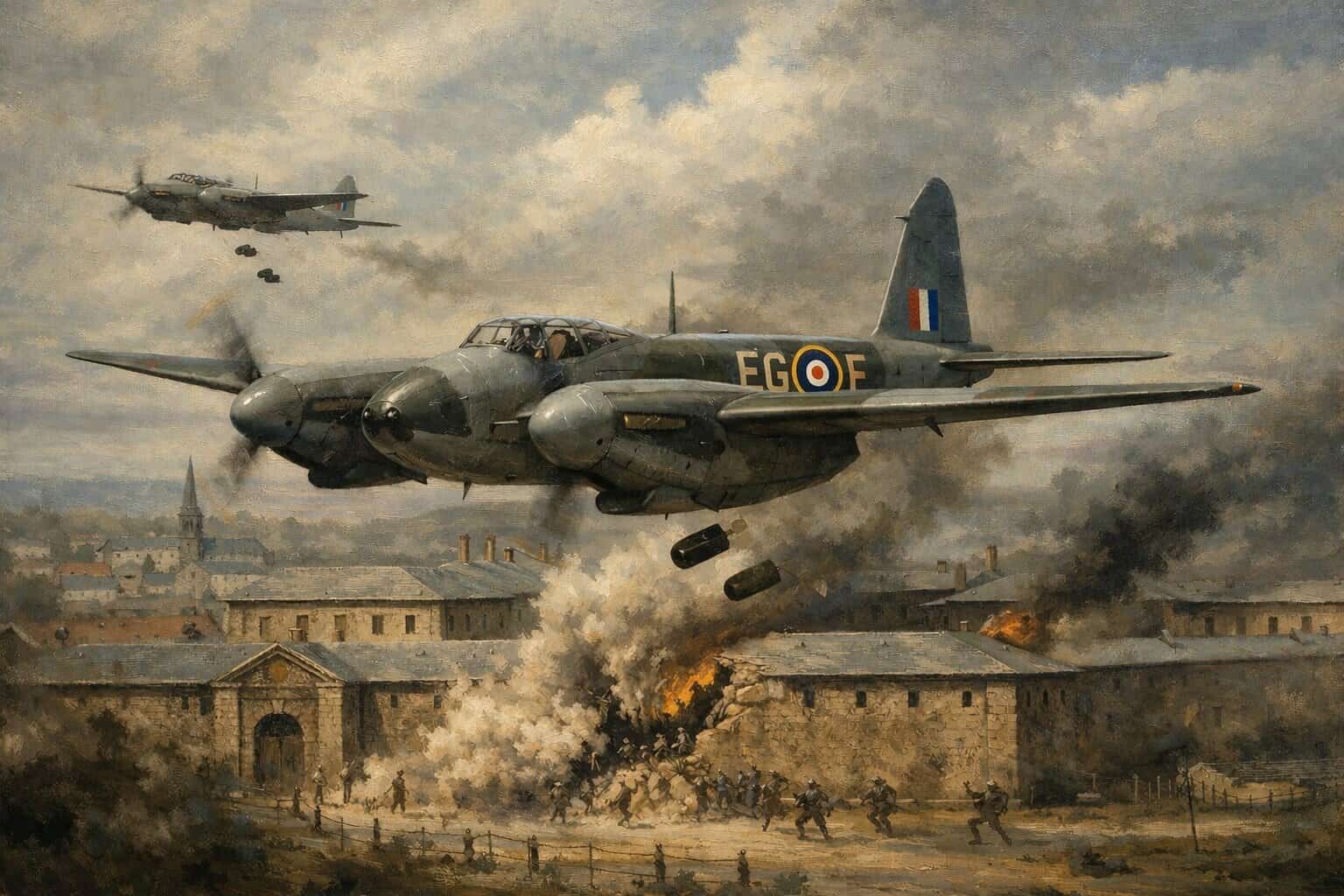
On 18 February 1944, aircraft of the RAF carried out one of the most precise and controversial low-level attacks of the Second World War. In an operation later known as Operation Jericho, de Havilland Mosquito aircraft struck Amiens Prison in German-occupied France in an attempt to breach its walls and facilitate the escape of prisoners, many of whom were believed to be members of the French Resistance awaiting execution.
The raid took place during a critical phase of the war in Western Europe, as Allied planners prepared for the eventual invasion of the continent. Disrupting German control, supporting resistance networks, and undermining occupation authorities were all considered essential components of the broader strategy.
Planning and Purpose
The exact origins and motivations behind Operation Jericho have been the subject of continued historical discussion. Still, it is generally understood that the raid was intended to assist Resistance prisoners facing imminent execution. Amiens Prison held a large number of detainees, including individuals involved in anti-German activities, and the destruction of its walls offered a chance, however uncertain, for escape.
The task of carrying out such a mission fell to the de Havilland Mosquito, an aircraft well suited to precision attack. Its high speed, manoeuvrability, and ability to operate at very low altitude made it ideal for striking a heavily defended target with a high degree of accuracy.
The operation required careful planning. The attacking aircraft would need to fly at extremely low levels across occupied France, avoid detection for as long as possible, and deliver their bombs with precision against specific sections of the prison structure. Timing was critical, as the intention was to maximise the chances of escape while limiting unintended damage.
The Attack on Amiens Prison
On the morning of 18 February 1944, the Mosquito aircraft crossed the English Channel and approached Amiens at low altitude. Flying at rooftop height, the crews avoided much of the German radar and air defence system, relying instead on speed and surprise.
The attack was carried out in carefully timed waves. The first aircraft targeted the outer walls of the prison, dropping bombs designed to create breaches through which prisoners could escape. Subsequent aircraft struck additional sections of the perimeter and key internal buildings, including guard areas, in order to disrupt German control of the site.
The accuracy of the bombing was notable, particularly given the difficulty of the task. Sections of the prison walls were successfully destroyed, and fires broke out within the complex. The assault caused confusion among the German guards and created opportunities for prisoners to attempt escape.
Results and Losses
The raid achieved its immediate objective in part. Large breaches were made in the prison walls, and a significant number of prisoners succeeded in escaping during and after the attack. Some were able to evade recapture and rejoin Resistance networks operating in the region.
However, the operation also resulted in considerable loss of life. A number of prisoners were killed during the bombing, either by the direct effects of the explosions or by collapsing structures. German personnel within the prison were also among the casualties.
The attacking force itself sustained losses. Several Mosquito aircraft were shot down during the operation, and aircrew were killed or captured. These losses reflected the inherent risks of low-level daylight attacks against defended targets.
Significance and Historical Debate
Operation Jericho quickly became one of the most well-known precision strikes carried out by the RAF during the war. It demonstrated air power’s capability to deliver highly targeted attacks in support of specific operational objectives, beyond traditional strategic bombing.
At the same time, the raid has remained the subject of debate. Questions have been raised regarding the extent to which the operation achieved its intended purpose and whether the loss of life among prisoners was justified by the results. The uncertainty surrounding aspects of its planning has further contributed to its historical complexity.
Nevertheless, the operation highlighted the growing importance of cooperation between Allied air forces and resistance movements across occupied Europe. It also illustrated the increasing use of specialised aircraft and tactics to achieve precise, limited objectives within a broader strategic framework.
Significance in the Air War
From an aviation perspective, the events of 18 February 1944 underscored the versatility of the Mosquito and the evolution of RAF operational doctrine. The ability to carry out low-level precision attacks against specific targets represented a significant development in the use of air power.
Operation Jericho stands as an example of how air operations could be adapted to support unconventional objectives, including disrupting enemy administration and directly assisting resistance activities.
In the wider context of the air war over Europe, the raid demonstrated both the potential and the limitations of precision attack. While it achieved notable results, it also revealed the difficulty of controlling outcomes in complex and hazardous conditions.
The attack on Amiens Prison remains a significant episode in RAF history, reflecting the ingenuity, skill, and risk inherent in such operations. It serves as a reminder that air power, even when applied with precision, carries consequences that extend beyond the mission’s immediate objectives.