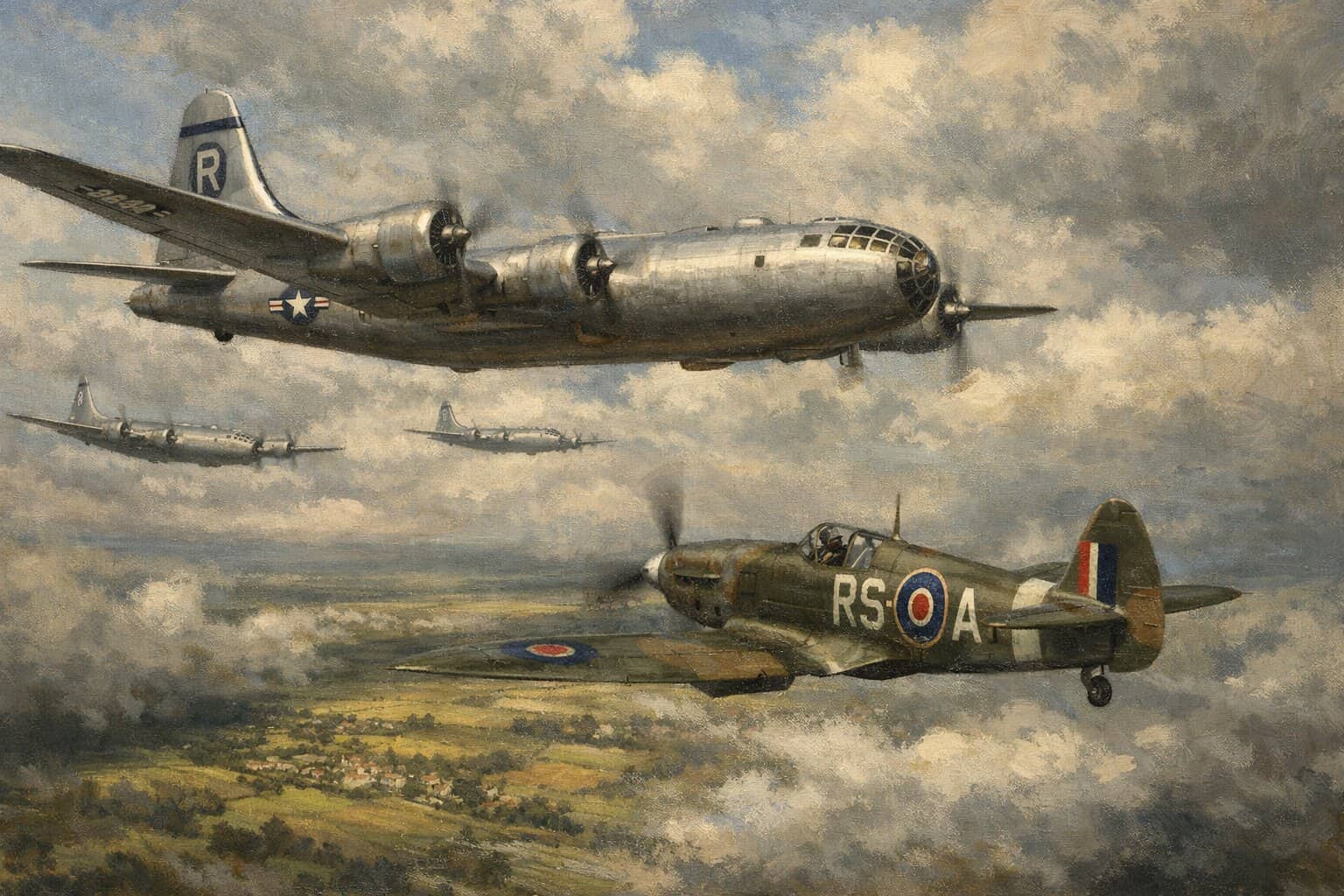
On 16 February 1948, units of the United States Air Force operating the Boeing B-29 Superfortress took part in a series of air defence exercises with RAF Fighter Command, marking one of the first occasions on which American strategic bombers operated in direct coordination with British air defences in the post-war period.
The exercise formed part of a broader effort to develop cooperation between the two air forces at a time when the strategic importance of air power was rapidly evolving. Coming less than three years after the end of the Second World War, the exercise reflected the changing nature of international relations and the increasing emphasis on preparedness in the early stages of what would become the Cold War.
Post-War Strategic Context
By 1948, the global strategic environment had shifted significantly. The wartime alliance between the Western Allies and the Soviet Union had given way to growing political tension. Air power, particularly long-range bombing capability, was increasingly viewed as a central element of national defence.
The United States Air Force, established as an independent service in 1947, placed considerable emphasis on its strategic bomber force. The B-29 Superfortress, which had played a major role in the Pacific War, remained one of its principal long-range aircraft.
In Britain, RAF Fighter Command retained responsibility for the air defence of the United Kingdom. Although wartime pressures had eased, the need to maintain an effective defensive system remained a priority, particularly in light of the emerging strategic threat posed by long-range bombers.
Purpose of the Exercise
The February 1948 exercise was designed to test the effectiveness of British air defences against high-altitude, long-range bomber formations. It also provided an opportunity to evaluate coordination between American bomber crews and British ground and fighter control systems.
For RAF Fighter Command, the presence of B-29 aircraft provided a realistic simulation of the threat that might be encountered in a future conflict. The aircraft’s range, altitude capability, and defensive armament made it an ideal stand-in for potential adversary bombers.
The exercise involved detecting, tracking, and intercepting American bombers as they approached British airspace. Ground-based radar stations played a central role, feeding information to control centres that directed fighter aircraft to intercept the incoming formations.
Execution and Air Defence Operations
During the exercise, B-29 aircraft flew profiles designed to test the limits of British radar and interception systems. Approaches were conducted at altitude, requiring Fighter Command to rely on its integrated air defence network developed during the Second World War and subsequently refined.
RAF fighter aircraft were scrambled to intercept the incoming bombers under controlled conditions. The exercise allowed for the assessment of interception times, communication procedures, and the effectiveness of radar coverage.
While no combat took place, the operation provided valuable data on how well Britain’s air defence system could respond to a modern bomber threat. It also highlighted areas where improvements in coordination and technology might be required.
The participation of the United States Air Force ensured that the exercise was not only a test of British defences but also an opportunity for both air forces to develop common procedures and mutual understanding.
Significance for Anglo-American Cooperation
The exercise represented an early example of the close cooperation that would come to characterise relations between the Royal Air Force and the United States Air Force during the Cold War. The sharing of operational experience and the development of joint procedures were essential steps in building an effective collective defence posture.
Such cooperation would later be formalised through alliances and agreements, but exercises of this kind provided the practical foundation. They demonstrated the value of interoperability between allied air forces and the importance of standardised methods of communication and control.
For RAF Fighter Command, working with B-29 aircraft offered insight into the capabilities of modern strategic bombers, reinforcing the need for continued development of radar systems, interceptor aircraft, and command-and-control structures.
Significance in the Evolution of Air Defence
From an aviation perspective, the events of 16 February 1948 illustrate the transition from wartime air defence to the more complex requirements of the Cold War era. The integrated air defence system that had proven effective during the Battle of Britain was now being tested against faster, higher-flying aircraft with greater range.
The exercise highlighted the enduring importance of radar, coordinated control, and rapid interception in defending national airspace. It also underscored the growing role of strategic bombers in shaping defence policy and planning.
In the wider history of the Royal Air Force, this early post-war cooperation with the United States Air Force marked an important step in adapting to a new strategic environment. The lessons learned from such exercises would influence the development of Britain’s air defence system in the years that followed, ensuring that it remained capable of responding to emerging threats in an increasingly uncertain world.