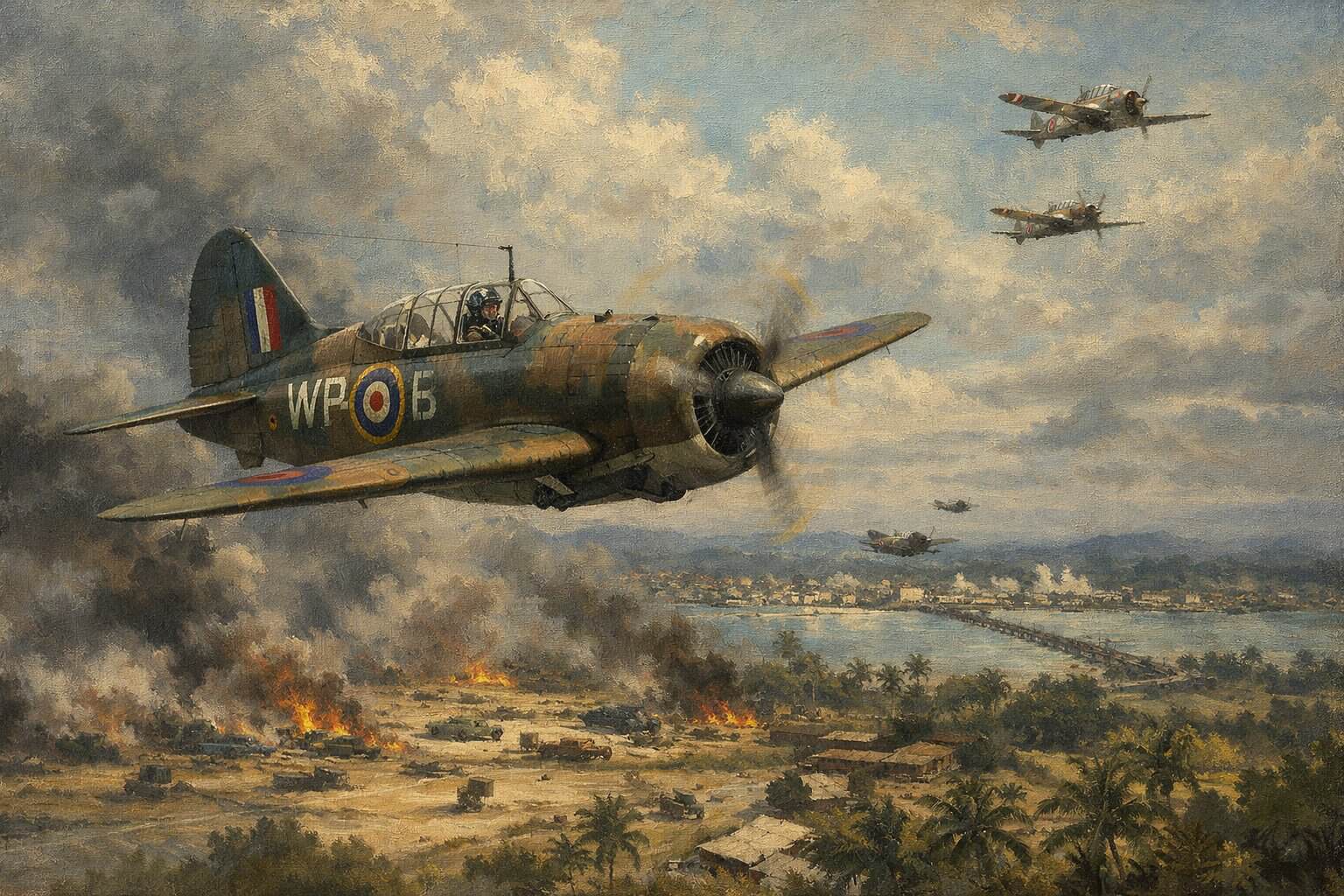
On 15 February 1942, British and Commonwealth forces in Singapore surrendered to advancing Japanese troops, marking one of the most severe defeats suffered by the British Empire during the Second World War.
The fall of Singapore brought an abrupt end to the Malayan Campaign, with profound implications for Allied strategy in the Far East. For the Royal Air Force, the campaign had already demonstrated the limitations of air power when faced with inadequate resources, dispersed forces, and an enemy possessing local superiority.
The Air Situation in Malaya
At the outset of the Japanese offensive in December 1941, Allied air forces in Malaya and Singapore were under considerable strain. RAF units, supported by Commonwealth and Dutch aircraft, were tasked with defending a wide area against a highly coordinated Japanese advance. The available aircraft included a mixture of modern and obsolete types, with fighters such as the Brewster Buffalo forming a significant part of the defensive strength.
Japanese forces, by contrast, deployed large numbers of modern aircraft with experienced crews. Their ability to establish air superiority early in the campaign proved decisive. RAF and Allied airfields in northern Malaya were quickly attacked, forcing repeated withdrawals southward as the Japanese advanced down the peninsula.
The loss of forward airfields severely reduced the effectiveness of Allied air operations. Aircraft were often forced to operate from increasingly limited and congested bases, restricting sortie rates and complicating maintenance and supply.
The Retreat to Singapore
As Japanese ground forces advanced rapidly through Malaya, supported by air superiority and effective coordination between land and air units, Allied forces were steadily pushed back towards Singapore. RAF units continued to provide whatever support they could, including reconnaissance and limited fighter defence, but their ability to influence the campaign’s outcome diminished as losses mounted.
By the time the defending forces withdrew onto Singapore Island in late January 1942, much of the RAF’s operational capability in the region had been severely reduced. Aircraft losses, shortages of spare parts, and the destruction of infrastructure had taken a heavy toll.
Japanese air attacks intensified during this period, targeting airfields, port facilities, and defensive positions on the island. With few aircraft remaining in effective service, Allied air defence was increasingly unable to contest Japanese control of the skies.
The Final Assault
In early February 1942, Japanese forces launched their assault on Singapore Island. The attack was supported by continued air operations, which further weakened defensive positions and disrupted communications.
The absence of effective air cover left Allied ground forces exposed to aerial reconnaissance and attack. Japanese aircraft were able to operate with relative freedom, providing support to advancing troops and striking key targets across the island.
Despite efforts to organise a defence, the situation deteriorated rapidly. Water supplies became uncertain, ammunition stocks dwindled, and the capacity to mount coordinated resistance declined. The lack of air support was a significant factor in the Allied forces’ inability to stabilise the situation.
On 15 February 1942, the decision was taken to surrender. The capitulation resulted in the capture of a large number of British, Australian, and Indian troops, making it one of the largest surrenders in British military history.
Consequences for the RAF and the Wider War
The fall of Singapore marked a turning point in the war in the Far East. It demonstrated the effectiveness of Japanese combined operations and exposed the vulnerabilities of Allied defences in the region. For the Royal Air Force, the campaign highlighted the consequences of insufficient preparation, outdated equipment, and the challenges of operating over extended distances with limited infrastructure.
In the months following the surrender, the Allies reassessed their position in the Far East. Efforts were made to rebuild air strength, improve coordination between services, and introduce more capable aircraft into the theatre.
The loss of Singapore also had a wider strategic impact. It weakened British influence in Southeast Asia, disrupted communications and supply routes, and provided Japan with a significant base for further operations.
Significance in the Air War
From an aviation perspective, the campaign underscored the critical importance of air superiority in modern warfare. The early loss of effective air power in Malaya and Singapore allowed Japanese forces to operate with relative freedom, shaping the campaign’s outcome on land and at sea.
The events leading to the surrender on 15 February 1942 illustrated how quickly air inferiority could translate into broader strategic defeat. They also influenced subsequent Allied planning, reinforcing the need for stronger, better-equipped air forces in future operations.
In the wider history of the Second World War, the fall of Singapore remains a significant example of how air power, or the lack of it, could decisively influence the outcome of a campaign.