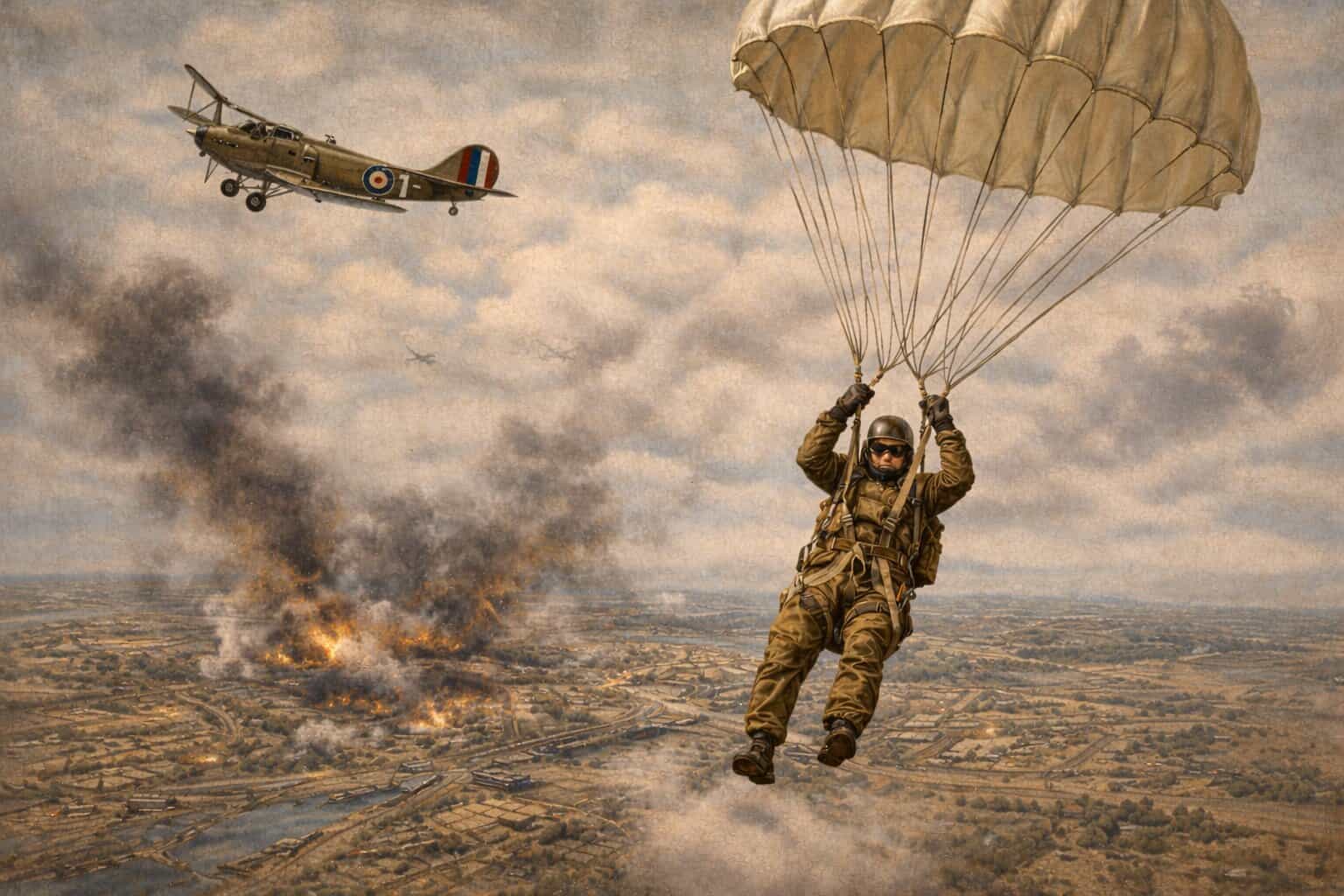
On 13 January 1917, Captain Clive Franklyn Collett of the Royal Flying Corps made the first British service parachute jump, descending from an aeroplane in flight using Everard Calthrop’s “Guardian Angel” parachute. Jumping from around 600 feet, Collett carried out the descent during a trial at the RFC’s Experimental Station at Orfordness, on the Suffolk coast.
Collett was a New Zealander serving with the Royal Flying Corps as a test pilot, and the aircraft he jumped from was a Royal Aircraft Factory B.E.2c. His trial came at a point in the war when aircraft were flying higher and faster, and when engine fire, structural failure and enemy action left crews with few means of escape. Aeroplane crews had no parachutes of their own to rely on. Royal Flying Corps kite balloon observers, whose stationary, tethered positions made a parachute far simpler to fit and use, had already been issued with them, but no equivalent system had been adopted for pilots and observers flying aeroplanes. Collett’s jump was one of a series of early attempts to establish whether a workable system could be developed for service aircraft.
The trial at Orfordness
Orfordness housed the RFC’s Experimental Station, where new equipment and armament were tested away from the front line. It was here, rather than in combat, that Collett made his descent, jumping from the B.E.2c at approximately 600 feet. Parachute descents were already a familiar novelty before the war, usually performed by exhibition parachutists jumping from tethered balloons at fairs and air displays. Collett’s jump was of a different kind. It was made from an aeroplane in flight, by a serving Royal Flying Corps officer, as part of a formal service trial, and it is this combination that makes it the first British service parachute jump rather than simply another parachute descent.
The Guardian Angel
The parachute Collett used was Everard Calthrop’s “Guardian Angel”, developed as a response to the shortcomings of earlier balloon and exhibition equipment. In its form as used in the 1917 aeroplane trials, the Guardian Angel pack was mounted externally beneath the aircraft, with the canopy deploying on a static line as the airman left the aeroplane. This arrangement differed from the manually operated ripcord systems and body-worn packs that became standard in later aviation parachutes. It was this static-line system, tested from a B.E.2c at Orfordness, that Collett proved could be deployed successfully from an aircraft in flight.
Why British pilots still lacked parachutes
Collett’s successful jump did not lead to the immediate adoption of parachutes across the Royal Flying Corps. Official reluctance had more than one root. Some senior officers feared that providing parachutes might make pilots more willing to abandon damaged aircraft rather than try to save them, and this concern contributed to the RFC’s rejection of Calthrop’s parachute in 1916. Alongside this, the Guardian Angel’s bulk and weight, and the practical difficulty of integrating an externally mounted, static-line system into existing aircraft, weighed against its adoption. The German air service, by contrast, moved progressively towards issuing parachutes to aircrew from 1918 onwards, while British authorities continued to weigh the equipment’s drawbacks against its potential to save lives.
From experiment to service equipment
An order to fit British single-seat aircraft with parachutes was finally given in September 1918, but it had not been implemented by the time the war ended two months later. British aircrew flying in combat through the First World War therefore did so without the equipment that Collett had shown, nearly two years earlier, could work. Full adoption came only after the Armistice, when parachutes became standard flying equipment for RAF aircrew during the interwar period.
Collett’s jump at Orfordness stands as the first successful parachute descent from an aeroplane by a British service flyer, though it did not transform Royal Flying Corps practice overnight. Parachutes did become standard equipment for British aircrew in the years that followed. Within a decade, a parachute was being used to save an airman’s life in the air in earnest, when Eric Pentland made the first RAF emergency parachute escape in June 1926.