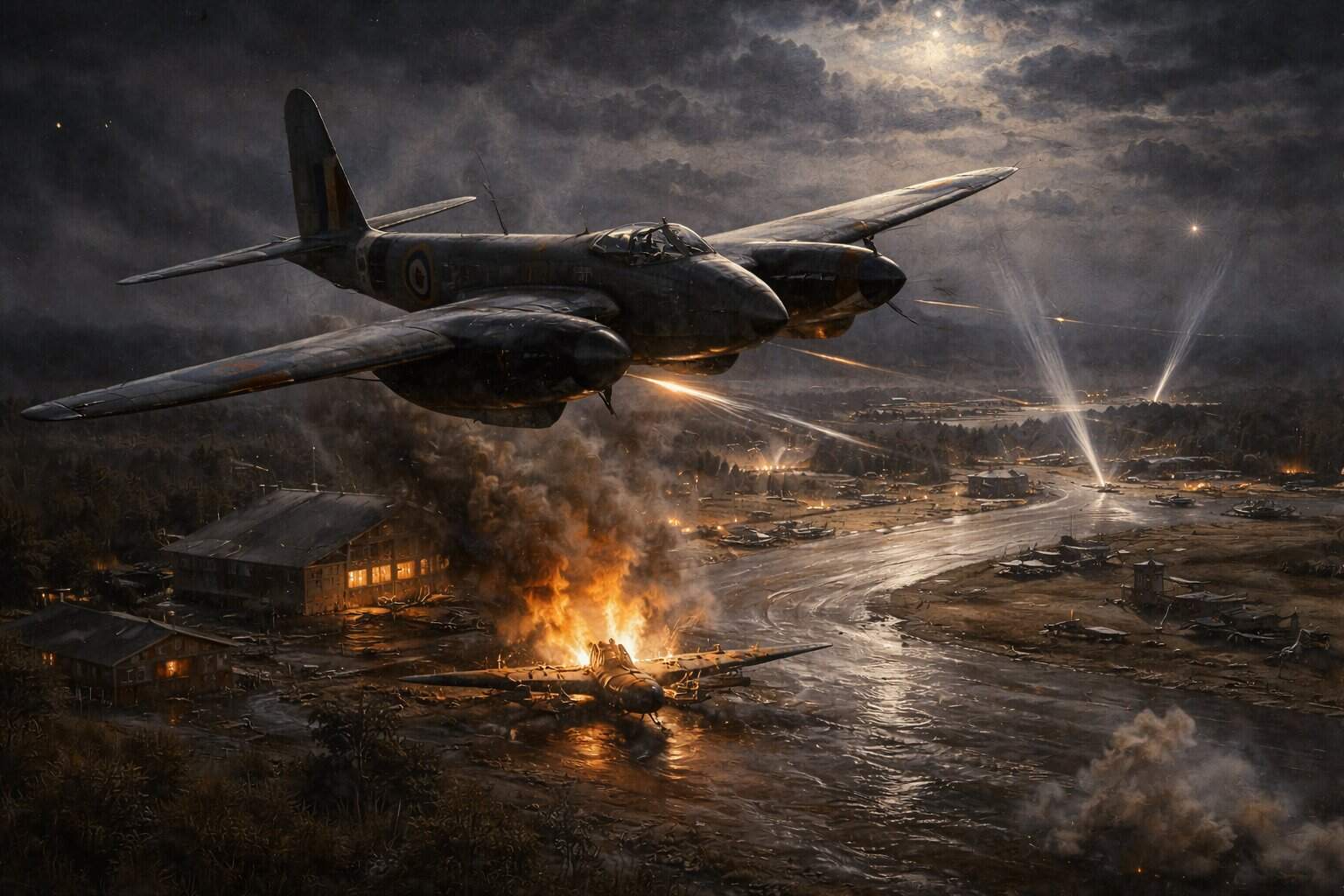
On 24 January 1941, Royal Air Force night fighters carried out one of the earliest successful “Intruder” patrols over German-occupied territory. The operation marked a significant evolution in British night air defence during the Blitz, shifting from a purely reactive posture to an offensive approach aimed at disrupting Luftwaffe operations at their source.
By January 1941, Britain had endured months of sustained night bombing. German aircraft crossed the Channel after dark to strike industrial centres, ports, and cities. Although radar, ground-controlled interception, and searchlight coordination were improving, night interception remained technically demanding. The limitations of early airborne radar and the difficulties of night navigation meant that many German bombers completed their missions and returned to base with limited interference.
Fighter Command, therefore, explored new tactics to impose pressure on the Luftwaffe beyond British airspace.
The Intruder Concept
The concept of “Intruder” operations involved dispatching RAF night fighters across the Channel to patrol over or near German-occupied airfields. The intention was to intercept enemy bombers as they returned from raids over Britain, often low on fuel, fatigued, and flying predictable approach patterns in preparation for landing.
Rather than defending against incoming attacks, Intruder patrols sought to exploit the vulnerable phase of the enemy’s return flight. In addition to the possibility of air-to-air combat, the presence of RAF fighters over occupied territory forced German authorities to adjust landing procedures, reduce airfield lighting, and strengthen local defences.
These early missions were experimental. Navigation over hostile territory at night presented serious challenges. Crews relied on dead reckoning, limited radio aids, and visual reference points when conditions allowed. Weather over the Channel and northern France could quickly complicate operations.
The Operation of 24 January
On 24 January 1941, RAF night fighters conducted patrols over German-occupied airfields in northern France. During these operations, contact was made with returning Luftwaffe aircraft. Engagements were reported, and at least one German aircraft was claimed destroyed in the vicinity of its base.
Although the scale of the action was modest, the significance lay in its execution. RAF fighters had crossed into enemy-controlled airspace at night, located hostile aircraft, and achieved a successful interception. This demonstrated both improved navigational competence and growing confidence in night-fighting techniques.
The mission also highlighted the increasing effectiveness of airborne interception radar, which, though still developing, provided crews with enhanced situational awareness compared with earlier months of the Blitz.
Operational Impact
The immediate tactical impact of the 24 January operation was limited in material terms. Losses inflicted on the Luftwaffe during individual Intruder sorties were small compared with the scale of bombing operations. However, the psychological and procedural effects were disproportionate to the number of people involved.
German aircrews returning from raids now faced the possibility of attack near their own bases. Airfield lighting arrangements were altered to reduce vulnerability, which in turn complicated landing procedures. Additional defensive measures were introduced, diverting resources that might otherwise have supported offensive operations.
For Fighter Command, the operation validated the Intruder concept. It demonstrated that offensive night patrols could be conducted successfully and provided valuable operational experience. Subsequent months saw continued refinement of the tactic.
Significance in the Wider Air War
The events of 24 January 1941 represent a turning point in Britain’s night air campaign. During the early Blitz, RAF night fighters were largely confined to defending British skies. Intruder operations signalled a transition toward a more proactive strategy aimed at contesting the Luftwaffe beyond the immediate target area.
Though limited in scale during 1941, Intruder tactics foreshadowed later developments in night fighting and offensive counter-air operations. The experience gained would contribute to the maturation of RAF night fighter doctrine as technology improved.
In the broader context of the air war over Europe, the operation illustrates the continuous interplay between defence and offence. Air superiority was not solely achieved through large-scale bombing or daylight battles; it was also shaped by incremental tactical innovation. The Intruder patrol of 24 January 1941 stands as an early example of the RAF’s adaptation to the demands of night warfare during one of the most testing phases of the conflict.